Technical Specifications
| Brand | Ford |
| Model | Puma |
| Generation | Puma (facelift 2024) |
| Type (Engine) | ST 1.0 EcoBoost (170 Hp) Mild Hybrid Powershift |
| Start of production | February, 2024 |
| Powertrain Architecture | MHEV (Mild Hybrid Electric Vehicle) |
| Body type | SUV, Crossover |
| Seats | 5 |
| Doors | 5 |
| Combined fuel consumption (WLTP) | 6-6.5 l/100 km (39.2 – 36.2 US mpg, 47.1 – 43.5 UK mpg, 16.7 – 15.4 km/l) |
| CO2 emissions (WLTP) | 135-146 g/km |
| Fuel Type | Petrol (Gasoline) |
| Acceleration 0 – 100 km/h | 7.4 sec |
| Acceleration 0 – 62 mph | 7.4 sec |
| Acceleration 0 – 60 mph | 7 sec (Calculated) |
| Maximum speed | 210 km/h (130.49 mph) |
| Emission standard | Euro 6d |
| Weight-to-power ratio | 7.7 kg/Hp, 129.3 Hp/tonne |
| Weight-to-torque ratio | 5.3 kg/Nm, 188.6 Nm/tonne |
| Battery voltage | 48 V |
| Battery technology | Lithium-ion (Li-Ion) |
| Battery location | Under the front seats |
| Electric motor power | 16 Hp |
| Electric motor location | Front, Transverse |
| Power | 170 Hp @ 5750 rpm |
| Power per litre | 170.2 Hp/l |
| Torque | 248 Nm @ 3000 rpm (182.92 lb.-ft. @ 3000 rpm) |
| Engine layout | Front, Transverse |
| Engine displacement | 999 cm3 (60.96 cu. in.) |
| Number of cylinders | 3 |
| Engine configuration | Inline |
| Cylinder Bore | 71.9 mm (2.83 in.) |
| Piston Stroke | 82 mm (3.23 in.) |
| Compression ratio | 10:1 |
| Number of valves per cylinder | 4 |
| Fuel injection system | Direct injection |
| Engine aspiration | Turbocharger, Intercooler |
| Valvetrain | DOHC, Ti-VCT |
| Engine systems | Start & Stop System, Particulate filter |
| Kerb Weight | 1315 kg (2899.08 lbs.) |
| Max. weight | 1850 kg (4078.55 lbs.) |
| Max load | 535 kg (1179.47 lbs.) |
| Trunk (boot) space – minimum | 456 l (16.1 cu. ft.) |
| Trunk (boot) space – maximum | 1216 l (42.94 cu. ft.) |
| Fuel tank capacity | 42 l (11.1 US gal | 9.24 UK gal) |
| Max. roof load | 25 kg (55.12 lbs.) |
| Permitted trailer load with brakes (12%) | 900 kg (1984.16 lbs.) |
| Permitted trailer load without brakes | 665 kg (1466.07 lbs.) |
| Permitted towbar download | 75 kg (165.35 lbs.) |
| Length | 4226 mm (166.38 in.) |
| Width with mirrors folded | 1805 mm (71.06 in.) |
| Width including mirrors | 1930 mm (75.98 in.) |
| Height | 1533 mm (60.35 in.) |
| Wheelbase | 2588 mm (101.89 in.) |
| Front track | 1567 mm (61.69 in.) |
| Rear (Back) track | 1523 mm (59.96 in.) |
| Front overhang | 875 mm (34.45 in.) |
| Rear overhang | 763 mm (30.04 in.) |
| Ride height (ground clearance) | 152 mm (5.98 in.) |
| Minimum turning circle | 11.2 m (36.75 ft.) |
| Approach angle | 13.8° |
| Departure angle | 24° |
| Drivetrain Architecture | ICE and electric motor drive front wheels, mixed mode operation |
| Drive wheel | Front wheel drive |
| Number of gears and type of gearbox | 7 gears, automatic transmission Powershift |
| Front suspension | Independent, McPherson with coil spring and anti-roll bar |
| Rear suspension | Transverse stabilizer, Coil spring, Elastic beam |
| Front brakes | Ventilated discs, 325×27 mm |
| Rear brakes | Disc, 271×11 mm |
| Assisting systems | ABS (Anti-lock braking system) |
| Steering type | Steering rack and pinion |
| Power steering | Electric Steering |
| Tires size | 225/40 R19 |
| Wheel rims size | 8J x 19 |
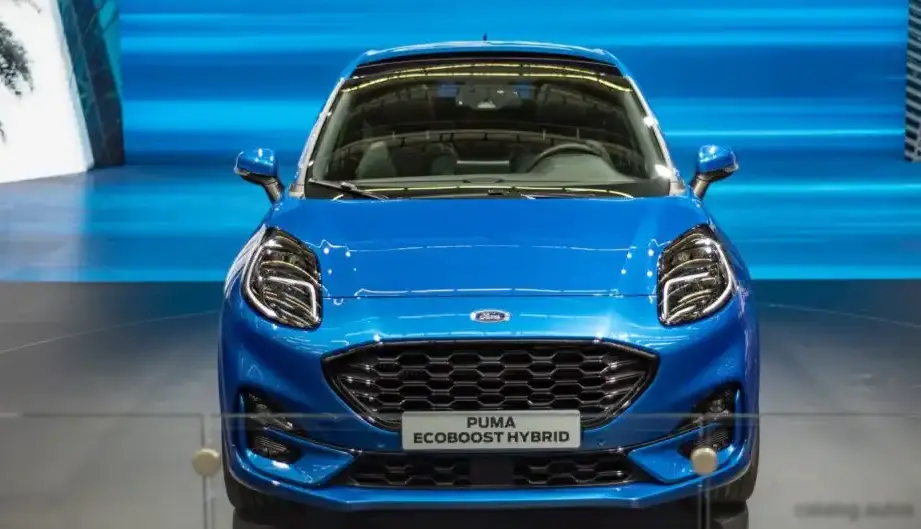
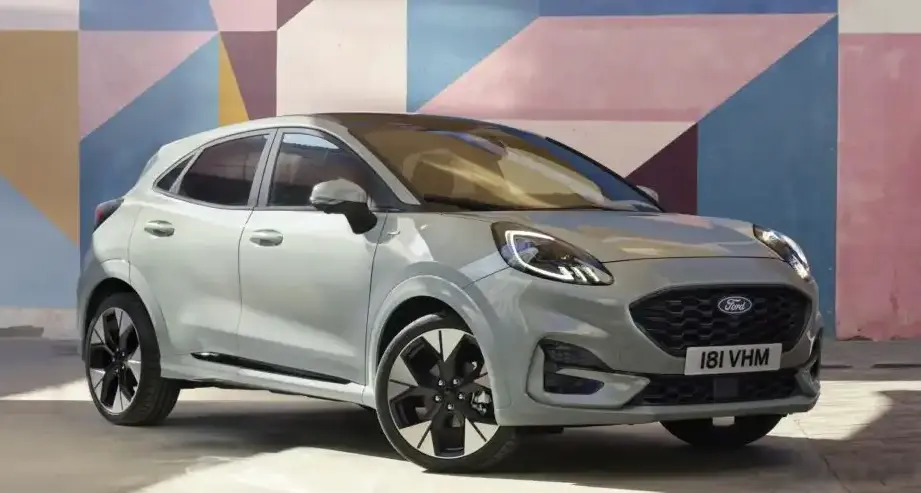
The Ford Puma ST 1.0 EcoBoost Mild Hybrid Powershift, introduced in February 2024 as part of the Puma’s facelift, represents a performance-oriented variant within the increasingly popular subcompact SUV/crossover segment. Positioned as a sporty offering, it builds upon the foundation of the Puma platform (shared with the Ford Fiesta) and aims to deliver a blend of efficiency, practicality, and engaging driving dynamics. This particular configuration, combining the 1.0-liter EcoBoost engine with mild-hybrid technology and a seven-speed Powershift dual-clutch transmission, occupies a middle ground within the Puma ST range, offering a balance between outright performance and everyday usability. It’s primarily targeted towards European markets, where the Puma has found significant success, though availability varies by region.
Powertrain & Engine Architecture
The heart of the Puma ST 1.0 EcoBoost is the 1.0-liter, three-cylinder turbocharged gasoline engine, internally designated as part of the EcoBoost family. This engine utilizes a direct fuel injection system and a twin-scroll turbocharger to deliver a respectable 170 horsepower at 5750 rpm and 248 Nm (182.92 lb.-ft.) of torque at 3000 rpm. The mild-hybrid system, featuring a 48V lithium-ion battery and a belt-integrated starter-generator (BiSG), provides a power assist during acceleration and enables smoother start-stop functionality, contributing to improved fuel economy. The engine incorporates Ford’s Ti-VCT variable valve timing technology on both intake and exhaust valves for optimized performance across the rev range. The Powershift seven-speed dual-clutch transmission (DCT) is a key component, offering quick and precise gear changes. Unlike a traditional automatic, the Powershift operates with two separate clutches, one for odd gears and one for even gears, allowing for seamless shifts and improved efficiency.
Driving Characteristics
The 1.0 EcoBoost with the Powershift transmission delivers a surprisingly engaging driving experience. While not as brutally fast as some of its rivals, the Puma ST offers a good balance of performance and usability. The turbocharger provides a noticeable boost in power, and the DCT responds quickly to driver inputs. The gear ratios are tuned to prioritize acceleration in the lower gears, making it feel responsive in city driving and during overtaking maneuvers. Compared to a manual transmission version, the Powershift offers convenience and ease of use, but some enthusiasts may find it lacks the direct connection and control of a traditional manual gearbox. The mild-hybrid system is largely transparent to the driver, providing a subtle boost during acceleration without significantly altering the driving experience.
Equipment & Trim Levels
The Puma ST 1.0 EcoBoost Mild Hybrid Powershift typically comes well-equipped as standard. Features generally include Ford’s SYNC 4 infotainment system with a touchscreen display, Apple CarPlay and Android Auto compatibility, a digital instrument cluster, and a suite of driver-assistance technologies such as lane-keeping assist, pre-collision assist with autonomous emergency braking, and cruise control. Interior upholstery is typically a combination of cloth and synthetic leather, with sport seats providing additional support. Optional extras often include a panoramic sunroof, premium audio system, and various styling enhancements. The ST trim level also includes unique exterior styling cues, such as a sportier body kit, larger alloy wheels, and a rear spoiler.
Chassis & Braking
The Puma ST utilizes an independent McPherson strut front suspension and a twist-beam rear suspension, optimized for sporty handling. The suspension is tuned to provide a firm but comfortable ride, with reduced body roll during cornering. The front brakes consist of ventilated discs measuring 325x27mm, while the rear brakes are solid discs measuring 271x11mm. Anti-lock braking system (ABS) is standard, along with electronic stability control (ESC). The steering is electrically assisted, providing a responsive and precise feel.
Market Reception & Comparison
The Ford Puma ST 1.0 EcoBoost Mild Hybrid Powershift has been generally well-received by automotive critics. It’s praised for its engaging driving dynamics, fuel efficiency, and practicality. Compared to other trims in the Puma lineup, the ST offers a significant performance upgrade, but at a higher price point. It competes with rivals such as the Volkswagen Polo GTI, Renault Clio RS Line, and Hyundai i20 N. The Puma ST often stands out for its value proposition, offering a compelling combination of performance, features, and price.
Legacy
The 1.0 EcoBoost engine has proven to be a reliable and efficient powerplant in various Ford models. The Powershift transmission, while generally dependable, has been subject to some reports of issues in earlier iterations, though improvements have been made over time. The Puma ST 1.0 EcoBoost Mild Hybrid Powershift is expected to hold its value reasonably well in the used car market, appealing to buyers seeking a sporty and practical subcompact SUV. Its blend of performance, efficiency, and technology positions it as a desirable option for years to come.