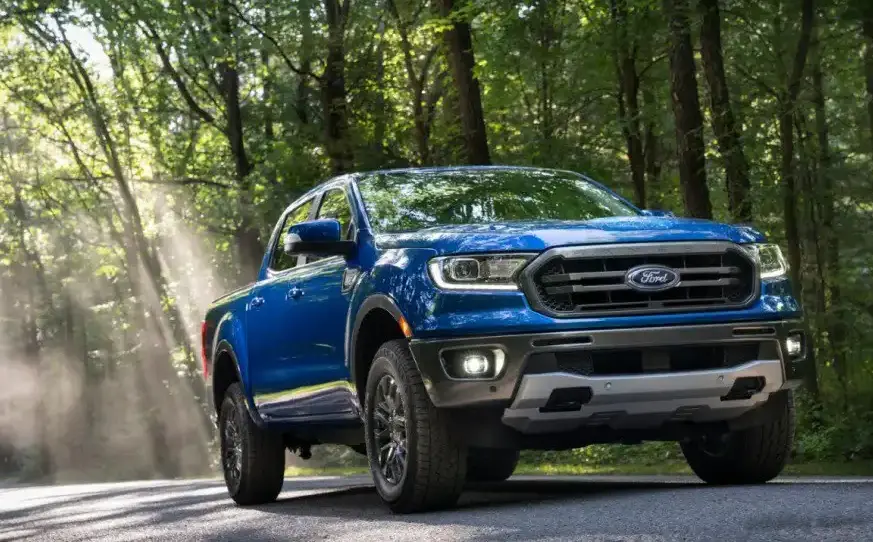
The Ford Ranger III Double Cab, specifically the facelifted version introduced in January 2019 and produced through 2022, represented a significant evolution of Ford’s mid-size pickup truck offering in the global market. This variant, equipped with the 2.0 EcoBlue turbocharged diesel engine producing 170 horsepower and paired with a 10-speed automatic transmission and a four-wheel-drive system, occupied a key position in the Ranger lineup, balancing fuel efficiency, capability, and affordability. It was primarily aimed at buyers needing a versatile vehicle for both work and family use, offering a compelling alternative to larger full-size trucks.
Technical Specifications
| Brand | Ford |
| Model | Ranger |
| Generation | Ranger III Double Cab (facelift 2019) |
| Type (Engine) | 2.0 EcoBlue (170 Hp) 4×4 Automatic |
| Start of production | January, 2019 |
| End of production | 2022 |
| Powertrain Architecture | Internal Combustion engine |
| Body type | Pick-up |
| Seats | 5 |
| Doors | 4 |
| Fuel consumption (combined) | 7.5-7.7 l/100 km (31.4 – 30.5 US mpg, 37.7 – 36.7 UK mpg, 13.3 – 13 km/l) |
| CO2 emissions | 197-201 g/km |
| Fuel Type | Diesel |
| Acceleration 0 – 100 km/h | 11.4 sec |
| Acceleration 0 – 62 mph | 11.4 sec |
| Acceleration 0 – 60 mph | 10.8 sec |
| Maximum speed | 180 km/h (111.85 mph) |
| Emission standard | Euro 6d-TEMP |
| Weight-to-power ratio | 13 kg/Hp, 77.2 Hp/tonne |
| Weight-to-torque ratio | 5.2 kg/Nm, 190.7 Nm/tonne |
| Power | 170 Hp |
| Power per litre | 85.1 Hp/l |
| Torque | 420 Nm (309.78 lb.-ft.) |
| Engine displacement | 1997 cm3 (121.86 cu. in.) |
| Number of cylinders | 4 |
| Engine configuration | Inline |
| Number of valves per cylinder | 4 |
| Fuel injection system | Diesel Commonrail |
| Engine aspiration | Turbocharger, Intercooler |
| Engine oil capacity | 8.1 l (8.56 US qt | 7.13 UK qt) |
| Coolant | 11 l (11.62 US qt | 9.68 UK qt) |
| Kerb Weight | 2202 kg (4854.58 lbs.) |
| Max. weight | 3270 kg (7209.12 lbs.) |
| Max load | 1068 kg (2354.54 lbs.) |
| Fuel tank capacity | 80 l (21.13 US gal | 17.6 UK gal) |
| AdBlue tank | 20 l (5.28 US gal | 4.4 UK gal) |
| Permitted trailer load with brakes (12%) | 3500 kg (7716.18 lbs.) |
| Permitted trailer load without brakes | 750 kg (1653.47 lbs.) |
| Length | 5359 mm (210.98 in.) |
| Width | 1867 mm (73.5 in.) |
| Width with mirrors folded | 1977 mm (77.83 in.) |
| Width including mirrors | 2163 mm (85.16 in.) |
| Height | 1821 mm (71.69 in.) |
| Wheelbase | 3220 mm (126.77 in.) |
| Front track | 1560 mm (61.42 in.) |
| Rear (Back) track | 1560 mm (61.42 in.) |
| Ride height (ground clearance) | 237 mm (9.33 in.) |
| Minimum turning circle | 12.7 m (41.67 ft.) |
| Approach angle | 29.0° |
| Departure angle | 27.0° |
| Ramp-over angle | 25.0° |
| Climb angle | 35.0° |
| Wading depth | 800 mm (31.5 in.) |
| Drive wheel | All wheel drive (4×4) |
| Number of gears and type of gearbox | 10 gears, automatic transmission |
| Front brakes | Disc |
| Rear brakes | Drum |
| Assisting systems | ABS (Anti-lock braking system) |
| Tires size | 265/65 R17 |
| Wheel rims size | 8J x 17 |
INTRODUCTION
The 2019-2022 Ford Ranger Double Cab with the 2.0 EcoBlue engine and 10-speed automatic transmission was a key offering in Ford’s global mid-size pickup strategy. Built on the T6 platform (internally designated as the Ranger III), this facelift brought updated styling, enhanced technology, and refined powertrain options. This particular configuration aimed to provide a balance between fuel economy, everyday usability, and off-road capability, making it a popular choice in markets where diesel engines are preferred, and where a smaller, more manageable pickup truck is desired compared to full-size options like the F-150. It served as a bridge between the base model Rangers and the higher-performance, often Raptor-branded, variants.
Powertrain & Engine Architecture
The heart of this Ranger variant is the 2.0-liter EcoBlue turbodiesel engine. This engine, part of Ford’s EcoBlue family, utilizes a common-rail direct injection system, a variable geometry turbocharger, and an intercooler to optimize combustion and boost power. The engine code is typically associated with variants like the 205PS version, but the 170hp version shares similar architecture. The 16-valve, four-cylinder engine is designed for efficiency and reduced emissions, meeting stringent Euro 6d-TEMP standards. The 10-speed automatic transmission, co-developed with General Motors, is a crucial component, offering a wide gear ratio spread for both improved acceleration and fuel economy. This transmission features sophisticated electronic control and adaptive shift logic. The transmission’s gear ratios are tuned to maximize the engine’s torque output, providing strong pulling power at lower speeds and efficient cruising at highway speeds.
Driving Characteristics
The 170 horsepower and 420 Nm (309.78 lb.-ft.) of torque delivered by this powertrain configuration provide adequate, though not exhilarating, performance. Acceleration from 0-60 mph takes around 10.8 seconds, and the top speed is limited to 180 km/h (111.85 mph). Compared to higher-output Ranger variants, such as those with more powerful diesel engines or the Ranger Raptor, this version feels less responsive, particularly when fully loaded or climbing steep inclines. However, the 10-speed automatic transmission helps to mitigate this by keeping the engine in its optimal power band. The automatic transmission shifts smoothly and efficiently, contributing to a comfortable driving experience. The four-wheel-drive system provides enhanced traction in off-road conditions, making it suitable for light to moderate off-roading. The relatively low weight of the 2.0L engine compared to larger diesel options contributes to better handling and agility.
Equipment & Trim Levels
The 2.0 EcoBlue 170hp Automatic typically sat in the mid-range of the Ranger Double Cab lineup. Standard equipment generally included air conditioning, power windows and locks, a basic infotainment system with Bluetooth connectivity, and a suite of safety features such as ABS, electronic stability control, and multiple airbags. Higher trim levels offered upgrades such as leather upholstery, a more advanced infotainment system with navigation, a rearview camera, parking sensors, and automatic climate control. Optional extras often included a tow package, alloy wheels, and various styling enhancements. Interior materials were generally durable and practical, reflecting the truck’s work-oriented nature.
Chassis & Braking
The Ranger Double Cab utilizes a body-on-frame construction, providing robust durability and off-road capability. The front suspension consists of independent double wishbones with coil springs and stabilizer bar, while the rear suspension employs leaf springs. The braking system features disc brakes on the front wheels and drum brakes on the rear wheels. ABS (Anti-lock Braking System) is standard. The chassis is designed to handle substantial payloads and towing loads, with a maximum payload capacity of 1068 kg (2354.54 lbs.) and a permitted trailer load of up to 3500 kg (7716.18 lbs.) with brakes. The suspension tuning prioritizes ride comfort and stability, although it can feel somewhat firm when unladen.
Market Reception & Comparison
The 2.0 EcoBlue 170hp Automatic Ranger Double Cab was generally well-received by automotive critics as a practical and efficient pickup truck. It was praised for its fuel economy (7.5-7.7 l/100 km) and comfortable ride. However, some reviewers noted that the engine lacked the outright power of larger diesel options. Compared to the higher-output Ranger variants, this version offered a more affordable entry point into the Ranger lineup, making it attractive to budget-conscious buyers. Compared to competitors like the Toyota Hilux and Nissan Navara, the Ranger offered a more modern interior and a more refined driving experience. Reliability reports have been generally positive, with the EcoBlue engine proving to be relatively durable.
Legacy
The 2.0 EcoBlue engine has become a mainstay in Ford’s European and global vehicle lineup, demonstrating its versatility and efficiency. The 10-speed automatic transmission has also proven to be a reliable and capable unit. In the used car market, the 2019-2022 Ranger Double Cab 2.0 EcoBlue Automatic holds its value reasonably well, particularly well-maintained examples with lower mileage. Its combination of practicality, fuel efficiency, and capability continues to make it a popular choice for buyers seeking a versatile mid-size pickup truck. While not the most powerful Ranger variant, it represents a sweet spot in the lineup for those prioritizing everyday usability and running costs.