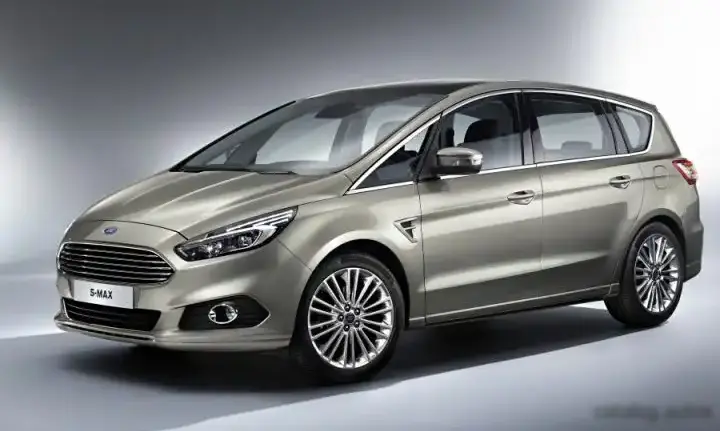
The Ford S-MAX II 2.0 TDCi 180 horsepower All-Wheel Drive (AWD) with the PowerShift dual-clutch transmission and Start/Stop system represents a significant iteration of Ford’s multi-purpose vehicle (MPV) offering. Produced from 2015 to 2018, this variant occupied a mid-to-upper position within the second-generation S-MAX lineup, appealing to buyers seeking a blend of practicality, performance, and fuel efficiency. It was primarily marketed in Europe, where the MPV segment remained strong, offering a compelling alternative to traditional minivans and crossovers.
Technical Specifications
| Brand | Ford |
| Model | S-MAX |
| Generation | S-MAX II |
| Type (Engine) | 2.0 TDCi (180 Hp) AWD PowerShift S&S |
| Start of production | 2015 |
| End of production | 2018 |
| Powertrain Architecture | Internal Combustion engine |
| Body type | MPV |
| Seats | 5 |
| Doors | 5 |
| Fuel consumption (urban) | 6.4 l/100 km (36.8 US mpg, 44.1 UK mpg, 15.6 km/l) |
| Fuel consumption (extra urban) | 5.4 l/100 km (43.6 US mpg, 52.3 UK mpg, 18.5 km/l) |
| Fuel consumption (combined) | 5.8 l/100 km (40.6 US mpg, 48.7 UK mpg, 17.2 km/l) |
| CO2 emissions | 149 g/km |
| Fuel Type | Diesel |
| Acceleration 0 – 100 km/h | 10.5 sec |
| Acceleration 0 – 62 mph | 10.5 sec |
| Acceleration 0 – 60 mph | 10 sec |
| Maximum speed | 206 km/h (128 mph) |
| Emission standard | Euro 6 |
| Weight-to-power ratio | 10.1 kg/Hp, 99.5 Hp/tonne |
| Weight-to-torque ratio | 4.5 kg/Nm, 221.1 Nm/tonne |
| Power | 180 Hp @ 3500 rpm |
| Power per litre | 90.1 Hp/l |
| Torque | 400 Nm @ 2000-2500 rpm (295.02 lb.-ft. @ 2000-2500 rpm) |
| Engine layout | Front, Transverse |
| Engine Model/Code | T8CG, T8CH, T8CI, T8CJ |
| Engine displacement | 1997 cm3 (121.86 cu. in.) |
| Number of cylinders | 4 |
| Engine configuration | Inline |
| Cylinder Bore | 85 mm (3.35 in.) |
| Piston Stroke | 88 mm (3.46 in.) |
| Compression ratio | 17:1 |
| Number of valves per cylinder | 4 |
| Fuel injection system | Diesel Commonrail |
| Engine aspiration | Turbocharger, Intercooler |
| Valvetrain | DOHC |
| Engine oil capacity | 5.6 l (5.92 US qt | 4.93 UK qt) |
| Coolant | 8.2 l (8.66 US qt | 7.21 UK qt) |
| Kerb Weight | 1809 kg (3988.16 lbs.) |
| Max. weight | 2615 kg (5765.09 lbs.) |
| Max load | 806 kg (1776.93 lbs.) |
| Trunk (boot) space – minimum | 700 l (24.72 cu. ft.) |
| Trunk (boot) space – maximum | 2200 l (77.69 cu. ft.) |
| Fuel tank capacity | 70 l (18.49 US gal | 15.4 UK gal) |
| Length | 4796 mm (188.82 in.) |
| Width | 1916 mm (75.43 in.) |
| Width including mirrors | 2137 mm (84.13 in.) |
| Height | 1655 mm (65.16 in.) |
| Wheelbase | 2849 mm (112.17 in.) |
| Front track | 1606 mm (63.23 in.) |
| Rear (Back) track | 1606 mm (63.23 in.) |
| Ride height (ground clearance) | 128-150 mm (5.04 – 5.91 in.) |
| Minimum turning circle | 12 m (39.37 ft.) |
| Drive wheel | All wheel drive (4×4) |
| Number of gears and type of gearbox | 6 gears, automatic transmission PowerShift |
| Front suspension | Independent, type McPherson with coil spring and anti-roll bar |
| Rear suspension | Independent coil spring |
| Front brakes | Ventilated discs |
| Rear brakes | Disc |
| Assisting systems | ABS (Anti-lock braking system) |
| Steering type | Steering rack and pinion |
| Tires size | 235/55 R17; 235/50 R18; 245/45 R19 |
| Wheel rims size | 7.5J x 17; 7.5J x 18; 8J x 19 |
Powertrain & Engine Architecture
At the heart of the S-MAX II 2.0 TDCi AWD lies the Ford Duratorq engine family. Specifically, this variant utilizes the 2.0-liter turbocharged diesel engine, designated with engine codes such as T8CG, T8CH, T8CI, and T8CJ. This engine is a four-cylinder, inline configuration with a double overhead camshaft (DOHC) and four valves per cylinder. The engine employs a common-rail direct fuel injection system, delivering fuel at extremely high pressure for optimized combustion. A turbocharger with an intercooler further enhances performance by forcing more air into the cylinders. The 180 horsepower output is achieved at 3500 rpm, while the substantial 400 Nm (295 lb-ft) of torque is available between 2000 and 2500 rpm, providing strong mid-range acceleration. Paired with this engine is the Ford PowerShift six-speed dual-clutch transmission (DCT). This transmission offers quicker and smoother gear changes compared to a traditional automatic, contributing to both performance and fuel efficiency. The AWD system is a viscous coupling system, providing all-wheel drive capability when needed, enhancing traction in slippery conditions.
Driving Characteristics
The 2.0 TDCi 180 hp AWD S-MAX delivers a balanced driving experience. While not as overtly sporty as some of its competitors, the engine provides ample power for everyday driving and overtaking maneuvers. The PowerShift transmission contributes to responsive acceleration, although some drivers have reported occasional low-speed jerkiness, a common characteristic of early DCT implementations. The AWD system provides enhanced stability and grip, particularly on wet or loose surfaces. Compared to the lower-powered 1.5 EcoBoost or 1.6 TDCi variants, the 2.0 TDCi offers significantly more performance. It also provides a more relaxed driving experience on long journeys due to the higher torque output. Compared to the higher-output 2.2 TDCi models, the 2.0 TDCi offers a better balance between performance and fuel economy.
Equipment & Trim Levels
The 2.0 TDCi 180 AWD S-MAX typically came equipped with a generous level of standard features. These included air conditioning, power windows, power mirrors, a multi-function steering wheel, and an audio system with USB connectivity. Higher trim levels, such as Titanium and Vignale, added features like leather upholstery, heated front seats, a navigation system, a panoramic sunroof, and advanced driver-assistance systems (ADAS) such as adaptive cruise control and lane-keeping assist. Optional extras included a rear-seat entertainment system, upgraded audio systems, and various styling enhancements.
Chassis & Braking
The S-MAX II utilizes an independent suspension setup on both the front and rear axles. The front suspension employs McPherson struts with coil springs and an anti-roll bar, while the rear suspension features an independent coil spring arrangement. This setup provides a comfortable ride quality while maintaining good handling characteristics. Braking duties are handled by ventilated discs on the front wheels and solid discs on the rear. Anti-lock Braking System (ABS) is standard, enhancing braking performance and stability. The steering system is a rack-and-pinion type, providing precise and responsive steering feel.
Market Reception & Comparison
The Ford S-MAX II 2.0 TDCi 180 AWD PowerShift S&S was generally well-received by automotive critics. It was praised for its spacious interior, comfortable ride, and strong performance. The PowerShift transmission received mixed reviews, with some critics noting its occasional hesitation at low speeds. Fuel economy was considered to be competitive for its class. Compared to rivals like the Volkswagen Touran and Citroën C4 Picasso, the S-MAX offered a more dynamic driving experience and a more premium interior. However, some competitors offered more flexible seating configurations.
Legacy
The 2.0 TDCi engine, while generally reliable, has been known to exhibit issues with the diesel particulate filter (DPF) and the dual-mass flywheel, particularly on vehicles that have primarily been used for short journeys. The PowerShift transmission has also been subject to some reliability concerns, with reports of clutch failures and software glitches. However, with proper maintenance and servicing, these issues can often be mitigated. Today, the S-MAX II 2.0 TDCi 180 AWD remains a popular choice in the used car market, offering a compelling combination of practicality, performance, and value. Its robust construction and relatively affordable running costs make it an attractive option for families and individuals seeking a versatile and capable MPV.