
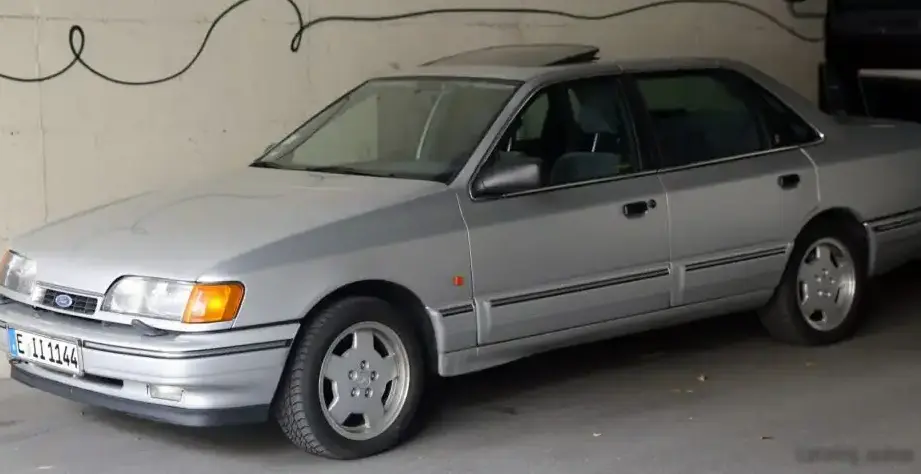
The Ford Scorpio I 1.8, producing 90 horsepower, was a variant of the GAE/GGE series produced between 1985 and 1987. Positioned as the entry-level model in the Scorpio lineup, it aimed to provide affordable, comfortable transportation within the large family car segment. The Scorpio I represented a significant step forward for Ford of Europe, replacing the aging Granada and Consul models. It was designed to compete with vehicles like the Opel/Vauxhall Senator and Rover SD1, offering a more modern and spacious interior, along with improved aerodynamics. This particular 1.8-liter version, often paired with a manual transmission (though an automatic was available), served as a more economical alternative to the larger, more powerful engines offered in the range.
Technical Specifications
| Brand | Ford |
| Model | Scorpio |
| Generation | Scorpio I (GAE,GGE) |
| Type (Engine) | 1.8 (90 Hp) |
| Start of production | 1985 |
| End of production | 1987 |
| Powertrain Architecture | Internal Combustion engine |
| Body type | Sedan |
| Seats | 5 |
| Doors | 4 |
| Fuel Type | Petrol (Gasoline) |
| Acceleration 0 – 100 km/h | 13.6 sec |
| Acceleration 0 – 62 mph | 13.6 sec |
| Acceleration 0 – 60 mph | 12.9 sec |
| Maximum speed | 180 km/h (111.85 mph) |
| Weight-to-power ratio | 14 kg/Hp, 71.4 Hp/tonne |
| Weight-to-torque ratio | 9 kg/Nm, 111.1 Nm/tonne |
| Power | 90 Hp @ 5400 rpm |
| Power per litre | 50.1 Hp/l |
| Torque | 140 Nm @ 3500 rpm (103.26 lb.-ft. @ 3500 rpm) |
| Engine layout | Front, Longitudinal |
| Engine Model/Code | REC |
| Engine displacement | 1796 cm3 (109.6 cu. in.) |
| Number of cylinders | 4 |
| Engine configuration | Inline |
| Cylinder Bore | 86.2 mm (3.39 in.) |
| Piston Stroke | 77 mm (3.03 in.) |
| Number of valves per cylinder | 2 |
| Fuel injection system | Carburettor |
| Engine aspiration | Naturally aspirated engine |
| Valvetrain | SOHC |
| Engine oil capacity | 3.75 l (3.96 US qt | 3.3 UK qt) |
| Coolant | 8 l (8.45 US qt | 7.04 UK qt) |
| Kerb Weight | 1260 kg (2777.82 lbs.) |
| Trunk (boot) space – minimum | 490 l (17.3 cu. ft.) |
| Fuel tank capacity | 70 l (18.49 US gal | 15.4 UK gal) |
| Length | 4744 mm (186.77 in.) |
| Width | 1766 mm (69.53 in.) |
| Height | 1450 mm (57.09 in.) |
| Wheelbase | 2761 mm (108.7 in.) |
| Minimum turning circle | 10.4 m (34.12 ft.) |
| Drivetrain Architecture | The Internal combustion engine (ICE) drives the rear wheels of the vehicle. |
| Drive wheel | Rear wheel drive |
| Number of gears and type of gearbox | 5 gears, manual transmission |
| Front suspension | Independent, type McPherson with coil spring and anti-roll bar |
| Rear suspension | Independent coil spring, Trailing arm |
| Front brakes | Ventilated discs, 260 mm |
| Rear brakes | Disc, 253 mm |
| Assisting systems | ABS (Anti-lock braking system) |
| Steering type | Steering rack and pinion |
| Power steering | Hydraulic Steering |
| Tires size | 185/70 R14 |
Powertrain & Engine Architecture
The 1.8-liter REC engine powering the Scorpio I was a naturally aspirated, inline-four cylinder unit. It utilized a single overhead camshaft (SOHC) valvetrain with two valves per cylinder. Fuel delivery was managed by a carburetor, a relatively common setup for the time, though increasingly being replaced by fuel injection in other markets. This engine produced 90 horsepower at 5400 rpm and 140 Nm (103.26 lb-ft) of torque at 3500 rpm. The engine was mounted longitudinally in the front of the vehicle, driving the rear wheels. The available transmission was primarily a five-speed manual, though a three-speed automatic transmission was also offered, albeit less frequently paired with this engine. The automatic gearbox, while providing convenience, did noticeably impact acceleration and fuel economy.
Driving Characteristics
The 1.8-liter Scorpio I offered a comfortable, if not particularly sporty, driving experience. Acceleration was modest, taking around 13.6 seconds to reach 62 mph (100 km/h). The carburetor-equipped engine felt somewhat sluggish at lower speeds, requiring frequent downshifts to maintain momentum. The manual transmission allowed for better control and responsiveness, while the automatic version prioritized ease of use. Compared to the larger 2.8-liter V6 or the diesel options, the 1.8 felt underpowered, especially when fully loaded with passengers and luggage. However, its lighter weight and simpler mechanicals contributed to better fuel economy and reduced maintenance costs.
Equipment & Trim Levels
The base-level 1.8 Scorpio I typically came equipped with features considered standard for a family car of its era. This included cloth upholstery, basic instrumentation, and a four-speaker stereo system. Power steering was often included, but air conditioning and electric windows were usually optional extras. Higher trim levels, such as the Ghia, added more luxurious appointments like leather upholstery, upgraded sound systems, and additional convenience features. The 1.8 model was often seen as a blank canvas for buyers who prioritized affordability and were willing to add options as needed.
Chassis & Braking
The Scorpio I featured independent suspension all around, with McPherson struts at the front and a trailing arm setup at the rear. This provided a reasonably comfortable ride, although it wasn’t particularly sporty in handling. The braking system consisted of ventilated discs on the front wheels and discs on the rear. Anti-lock braking (ABS) was available as an option, enhancing safety in emergency braking situations. The steering was rack and pinion, providing precise control, and assisted by hydraulic power steering for ease of maneuvering.
Market Reception & Comparison
The 1.8-liter Scorpio I received mixed reviews. Critics generally praised its spacious interior, comfortable ride, and improved aerodynamics compared to the Granada. However, the 1.8-liter engine was often criticized for being underpowered, particularly when paired with the automatic transmission. Compared to the 2.8-liter V6, the 1.8 offered significantly lower performance but also better fuel economy. The diesel versions provided even better fuel efficiency but lacked the refinement of the gasoline engines. The 1.8 Scorpio I appealed to buyers who prioritized affordability and practicality over outright performance.
Legacy
The Ford Scorpio I 1.8, while not the most powerful or exciting variant, remains a relatively reliable and affordable classic car. The REC engine is known for its durability, although carburetor maintenance can be required over time. Parts availability is generally good, although some specific trim pieces may be difficult to find. Today, the Scorpio I 1.8 represents a unique piece of Ford’s history, offering a glimpse into the design and engineering of the 1980s. It’s a popular choice among classic car enthusiasts who appreciate its spaciousness, comfort, and relatively simple mechanicals. The automatic transmission versions, while less desirable to some, offer a more relaxed driving experience and can be found at lower prices in the used car market.
