
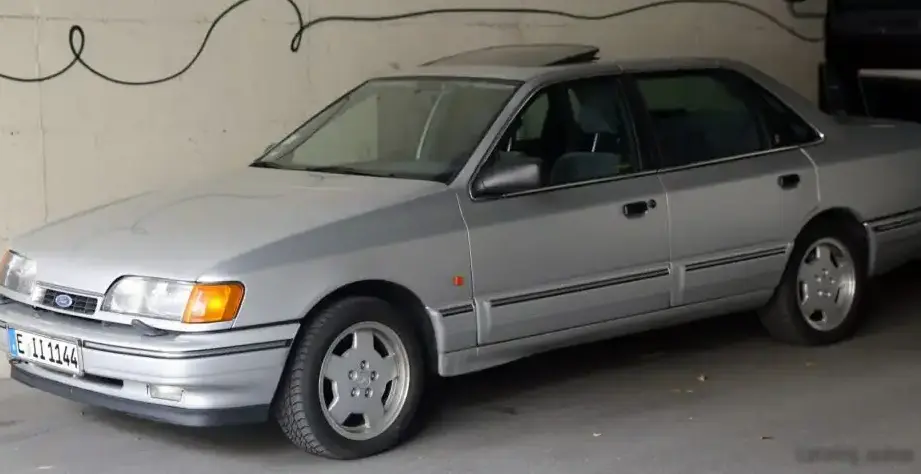
The Ford Scorpio I, specifically the 2.0-liter (105 hp) variant, was produced between 1985 and 1989. It represented a significant step upmarket for Ford of Europe, intended to replace the aging Granada and Consul models. The Scorpio, designated as the GAE and GGE series, aimed to compete with executive cars like the Opel/Vauxhall Senator and Rover 2000. This 2.0L engine configuration served as an entry point into the Scorpio range, offering a balance of affordability and reasonable performance. It was positioned below the more powerful 2.8i and 2.9i models, targeting buyers who prioritized fuel economy and lower running costs over outright speed.
Technical Specifications
| Brand | Ford |
| Model | Scorpio |
| Generation | Scorpio I (GAE, GGE) |
| Type (Engine) | 2.0 (105 Hp) |
| Start of production | 1985 |
| End of production | 1989 |
| Powertrain Architecture | Internal Combustion engine |
| Body type | Sedan |
| Seats | 5 |
| Doors | 4 |
| Fuel Type | Petrol (Gasoline) |
| Acceleration 0 – 100 km/h | 12.3 sec |
| Acceleration 0 – 62 mph | 12.3 sec |
| Acceleration 0 – 60 mph | 11.7 sec |
| Maximum speed | 183 km/h (113.71 mph) |
| Weight-to-power ratio | 14.9 kg/Hp, 67.3 Hp/tonne |
| Weight-to-torque ratio | 9.9 kg/Nm, 100.6 Nm/tonne |
| Power | 105 Hp @ 5200 rpm |
| Power per litre | 52.7 Hp/l |
| Torque | 157 Nm @ 3500 rpm (115.8 lb.-ft. @ 3500 rpm) |
| Engine layout | Front, Longitudinal |
| Engine Model/Code | N8D, NEL |
| Engine displacement | 1993 cm3 (121.62 cu. in.) |
| Number of cylinders | 4 |
| Engine configuration | Inline |
| Cylinder Bore | 90.8 mm (3.57 in.) |
| Piston Stroke | 77 mm (3.03 in.) |
| Number of valves per cylinder | 2 |
| Fuel injection system | Carburettor |
| Engine aspiration | Naturally aspirated engine |
| Valvetrain | OHC |
| Engine oil capacity | 3.8 l (4.02 US qt | 3.34 UK qt) |
| Kerb Weight | 1560 kg (3439.21 lbs.) |
| Fuel tank capacity | 70 l (18.49 US gal | 15.4 UK gal) |
| Length | 4744 mm (186.77 in.) |
| Width | 1766 mm (69.53 in.) |
| Height | 1450 mm (57.09 in.) |
| Wheelbase | 2761 mm (108.7 in.) |
| Minimum turning circle | 10.4 m (34.12 ft.) |
| Drivetrain Architecture | Rear wheel drive |
| Drive wheel | Rear wheel drive |
| Number of gears | 5 gears, manual transmission |
| Front brakes | Ventilated discs |
| Rear brakes | Disc |
| Assisting systems | ABS (Anti-lock braking system) |
| Steering type | Steering rack and pinion |
Powertrain & Engine Architecture
The 2.0-liter engine, identified by the codes N8D and NEL, was a naturally aspirated, inline-four cylinder unit. It featured a single overhead camshaft (OHC) design and utilized a carburetor for fuel delivery. This carburetor setup, while common for the time, was a point of criticism compared to the fuel injection systems found in some competitors. The engine produced 105 horsepower at 5200 rpm and 157 Nm (115.8 lb-ft) of torque at 3500 rpm. The engine was mounted longitudinally in the front of the vehicle, driving the rear wheels. The five-speed manual transmission was the standard offering for this variant, providing a relatively conventional driving experience. The transmission’s gear ratios were tuned for a balance of fuel efficiency and acceptable acceleration, rather than outright performance.
Driving Characteristics
The 2.0-liter Scorpio offered a comfortable, if not particularly exciting, driving experience. Acceleration from 0-60 mph took around 11.7 seconds, making it adequate for everyday driving but noticeably slower than the higher-powered versions. The carburetor could sometimes lead to a slight delay in throttle response, and the engine needed to be revved to extract its full potential. The rear-wheel-drive configuration provided balanced handling, but the relatively soft suspension setup prioritized ride comfort over sharp cornering. Compared to the 2.8i and 2.9i models, the 2.0L felt less refined and lacked the effortless power delivery of those larger engines. However, it offered significantly better fuel economy, making it a more practical choice for high-mileage drivers.
Equipment & Trim Levels
The 2.0-liter Scorpio typically came with a fairly basic level of equipment, reflecting its position as the entry-level model. Standard features included cloth upholstery, a basic instrument cluster, and manual windows and door locks. Air conditioning, central locking, and electric windows were often optional extras. Interior trim was generally functional and durable, rather than luxurious. The dashboard layout was straightforward and easy to use, with clearly labeled controls. Higher trim levels, available with the larger engines, offered more luxurious appointments such as leather upholstery, wood trim, and upgraded audio systems.
Chassis & Braking
The Scorpio I utilized a traditional body-on-frame construction, providing a robust and durable chassis. The front suspension featured independent, MacPherson struts, while the rear suspension employed a live axle with trailing arms. The 2.0-liter models typically had disc brakes on all four wheels, although some earlier versions may have featured drum brakes on the rear. An anti-lock braking system (ABS) was available as an option, enhancing safety. The steering was a rack-and-pinion system, providing reasonably precise control. Stabilizer bars were fitted to both the front and rear axles to reduce body roll during cornering.
Market Reception & Comparison
The 2.0-liter Scorpio received mixed reviews. Critics generally praised its comfortable ride and spacious interior, but the engine was often criticized for being underpowered, especially when compared to its rivals. The carburetor fuel system was also seen as outdated. Compared to the 2.8i and 2.9i models, the 2.0L offered significantly better fuel economy, making it a more attractive option for fleet buyers and private drivers concerned about running costs. However, the higher-powered models were generally preferred by those seeking a more refined and engaging driving experience. The Scorpio faced competition from cars like the Opel Senator, Rover 2000, and Peugeot 604.
Legacy
The Ford Scorpio I, including the 2.0-liter variant, has developed a modest following among classic car enthusiasts. While not as highly sought after as the larger-engined models, the 2.0L offers a more affordable entry point into Scorpio ownership. The engine is generally considered reliable, although carburetor maintenance can be required. Parts availability can be a challenge, but many components are still available through specialist suppliers. Today, these Scorpios are appreciated for their spaciousness, comfortable ride, and distinctive 1980s styling. The 2.0L version, while not the fastest, represents a practical and relatively economical classic car option.
