
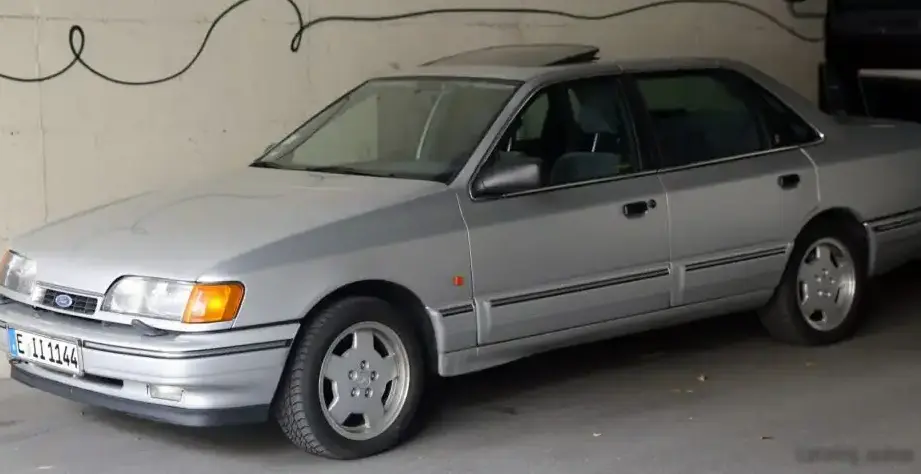
Technical Specifications
| Brand | Ford |
| Model | Scorpio |
| Generation | Scorpio I (GAE, GGE) |
| Type (Engine) | 2.5 TD (92 Hp) |
| Start of production | 1988 |
| End of production | 1992 |
| Powertrain Architecture | Internal Combustion engine |
| Body type | Sedan |
| Seats | 5 |
| Doors | 4 |
| Fuel Type | Diesel |
| Power | 92 Hp |
| Engine layout | Front, Longitudinal |
| Engine Model/Code | SFA, SFB |
| Number of cylinders | 4 |
| Engine configuration | Inline |
| Fuel injection system | Precombustion chamber injection |
| Engine aspiration | Turbocharger |
| Valvetrain | OHC |
| Engine oil capacity | 5.6 l (5.92 US qt | 4.93 UK qt) |
| Coolant capacity | 11 l (11.62 US qt | 9.68 UK qt) |
| Fuel tank capacity | 70 l (18.49 US gal | 15.4 UK gal) |
| Length | 4744 mm (186.77 in) |
| Width | 1766 mm (69.53 in) |
| Height | 1450 mm (57.09 in) |
| Wheelbase | 2761 mm (108.7 in) |
| Minimum turning circle | 10.4 m (34.12 ft) |
| Drivetrain Architecture | Rear wheel drive |
| Number of gears | 5 |
| Gearbox type | Manual transmission |
| Front brakes | Ventilated discs |
| Rear brakes | Disc |
| Steering type | Steering rack and pinion |
The Ford Scorpio I 2.5 TD, produced between 1988 and 1992, was a significant offering in Ford’s large executive car lineup. Positioned as a diesel-powered alternative within the GAE and GGE series Scorpio I range, it aimed to provide a blend of fuel efficiency and long-distance comfort. The Scorpio I was intended as a replacement for the Granada and Consul, and was a substantial vehicle designed to compete with European rivals like the Opel/Vauxhall Senator and Rover 800. The 2.5 TD variant, generating 92 horsepower, served as a mid-range option, appealing to buyers prioritizing economy over outright performance. It was a key model for Ford in the European market, where diesel engines were gaining popularity for their fuel savings.
Powertrain & Engine Architecture
The heart of the Scorpio I 2.5 TD was the Ford SFA or SFB engine, a 2.5-liter inline four-cylinder diesel. This engine utilized precombustion chamber injection, a system common in European diesels of the era. This system involved injecting fuel into a precombustion chamber connected to the main cylinder, promoting more complete combustion and reducing noise. The addition of a turbocharger significantly boosted power output to 92 horsepower, a respectable figure for a diesel engine of that time. The engine featured a single overhead camshaft (OHC) design, simplifying valvetrain complexity compared to older pushrod engines. The five-speed manual transmission was the standard offering for this variant, providing a good balance between fuel economy and drivability. The engine’s longitudinal mounting within the chassis contributed to a balanced weight distribution, typical of rear-wheel-drive vehicles.
Driving Characteristics
The 2.5 TD Scorpio I offered a distinctly different driving experience compared to its petrol-powered siblings. While lacking the outright acceleration of the V6 models, the diesel provided ample torque, particularly at lower engine speeds. This made it well-suited for long-distance cruising and towing. The five-speed manual transmission allowed drivers to keep the engine within its optimal power band. Gear ratios were geared towards economy, with a relatively tall fifth gear for highway driving. Compared to the higher-output versions, the 2.5 TD felt less stressed at higher speeds, contributing to a more relaxed driving experience. However, the diesel engine was noticeably louder and produced more vibration than the petrol engines. The rear-wheel-drive configuration provided predictable handling, although it wasn’t as agile as front-wheel-drive alternatives.
Equipment & Trim Levels
The Scorpio I 2.5 TD typically came with a reasonable level of standard equipment, reflecting its position as a mid-range model. Interior upholstery was generally cloth, with options for upgraded velour or leather available. The dashboard featured a straightforward layout with analog gauges for speed, engine temperature, fuel level, and other vital information. Power steering was standard, making the large car easier to maneuver. Optional extras included electric windows, central locking, a sunroof, and upgraded audio systems. Trim levels varied slightly depending on the market, but generally, the 2.5 TD offered a comfortable and well-equipped interior without the luxury appointments of the higher-spec models.
Chassis & Braking
The Scorpio I utilized a traditional body-on-frame construction, providing a robust and durable chassis. Suspension consisted of independent front suspension with MacPherson struts and a live axle with coil springs at the rear. The rear axle was typically equipped with disc brakes, although some earlier models may have featured drum brakes. Ventilated disc brakes were used at the front to provide effective stopping power. A stabilizer bar was fitted to both the front and rear axles to reduce body roll during cornering. The steering system employed a rack and pinion setup, offering precise and responsive steering feel. The chassis was designed to provide a comfortable ride, absorbing bumps and imperfections in the road surface effectively.
Market Reception & Comparison
The Ford Scorpio I 2.5 TD was generally well-received by critics as a practical and economical choice for long-distance drivers. It offered a compelling alternative to petrol-powered rivals, particularly in markets where diesel fuel was cheaper and fuel economy was a priority. Compared to the V6 models, the 2.5 TD was significantly more fuel-efficient, making it a popular choice for fleet operators and high-mileage drivers. However, it lacked the performance and refinement of the higher-spec models. Reliability was generally good, although the diesel engine required regular maintenance to ensure optimal performance. The Scorpio I 2.5 TD competed directly with other large European sedans, such as the Opel Senator, Rover 800, and Peugeot 604.
Legacy
The Ford Scorpio I 2.5 TD, while not as iconic as some of its petrol-powered siblings, remains a respected vehicle among enthusiasts. The SFA/SFB diesel engine proved to be relatively durable, and many examples are still on the road today. However, finding parts can be challenging, and maintenance requires specialized knowledge. In the used car market, the 2.5 TD Scorpio I is often sought after by those looking for a classic European sedan with good fuel economy and a comfortable ride. It represents a significant chapter in Ford’s history, showcasing the company’s commitment to providing a diverse range of vehicles to meet the needs of different buyers. The Scorpio I, in all its variants, paved the way for future Ford models and helped establish the company as a major player in the European automotive market.
