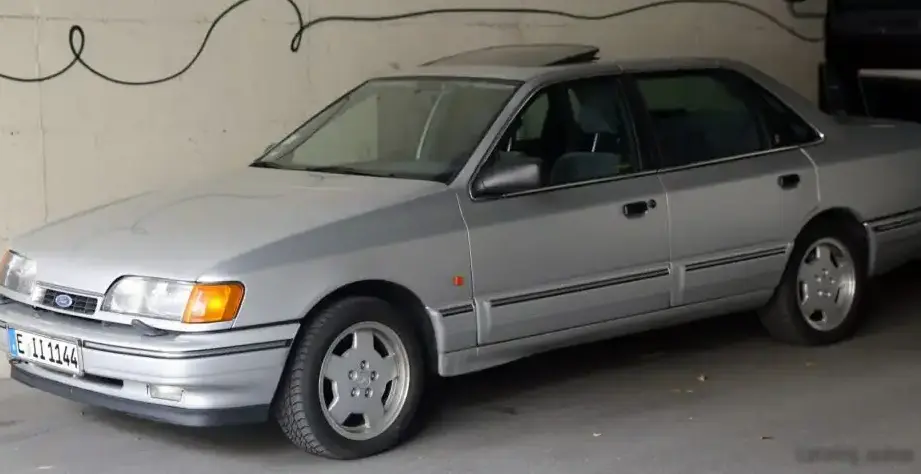
The Ford Scorpio I Turnier (GGE) 2.0i, produced between 1991 and 1994, represented a significant offering in Ford’s European lineup as a spacious and practical estate car. Positioned as a mid-range variant within the Scorpio I series, the 2.0i Turnier aimed to balance affordability with reasonable performance and comfort. The Turnier body style, Ford’s designation for its station wagon models, was crucial in appealing to families and those requiring substantial cargo capacity. This variant utilized the Ford NRA or NRI engine code, and was part of the larger GGE generation, sharing its platform with the saloon (sedan) version but distinguished by its extended rear section and increased practicality. It served as a competitor to other European estates like the Opel/Vauxhall Carlton Estate and the Volvo 740/760 series.
Technical Specifications
| Brand | Ford |
| Model | Scorpio |
| Generation | Scorpio I Turnier (GGE) |
| Type (Engine) | 2.0 i (115 Hp) |
| Start of production | 1991 |
| End of production | 1994 |
| Powertrain Architecture | Internal Combustion engine |
| Body type | Station wagon (estate) |
| Fuel Type | Petrol (Gasoline) |
| Power | 115 Hp @ 5500 rpm |
| Power per litre | 57.7 Hp/l |
| Torque | 160 Nm @ 4000 rpm / 118.01 lb.-ft. @ 4000 rpm |
| Engine layout | Front, Longitudinal |
| Engine Model/Code | NRA, NRI |
| Engine displacement | 1993 cm3 / 121.62 cu. in. |
| Number of cylinders | 4 |
| Engine configuration | Inline |
| Cylinder Bore | 90.8 mm / 3.57 in. |
| Piston Stroke | 77 mm / 3.03 in. |
| Number of valves per cylinder | 4 |
| Fuel injection system | Multi-port manifold injection |
| Engine aspiration | Naturally aspirated engine |
| Valvetrain | DOHC |
| Engine oil capacity | 3.8 l / 4.02 US qt | 3.34 UK qt |
| Coolant | 8 l / 8.45 US qt | 7.04 UK qt |
Powertrain & Engine Architecture
The heart of the Scorpio I Turnier 2.0i was the Ford NRA or NRI inline-four cylinder engine, displacing 1993cc (121.62 cubic inches). This engine was a development of Ford’s earlier ‘Pinto’ series, but significantly updated with multi-port fuel injection and a double overhead camshaft (DOHC) valvetrain. The DOHC configuration, with four valves per cylinder, allowed for improved breathing and higher engine speeds compared to older designs. The engine utilized a Bosch fuel injection system, carefully calibrated to deliver a balance of performance and fuel economy. The longitudinal engine layout, coupled with rear-wheel drive, was a traditional configuration for larger Ford models at the time, offering a different driving experience than the increasingly common front-wheel drive layouts. While not a high-performance engine, the 2.0i provided adequate power for comfortable cruising and hauling loads, typical for the intended use of the Turnier estate.
Driving Characteristics
The 2.0i engine, producing 115 horsepower, delivered a respectable but not exhilarating driving experience. Acceleration was adequate for everyday driving, but the Scorpio Turnier 2.0i wasn’t designed for sporty performance. The automatic transmission, typically a four-speed unit, further tempered acceleration, prioritizing smooth shifts and ease of use over outright speed. Gear ratios were geared towards fuel efficiency and comfortable highway cruising. Compared to the higher-output 2.9-liter V6 versions of the Scorpio, the 2.0i felt noticeably less powerful, particularly when fully loaded. However, the 2.0i offered a more economical driving experience, and the automatic transmission made it easier to navigate city traffic. The rear-wheel drive configuration provided a balanced feel, although it lacked the agility of front-wheel drive cars.
Equipment & Trim Levels
The Scorpio I Turnier 2.0i typically came equipped with a reasonable level of standard features for its time. Interior upholstery was generally cloth, with options for upgraded velour or leather available. Standard equipment included central locking, electric front windows, and a basic stereo system. Higher trim levels, often denoted by ‘GL’ or ‘Ghia’ badges, added features such as alloy wheels, upgraded interior trim, a sunroof, and more sophisticated audio systems. Air conditioning was often an optional extra. The Turnier’s interior was spacious, offering ample headroom and legroom for passengers, and the estate body style provided a generous cargo area, further enhanced by folding rear seats. The dashboard layout was functional and straightforward, typical of Ford designs of the early 1990s.
Chassis & Braking
The Scorpio I Turnier utilized a traditional body-on-frame construction, providing a robust and durable chassis. Suspension consisted of independent front suspension with MacPherson struts and a live axle rear suspension with coil springs. The rear axle was typically equipped with drum brakes, while the front wheels featured disc brakes. Stabilizer bars were fitted to both the front and rear axles to reduce body roll during cornering. Steering was power-assisted, making it relatively easy to maneuver the large estate car. The suspension was tuned for comfort, providing a smooth ride over most road surfaces, although it could feel somewhat wallowy when pushed hard. The braking system was adequate for normal driving conditions, but lacked the stopping power of more modern systems.
Market Reception & Comparison
The Scorpio I Turnier 2.0i was generally well-received by automotive critics as a practical and comfortable estate car. It was praised for its spacious interior, generous cargo capacity, and relatively affordable price. However, it was often criticized for its somewhat bland styling and lack of sporting pretensions. Compared to the V6-powered Scorpio variants, the 2.0i offered better fuel economy but significantly less performance. The automatic transmission was seen as a convenience feature, but it did detract from the car’s overall responsiveness. In terms of reliability, the 2.0i engine was generally considered to be robust and dependable, although the automatic transmission could be prone to issues if not properly maintained. Fuel economy was reasonable for a car of its size and class, typically achieving around 25-30 mpg on a combined cycle.
Legacy
The Ford Scorpio I Turnier 2.0i, while not a particularly iconic model, remains a fondly remembered car for those who owned or drove one. The 2.0i powertrain, while not the most powerful option, proved to be relatively reliable and economical. Today, surviving examples are becoming increasingly rare, and well-maintained cars are sought after by classic Ford enthusiasts. The Turnier body style, in particular, is appreciated for its practicality and spaciousness. The Scorpio I, as a whole, represents a significant chapter in Ford’s European history, showcasing the company’s commitment to building large, comfortable, and practical family cars. The 2.0i automatic variant, while often overlooked in favor of the more powerful V6 models, offered a compelling combination of affordability, comfort, and usability.