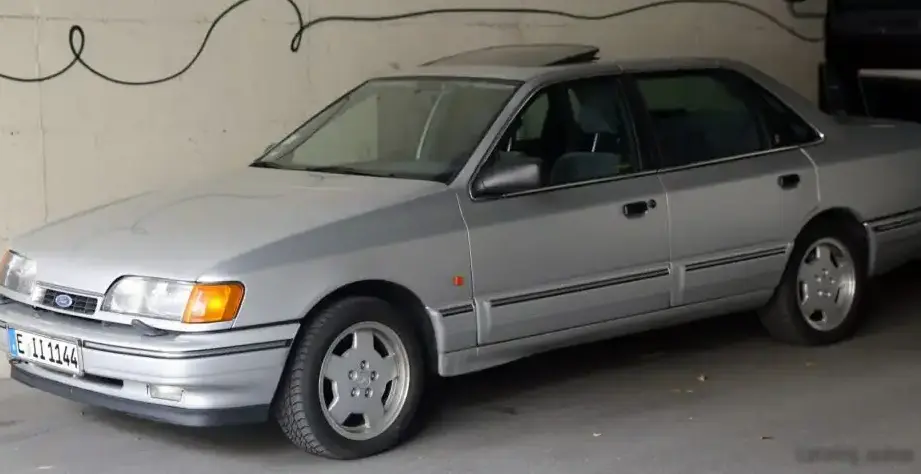
The Ford Scorpio II 2.9i 24V, produced between 1995 and 1998, represented the upper echelon of Ford of Europe’s executive car offerings. Falling within the GFR and GGR chassis codes, this variant was positioned as a premium trim within the Scorpio II range, offering a significant performance upgrade over the lower-spec engines. The Scorpio II, intended as a replacement for both the Ford Granada and Ford Sierra, aimed to compete with established European rivals like the BMW 5 Series and Mercedes-Benz E-Class. The 2.9i 24V, with its Cologne V6 engine, was a key component in establishing the Scorpio’s reputation for refined power and comfortable long-distance cruising.
Technical Specifications
| Brand | Ford |
| Model | Scorpio |
| Generation | Scorpio II (GFR,GGR) |
| Type (Engine) | 2.9i 24V (207 Hp) |
| Start of production | 1995 |
| End of production | 1998 |
| Powertrain Architecture | Internal Combustion engine |
| Body type | Sedan |
| Seats | 5 |
| Doors | 4 |
| Fuel consumption (combined) | 10.9 l/100 km |
| Fuel consumption (US mpg) | 21.6 US mpg |
| Fuel consumption (UK mpg) | 25.9 UK mpg |
| Fuel consumption (km/l) | 9.2 km/l |
| Fuel Type | Petrol (Gasoline) |
| Acceleration 0 – 100 km/h | 9 sec |
| Acceleration 0 – 62 mph | 9 sec |
| Acceleration 0 – 60 mph | 8.6 sec |
| Maximum speed | 225 km/h (139.81 mph) |
| Weight-to-power ratio | 7.8 kg/Hp |
| Weight-to-torque ratio | 5.8 kg/Nm |
| Power | 207 Hp @ 6000 rpm |
| Power per litre | 70.5 Hp/l |
| Torque | 281 Nm @ 4200 rpm (207.25 lb.-ft. @ 4200 rpm) |
| Engine layout | Front, Longitudinal |
| Engine Model/Code | BOB |
| Engine displacement | 2935 cm3 (179.1 cu. in.) |
| Number of cylinders | 6 |
| Engine configuration | V-engine |
| Cylinder Bore | 93 mm (3.66 in.) |
| Piston Stroke | 72 mm (2.83 in.) |
| Compression ratio | 9.7:1 |
| Number of valves per cylinder | 4 |
| Fuel injection system | Multi-port manifold injection |
| Engine aspiration | Naturally aspirated engine |
| Valvetrain | DOHC |
| Engine oil capacity | 4.5 l (4.76 US qt | 3.96 UK qt) |
| Coolant capacity | 9.5 l (10.04 US qt | 8.36 UK qt) |
| Kerb Weight | 1618 kg (3567.08 lbs.) |
| Max. weight | 2080 kg (4585.62 lbs.) |
| Max load | 462 kg (1018.54 lbs.) |
| Trunk (boot) space – minimum | 465 l (16.42 cu. ft.) |
| Trunk (boot) space – maximum | 833 l (29.42 cu. ft.) |
| Fuel tank capacity | 70 l (18.49 US gal | 15.4 UK gal) |
| Length | 4825 mm (189.96 in.) |
| Width | 1760 mm (69.29 in.) |
| Height | 1402 mm (55.2 in.) |
| Wheelbase | 2770 mm (109.06 in.) |
| Front track | 1478 mm (58.19 in.) |
| Rear track | 1495 mm (58.86 in.) |
| Drivetrain Architecture | Rear wheel drive |
| Number of gears | 4 |
| Gearbox type | Automatic transmission |
| Front suspension | Wishbone |
| Rear suspension | Coil spring |
| Front brakes | Ventilated discs |
| Rear brakes | Disc |
| Assisting systems | ABS (Anti-lock braking system), Hydraulic Power Steering |
| Tires size | 205/60 R15 |
Introduction
The Ford Scorpio II 2.9i 24V, launched in 1995, was a significant upgrade within the Scorpio II lineup. Built on the 1HX0/A3 platform, it aimed to provide a more sophisticated and powerful alternative to the base models. The Scorpio II, as a whole, was Ford’s attempt to create a genuinely competitive large executive car for the European market, replacing the aging Granada. The 2.9i 24V trim was positioned as a mid-to-high range offering, appealing to drivers who prioritized performance and refinement over outright economy.
Powertrain & Engine Architecture
The heart of the Scorpio II 2.9i 24V is the Ford Cologne 2.9-liter V6 engine, designated as the BOB engine code. This engine is a naturally aspirated, 24-valve (four valves per cylinder) V6, known for its smooth operation and relatively high power output. It utilizes a multi-port fuel injection system, delivering fuel directly to each intake port for optimized combustion. The engine’s DOHC (Dual Overhead Camshaft) valvetrain further enhances its breathing and contributes to its power delivery. Paired with this engine is a four-speed automatic transmission, designed to provide comfortable and effortless cruising. This transmission, while not known for its sportiness, was chosen for its smoothness and suitability for long-distance driving. The longitudinal engine layout and rear-wheel drive configuration were traditional for executive cars of this era, contributing to balanced handling characteristics.
Driving Characteristics
The 2.9i 24V Scorpio offered a noticeable performance improvement over the lower-powered variants. The 207 horsepower and 281 Nm (207 lb-ft) of torque provided brisk acceleration, with a 0-60 mph time of around 8.6 seconds and a top speed of 139.81 mph. However, the four-speed automatic transmission meant that the engine didn’t always feel as responsive as it could have been. Gear ratios were geared towards comfortable cruising rather than outright performance. Compared to the manual transmission versions, the automatic felt slightly more relaxed, sacrificing some immediacy for ease of use. Against the lower-powered 2.0-liter models, the 2.9i 24V offered a substantial power boost, making it a more capable vehicle for overtaking and highway driving. It wasn’t as sporty as some of its rivals, but it provided a comfortable and refined driving experience.
Equipment & Trim Levels
The 2.9i 24V trim typically included a generous level of standard equipment. Interior features often included comfortable cloth or leather upholstery, power windows and mirrors, central locking, and an upgraded audio system. Air conditioning was standard, and many examples were equipped with optional extras such as a sunroof, heated front seats, and upgraded trim materials. The dashboard layout was functional and well-designed, although it lacked the cutting-edge styling of some of its German competitors. The Scorpio II generally offered a spacious and comfortable cabin, with ample room for both front and rear passengers.
Chassis & Braking
The Scorpio II 2.9i 24V featured a robust chassis designed to handle the increased power output. Front suspension utilized a wishbone setup, while the rear employed a coil spring arrangement. Braking was handled by ventilated discs at the front and solid discs at the rear, providing adequate stopping power for the vehicle’s weight and performance. Anti-lock Braking System (ABS) was standard, enhancing safety and control during emergency braking situations. Hydraulic power steering was also standard, making the car easier to maneuver at low speeds. Stabilizer bars were fitted to both the front and rear axles to reduce body roll during cornering.
Market Reception & Comparison
The Scorpio II 2.9i 24V received mixed reviews from automotive critics. While the engine was praised for its smoothness and power, the car was often criticized for its somewhat dated styling and the lack of a more modern automatic transmission. Fuel economy, at 21.6 US mpg, was reasonable for a V6-powered executive car of the time, but it wasn’t class-leading. Compared to the 2.0-liter models, the 2.9i 24V offered significantly better performance, but at the cost of increased fuel consumption and a slightly higher purchase price. Reliability was generally good, although the complex fuel injection system and automatic transmission could require occasional maintenance. The Scorpio II struggled to gain significant market share against its established German rivals, but the 2.9i 24V remained a popular choice for those seeking a comfortable and powerful executive car.
Legacy
The Ford Scorpio II 2.9i 24V, while not a commercial success on the scale of some of its competitors, has developed a loyal following among enthusiasts. The Cologne V6 engine is known for its durability and relatively straightforward maintenance. Today, well-maintained examples are becoming increasingly collectible. The automatic transmission, while not the most exciting, has proven to be reasonably reliable. The Scorpio II 2.9i 24V represents a unique chapter in Ford’s history, showcasing the company’s ambition to compete in the executive car segment. Its blend of power, comfort, and relative affordability continues to appeal to a niche market of classic car enthusiasts.