
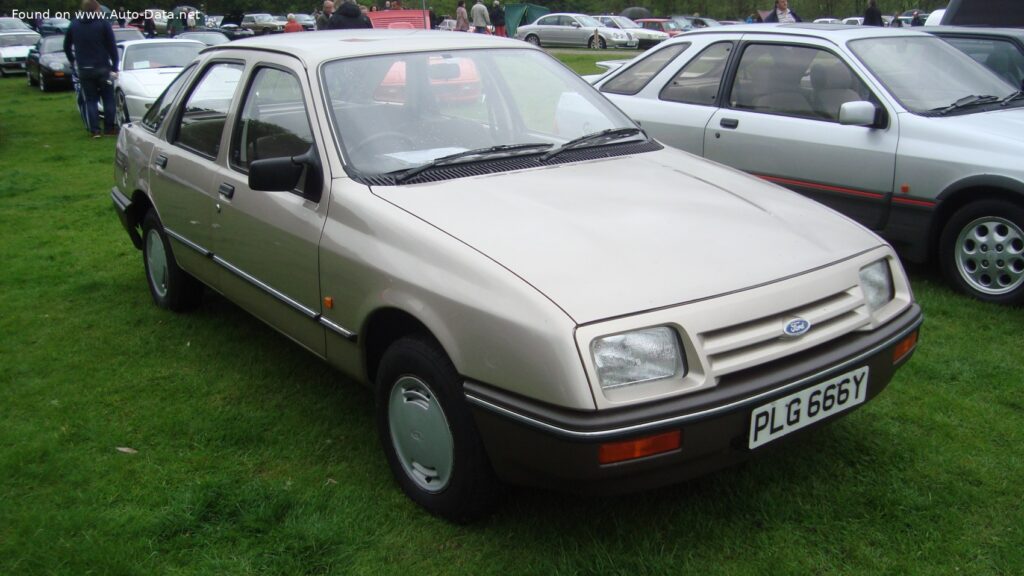
The Ford Sierra, launched in 1982, represented a significant departure for Ford of Europe, replacing the long-running and increasingly dated Cortina. The Sierra, specifically the Hatchback I 1.3 model, was intended to be a modern, aerodynamic, and globally competitive family car. While not officially sold in the United States, the Sierra was a crucial model for Ford in Europe, serving as a mainstay in the mid-size segment for over seven years. It was available in various body styles, including a saloon (sedan), estate (wagon), and the popular hatchback, with the 1.3-liter engine being the entry-level option. The Sierra aimed to appeal to a broader audience with its contemporary design and improved efficiency, marking a shift towards more modern automotive engineering principles.
The Ford Sierra Hatchback I 1.3: A European Family Car
The Sierra’s design was revolutionary for its time, embracing a more streamlined and aerodynamic profile than its predecessor. This focus on aerodynamics wasn’t merely aesthetic; it was driven by a desire to improve fuel efficiency and reduce drag, crucial considerations in the early 1980s. The Hatchback I 1.3, while the base model, offered a practical and affordable option for families and individuals seeking a reliable and economical vehicle. It played a vital role in establishing the Sierra’s presence in the European market, paving the way for more powerful and sophisticated variants. The Sierra’s impact extended beyond just sales figures; it influenced automotive design trends in Europe and set a new benchmark for family car practicality.
Engine & Performance
The Ford Sierra Hatchback I 1.3 was powered by a 1.3-liter, naturally aspirated gasoline engine producing 60 horsepower. This engine, while not particularly powerful by modern standards, was designed for fuel efficiency and reliability. It was a simple, overhead valve (OHV) design, reflecting the engineering priorities of the era. The engine’s modest output was sufficient for everyday driving, particularly in urban and suburban environments. Power was delivered to the rear wheels via a four-speed manual transmission. This rear-wheel-drive configuration was a carryover from the Cortina and provided a different driving experience compared to the increasingly popular front-wheel-drive layouts. Acceleration was modest, but the Sierra 1.3 prioritized fuel economy and ease of driving over outright performance. The engine’s simplicity also meant relatively low maintenance costs, making it an attractive option for budget-conscious buyers.
Design & Features
The Sierra Hatchback I featured a distinctive three or five-door hatchback body style. The hatchback configuration offered increased practicality and versatility compared to traditional saloon cars, allowing for easier loading and unloading of cargo. The Sierra’s interior was functional and designed with family use in mind. While not luxurious, it provided comfortable seating for five passengers. Safety features were relatively basic by today’s standards, reflecting the regulations and expectations of the early 1980s. However, the Sierra did incorporate features such as seat belts and a collapsible steering column, representing improvements over earlier Ford models. The exterior design was characterized by clean lines and a relatively flat profile, maximizing interior space. The Sierra’s aerodynamic shape was a key selling point, contributing to improved fuel efficiency and a more modern appearance. The car’s overall design represented a significant step forward for Ford of Europe, moving away from the more traditional styling of the Cortina.
Market Position and Legacy
The Ford Sierra was a direct competitor to vehicles like the Vauxhall/Opel Astra, Volkswagen Jetta, and Renault 18 in the European market. The 1.3-liter model specifically targeted buyers looking for an affordable and economical family car. Its success helped establish the Sierra as a leading model in the mid-size segment. The Sierra’s influence extended beyond its sales figures. It introduced new design and engineering concepts to the European automotive landscape, paving the way for future Ford models. The Sierra was eventually replaced by the Ford Mondeo in 1993, but its legacy as a modern and practical family car remains significant. The Sierra’s focus on aerodynamics and fuel efficiency foreshadowed the growing importance of these factors in automotive design and engineering.
Technical Specifications
| Brand | Ford |
| Model | Sierra |
| Generation | Sierra Hatchback I |
| Type (Engine) | 1.3 (60 Hp) |
| Start of production | 1982 |
| End of production | 1989 |
| Powertrain Architecture | Internal Combustion engine |
| Body type | Hatchback |
| Seats | 5 |
| Doors | 3/5 |
| Fuel Type | Petrol (Gasoline) |
| Power | 60 Hp |
| Engine aspiration | Naturally aspirated engine |
| Fuel tank capacity | 60 l / 15.85 US gal / 13.2 UK gal |
| Length | 4425 mm / 174.21 in. |
| Width | 1694 mm / 66.69 in. |
| Height | 1407 mm / 55.39 in. |
| Wheelbase | 2608 mm / 102.68 in. |
| Front track | 1452 mm / 57.17 in. |
| Rear track | 1468 mm / 57.8 in. |
| Drivetrain Architecture | Internal Combustion engine (ICE) drives the rear wheels |
| Drive wheel | Rear wheel drive |
| Number of gears | 4 |
| Type of gearbox | Manual transmission |
| Front brakes | Disc |
| Rear brakes | Drum |
