
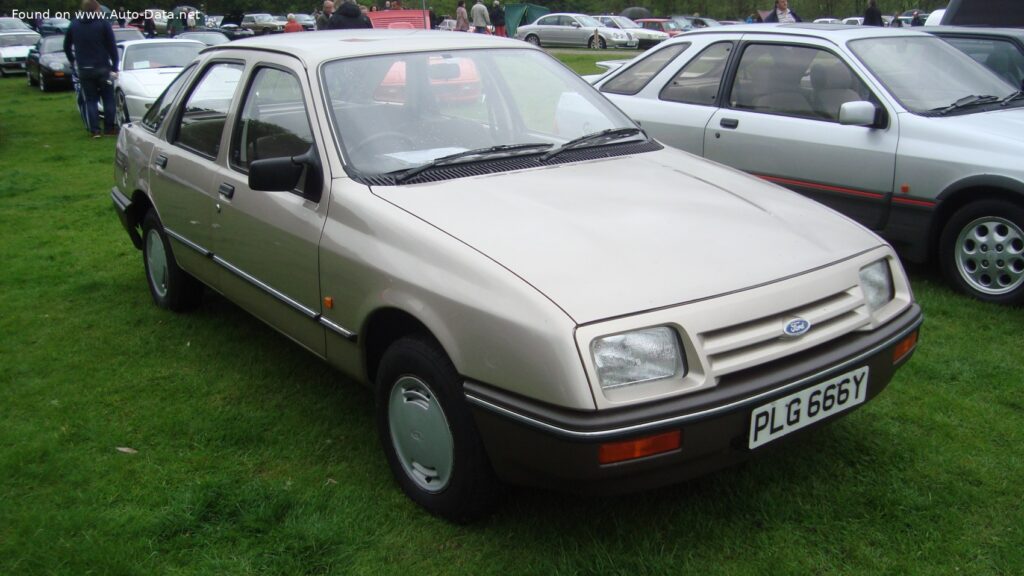
The Ford Sierra, launched in 1982, represented a significant departure for Ford of Europe, replacing the long-running and increasingly dated Cortina. Designed to compete in the mid-size family car segment, the Sierra prioritized aerodynamic efficiency and modern styling. The Sierra Hatchback I, produced from 1982 to 1986, was a pivotal model, offering a practical and stylish alternative to traditional saloon cars. The 2.0-liter version, producing 100 horsepower, was a popular choice, balancing performance with affordability. While not officially sold in the United States, the Sierra was a cornerstone of Ford’s European lineup, and its design influenced subsequent Ford models globally.
Ford Sierra Hatchback I 2.0: A Detailed Overview
The Ford Sierra Hatchback I 2.0 (100 Hp) occupied a crucial space in the European automotive market during the mid-1980s. It was designed to appeal to families and individuals seeking a modern, efficient, and reasonably priced vehicle. The hatchback body style, relatively uncommon in the segment at the time, offered increased practicality and versatility compared to traditional saloons. The 2.0-liter engine provided a good balance of power and fuel economy, making it suitable for both urban commuting and longer journeys. The Sierra’s introduction marked a shift towards more aerodynamic designs, contributing to improved fuel efficiency and handling.
Engine & Performance
The heart of the Sierra Hatchback I 2.0 was a 1993cc inline-four cylinder petrol engine. This naturally aspirated engine produced 100 horsepower at 5200 rpm and 157 Nm (115.8 lb.-ft.) of torque at 3500 rpm. While not a high-performance engine by modern standards, it provided adequate power for the vehicle’s weight and intended purpose. The engine featured a single overhead camshaft (OHC) valvetrain with two valves per cylinder and utilized a carburetor fuel injection system, typical for the era. Power delivery was relatively smooth, and the engine was known for its reliability. The engine’s longitudinal front-engine layout, coupled with rear-wheel drive, provided a balanced driving experience, although it differed from the increasingly common front-wheel-drive configuration of its competitors. The 5-speed manual transmission allowed drivers to effectively utilize the engine’s power band. The power-to-weight ratio of 50.2 hp per liter was respectable for the time.
Design & Features
The Ford Sierra Hatchback I distinguished itself with its sleek, aerodynamic design. The hatchback body style, available with either three or five doors, offered a large and accessible cargo area, enhancing its practicality. The Sierra’s design was a significant departure from the boxier styling of the Cortina it replaced. The interior was functional and relatively spacious, offering seating for five passengers. While not lavishly equipped by today’s standards, the Sierra offered essential features for the time, including comfortable seating, a basic instrument panel, and ventilation system. Safety features were limited compared to modern vehicles, but included ventilated disc brakes on the front wheels and drum brakes on the rear. The Sierra’s suspension system was designed to provide a comfortable ride while maintaining reasonable handling characteristics. The car’s relatively simple construction contributed to its ease of maintenance and repair.
Technical Specifications
| Brand | Ford |
| Model | Sierra |
| Generation | Sierra Hatchback I |
| Type (Engine) | 2.0 (100 Hp) |
| Start of production | 1985 |
| End of production | 1986 |
| Powertrain Architecture | Internal Combustion engine |
| Body type | Hatchback |
| Seats | 5 |
| Doors | 3/5 |
| Fuel Type | Petrol (Gasoline) |
| Power | 100 Hp @ 5200 rpm |
| Power per litre | 50.2 Hp/l |
| Torque | 157 Nm @ 3500 rpm |
| Torque (lb.-ft.) | 115.8 lb.-ft. @ 3500 rpm |
| Engine layout | Front, Longitudinal |
| Engine displacement | 1993 cm3 |
| Engine displacement (cu. in.) | 121.62 cu. in. |
| Number of cylinders | 4 |
| Engine configuration | Inline |
| Cylinder Bore | 90.8 mm |
| Cylinder Bore (in.) | 3.57 in. |
| Piston Stroke | 77 mm |
| Piston Stroke (in.) | 3.03 in. |
| Number of valves per cylinder | 2 |
| Fuel injection system | Carburettor |
| Engine aspiration | Naturally aspirated engine |
| Valvetrain | OHC |
| Fuel tank capacity | 60 l |
| Fuel tank capacity (US gal) | 15.85 US gal |
| Fuel tank capacity (UK gal) | 13.2 UK gal |
| Length | 4425 mm |
| Length (in.) | 174.21 in. |
| Width | 1694 mm |
| Width (in.) | 66.69 in. |
| Height | 1407 mm |
| Height (in.) | 55.39 in. |
| Wheelbase | 2608 mm |
| Wheelbase (in.) | 102.68 in. |
| Front track | 1452 mm |
| Front track (in.) | 57.17 in. |
| Rear (Back) track | 1468 mm |
| Rear (Back) track (in.) | 57.8 in. |
| Minimum turning circle (turning diameter) | 10 m |
| Minimum turning circle (turning diameter) (ft.) | 32.81 ft. |
| Drivetrain Architecture | The Internal combustion engine (ICE) drives the rear wheels of the vehicle. |
| Drive wheel | Rear wheel drive |
| Number of gears and type of gearbox | 5 gears, manual transmission |
| Front brakes | Ventilated discs |
| Rear brakes | Drum |
The Ford Sierra Hatchback I 2.0 (100 Hp) represents a significant milestone in Ford’s history. It was a well-rounded and practical vehicle that appealed to a wide range of buyers in Europe. Its aerodynamic design, combined with a reliable engine and a spacious interior, made it a popular choice in the mid-size family car segment. While not a performance car, the Sierra offered a comfortable and enjoyable driving experience. Its legacy continues to influence Ford’s design and engineering philosophies today.
