
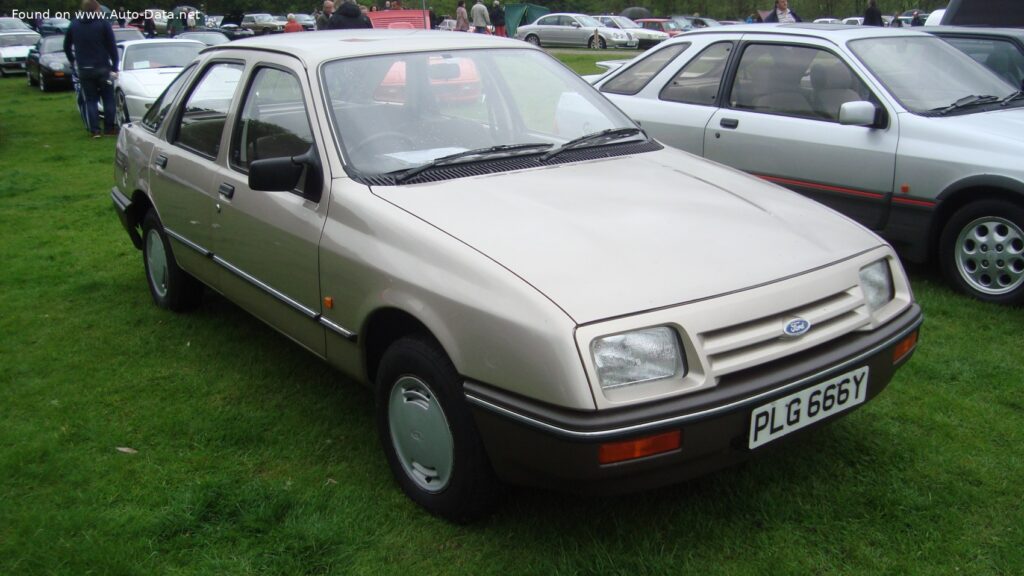
The Ford Sierra, launched in 1982, represented a significant departure for Ford of Europe, replacing the long-running and popular Cortina. The Ford Sierra Hatchback I 2.0 (105 Hp), specifically, was a key variant in establishing the Sierra’s presence in the competitive mid-size family car segment. Designed to offer a more modern and aerodynamic profile than its predecessor, the Sierra aimed to appeal to a changing European automotive landscape, prioritizing fuel efficiency and contemporary styling. While not officially sold in the United States, the Sierra was a crucial model for Ford in Europe, serving as a direct competitor to vehicles like the Opel Ascona and Volkswagen Passat. Its introduction marked a shift towards more technologically advanced features and a greater emphasis on driving dynamics within the Ford lineup.
Engine & Performance
The Sierra Hatchback I 2.0 (105 Hp) was powered by a 1.998-liter (121.93 cubic inches) inline-four cylinder petrol engine. This naturally aspirated engine produced 105 horsepower at 5100 rpm, delivering a power-to-weight ratio of 15.2 kg/Hp (65.6 Hp/tonne). While not a high-performance machine by modern standards, the 2.0-liter engine provided adequate power for comfortable cruising and everyday driving. The engine featured a compression ratio of 9:1 and utilized a carburettor fuel injection system, a common technology for the era. The overhead camshaft (OHC) valvetrain, with two valves per cylinder, contributed to the engine’s relatively efficient operation. Power delivery was managed through a five-speed manual transmission, driving the rear wheels. Fuel economy figures were rated at 12 liters per 100 kilometers (19.6 US mpg) in urban conditions, 7 liters per 100 kilometers (33.6 US mpg) on the extra-urban cycle, and 10 liters per 100 kilometers (23.5 US mpg) combined. These figures were competitive for the time, reflecting the Sierra’s aerodynamic design and relatively lightweight construction.
Design & Features
The Ford Sierra Hatchback I distinguished itself with its distinctive, wedge-shaped silhouette and a focus on aerodynamic efficiency. Available as a three or five-door hatchback, the Sierra offered practical access to the rear cargo area. The body style was a significant departure from the more traditional saloon (sedan) shape of the Cortina, embracing a more contemporary aesthetic. Inside, the Sierra provided seating for five passengers. The interior design, while functional, was typical of early 1980s automotive interiors, prioritizing durability and practicality over luxury. Safety features were relatively basic by today’s standards, but included ventilated disc brakes on the front wheels and drum brakes on the rear. Steering was handled by a steering rack and pinion system, providing responsive and precise control. The Sierra’s design prioritized maximizing interior space within a relatively compact footprint, making it a practical choice for families. The longitudinal engine placement and rear-wheel drive configuration were hallmarks of traditional European car design, offering a balanced driving experience.
The Sierra in the European Market
The Ford Sierra was specifically designed for the European market, and its success there was substantial. It represented a move away from the traditional British Ford styling and engineering, embracing a more pan-European approach. The Sierra’s aerodynamic design was particularly noteworthy, as it helped to improve fuel efficiency and reduce wind noise. The hatchback body style was also a key selling point, as it offered greater practicality and versatility than the traditional saloon. The Sierra underwent several revisions during its production run, including facelifts and engine upgrades. It was eventually replaced by the Ford Mondeo in 1993, but its legacy as a groundbreaking and influential family car remains.
Technical Specifications
| Brand | Ford |
| Model | Sierra |
| Generation | Sierra Hatchback I |
| Type (Engine) | 2.0 (105 Hp) |
| Start of production | 1982 |
| End of production | 1986 |
| Powertrain Architecture | Internal Combustion engine |
| Body type | Hatchback |
| Seats | 5 |
| Doors | 3/5 |
| Fuel consumption (urban) | 12 l/100 km (19.6 US mpg, 23.5 UK mpg, 8.3 km/l) |
| Fuel consumption (extra urban) | 7 l/100 km (33.6 US mpg, 40.4 UK mpg, 14.3 km/l) |
| Fuel consumption (combined) | 10 l/100 km (23.5 US mpg, 28.2 UK mpg, 10 km/l) |
| Fuel Type | Petrol (Gasoline) |
| Weight-to-power ratio | 15.2 kg/Hp |
| Power | 105 Hp @ 5100 rpm |
| Power per litre | 52.6 Hp/l |
| Engine displacement | 1998 cm3 (121.93 cu. in.) |
| Number of cylinders | 4 |
| Engine configuration | Inline |
| Cylinder Bore | 90.82 mm (3.58 in.) |
| Piston Stroke | 76.95 mm (3.03 in.) |
| Compression ratio | 9:1 |
| Number of valves per cylinder | 2 |
| Fuel injection system | Carburettor |
| Engine aspiration | Naturally aspirated |
| Valvetrain | OHC |
| Kerb Weight | 1600 kg (3527.4 lbs.) |
| Fuel tank capacity | 60 l (15.85 US gal | 13.2 UK gal) |
| Length | 4425 mm (174.21 in.) |
| Width | 1694 mm (66.69 in.) |
| Height | 1407 mm (55.39 in.) |
| Wheelbase | 2608 mm (102.68 in.) |
| Front track | 1452 mm (57.17 in.) |
| Rear track | 1468 mm (57.8 in.) |
| Drivetrain Architecture | Rear wheel drive |
| Drive wheel | Rear wheel drive |
| Number of gears | 5 gears, manual transmission |
| Front brakes | Ventilated discs |
| Rear brakes | Drum |
| Steering type | Steering rack and pinion |
