
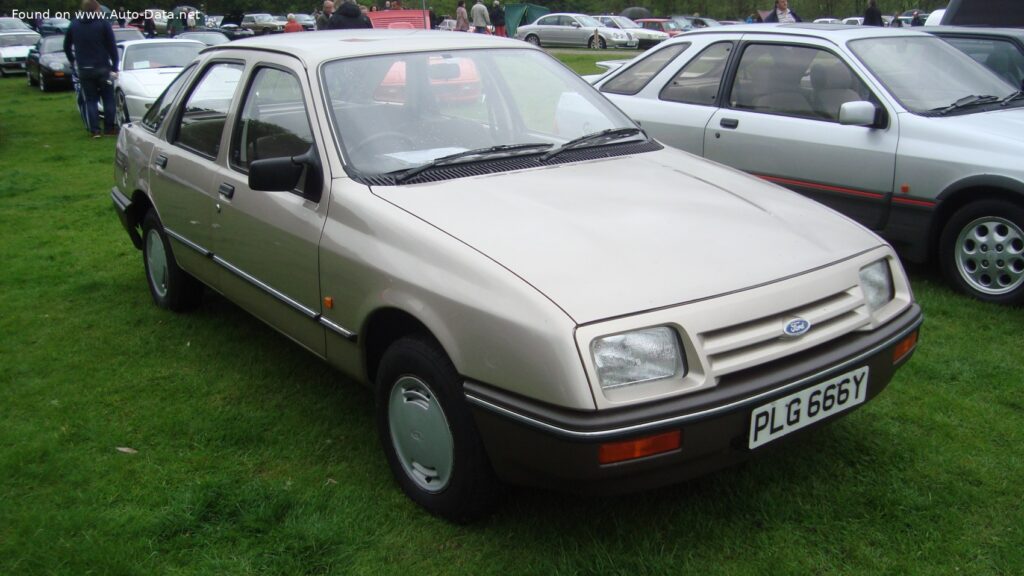
The Ford Sierra, launched in 1982, represented a significant departure for Ford of Europe, replacing the long-running and increasingly dated Cortina. Designed to compete in the mid-size family car segment, the Sierra aimed to offer a more modern and aerodynamic package than its predecessor. The Sierra Hatchback I 2.3 D, powered by a diesel engine producing 67 horsepower, was a key variant, particularly in European markets where diesel fuel was becoming increasingly popular due to economic factors and government incentives. This model offered a practical and economical option for families and fleet operators, prioritizing fuel efficiency over outright performance. While not officially sold in the United States, understanding the Sierra provides insight into Ford’s global strategy during the 1980s and the evolving demands of the automotive market.
Ford Sierra Hatchback I 2.3 D: A Detailed Overview
The Sierra marked a shift in Ford’s design philosophy, embracing a more contemporary aesthetic with a focus on aerodynamics. The hatchback body style, available with either three or five doors, provided increased practicality and cargo space compared to traditional saloon (sedan) configurations. The 2.3 D variant, while not the most powerful in the Sierra lineup, was a crucial component, catering to buyers seeking low running costs and durability. It was a workhorse, designed for everyday use and long distances.
Engine & Performance
The heart of the Sierra 2.3 D is its 2.3-liter inline-four cylinder diesel engine, designated the YTT. This engine produced 67 horsepower at 4200 rpm and 139 Nm (102.52 lb.-ft.) of torque at 2000 rpm. While the horsepower figure might seem modest by modern standards, the diesel engine’s torque characteristics provided reasonable performance for everyday driving. The engine employed precombustion chamber injection, a common diesel technology of the era, to improve combustion efficiency. The engine’s longitudinal front-engine layout and rear-wheel drive configuration were typical for European cars of this period, offering a balanced driving experience. The weight-to-power ratio of 17.3 kg/Hp and a weight-to-torque ratio of 8.3 kg/Nm reflect the engine’s focus on usability rather than outright speed. The five-speed manual transmission allowed drivers to optimize engine performance and fuel economy.
Design & Features
The Ford Sierra Hatchback I featured a distinctively angular design, a hallmark of 1980s automotive styling. The hatchback configuration offered enhanced practicality, making it easier to load and unload cargo. Interior appointments were functional and durable, reflecting the car’s intended role as a practical family vehicle. Safety features, while limited by the standards of the time, included ventilated disc brakes on the front wheels and drum brakes on the rear. Hydraulic power steering was also included, improving maneuverability. The Sierra’s interior prioritized space and usability, offering seating for five passengers. The availability of both three and five-door versions catered to different customer preferences, with the five-door model offering greater convenience for rear-seat passengers. The car’s dimensions – 4425 mm (174.21 in) in length, 1694 mm (66.69 in) in width, and 1407 mm (55.39 in) in height – positioned it squarely within the mid-size family car segment.
Technical Specifications
| Brand | Ford |
| Model | Sierra |
| Generation | Sierra Hatchback I |
| Type (Engine) | 2.3 D (67 Hp) |
| Start of production | 1982 |
| End of production | 1986 |
| Powertrain Architecture | Internal Combustion engine |
| Body type | Hatchback |
| Seats | 5 |
| Doors | 3/5 |
| Fuel Type | Diesel |
| Weight-to-power ratio | 17.3 kg/Hp |
| Weight-to-torque ratio | 8.3 kg/Nm |
| Power | 67 Hp @ 4200 rpm |
| Power per litre | 29.1 Hp/l |
| Torque | 139 Nm @ 2000 rpm (102.52 lb.-ft. @ 2000 rpm) |
| Engine layout | Front, Longitudinal |
| Engine Model/Code | YTT |
| Engine displacement | 2304 cm3 (140.6 cu. in.) |
| Number of cylinders | 4 |
| Engine configuration | Inline |
| Cylinder Bore | 94 mm (3.7 in.) |
| Piston Stroke | 83 mm (3.27 in.) |
| Number of valves per cylinder | 2 |
| Fuel injection system | Precombustion chamber injection |
| Engine aspiration | Naturally aspirated engine |
| Valvetrain | OHC |
| Engine oil capacity | 5.6 l (5.92 US qt | 4.93 UK qt) |
| Coolant | 9.5 l (10.04 US qt | 8.36 UK qt) |
| Kerb Weight | 1160 kg (2557.36 lbs.) |
| Fuel tank capacity | 60 l (15.85 US gal | 13.2 UK gal) |
| Length | 4425 mm (174.21 in.) |
| Width | 1694 mm (66.69 in.) |
| Height | 1407 mm (55.39 in.) |
| Wheelbase | 2608 mm (102.68 in.) |
| Front track | 1452 mm (57.17 in.) |
| Rear (Back) track | 1468 mm (57.8 in.) |
| Drivetrain Architecture | The Internal combustion engine (ICE) drives the rear wheels of the vehicle. |
| Drive wheel | Rear wheel drive |
| Number of gears and type of gearbox | 5 gears, manual transmission |
| Front brakes | Ventilated discs |
| Rear brakes | Drum |
| Power steering | Hydraulic Steering |
The Ford Sierra, and specifically the 2.3 D variant, played a significant role in the European automotive landscape of the 1980s. It offered a blend of practicality, fuel efficiency, and durability that appealed to a wide range of buyers. While not a performance car, the Sierra 2.3 D was a reliable and economical choice for families and businesses alike, cementing its place as a popular and important model in Ford’s history.
