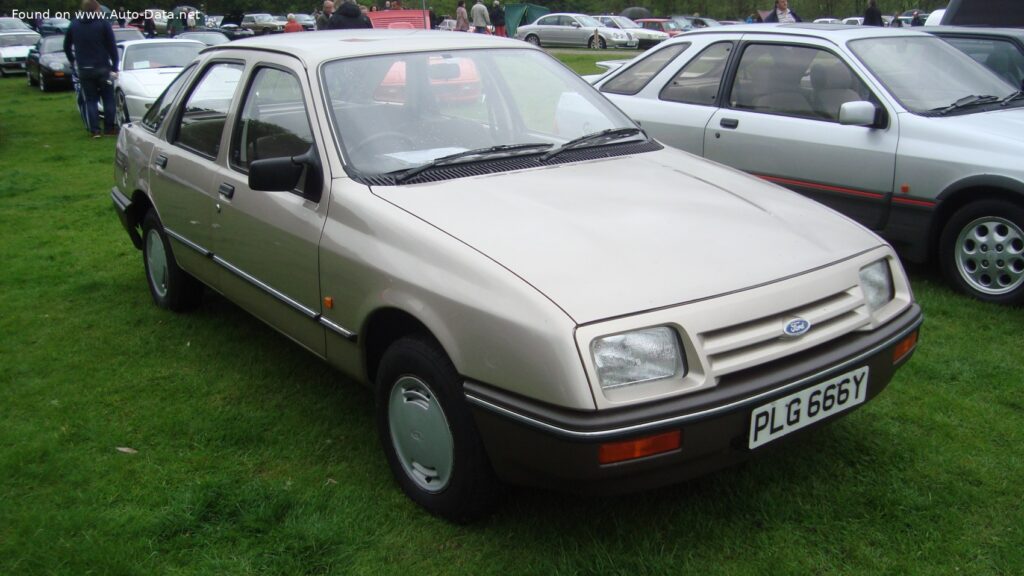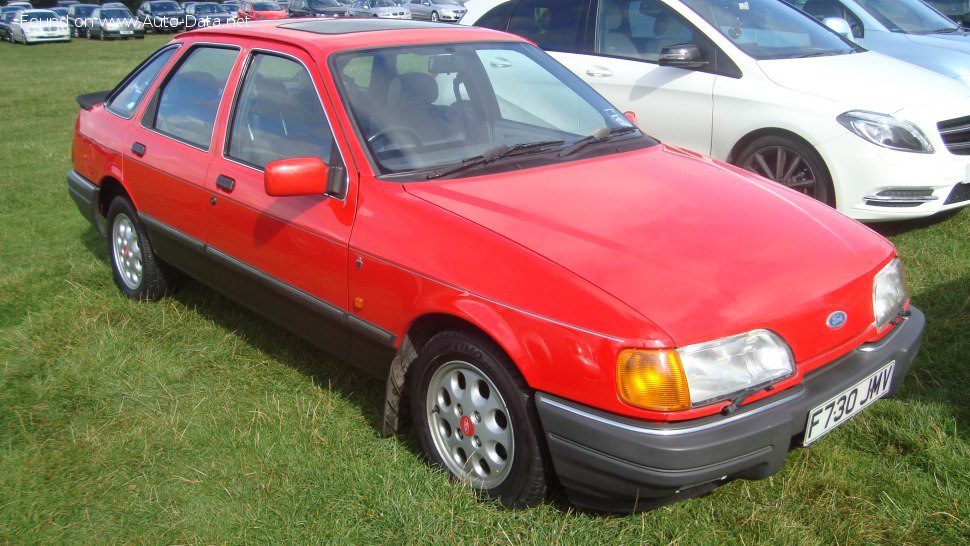
The Ford Sierra, launched in 1982, represented a significant departure for Ford of Europe, replacing the long-running and increasingly dated Cortina. The Sierra was a thoroughly modern design for its time, embracing aerodynamics and offering a more spacious interior than its predecessor. The Ford Sierra Hatchback II 2.0, produced from 1987 to 1993, was a key iteration of the model, refining the original design and offering a compelling blend of practicality, performance, and affordability. While never officially sold in the United States, the Sierra was a hugely popular vehicle in Europe, competing with models like the Opel/Vauxhall Astra and Volkswagen Jetta. It marked a shift towards more contemporary automotive design and engineering within the Ford lineup.
The Ford Sierra Hatchback II 2.0: A European Success Story
The Sierra II, introduced in 1987, featured subtle but important revisions to the original Sierra. These included updated styling, improved interior trim, and, crucially, mechanical enhancements. The 2.0-liter engine variant, producing 105 horsepower, was a popular choice, offering a good balance between fuel economy and performance for the European market. The hatchback body style, with its five doors and five-seat capacity, provided a practical and versatile option for families and individuals alike. The Sierra’s rear-wheel-drive layout was a defining characteristic, offering a different driving experience compared to the increasingly common front-wheel-drive vehicles of the era.
Engine & Performance
The heart of the Sierra Hatchback II 2.0 is its 1993cc inline-four cylinder engine. This naturally aspirated powerplant delivers 105 horsepower at 5200 rpm and 157 Nm (115.8 lb.-ft.) of torque at 3500 rpm. While these figures might seem modest by modern standards, they provided respectable performance for the late 1980s and early 1990s. The engine utilizes a carburetor fuel injection system, a common feature for the time, and an overhead camshaft (OHC) valvetrain with two valves per cylinder. The longitudinal engine layout, coupled with rear-wheel drive, contributed to the Sierra’s balanced handling characteristics. The 5-speed manual transmission allowed drivers to effectively utilize the engine’s power band. Power per liter is rated at 52.7 hp/l, indicating a reasonably efficient engine design for its era. The engine requires 3.8 liters (4.02 US quarts) of engine oil and 8 liters (8.45 US quarts) of coolant for optimal operation.
Design & Features
The Sierra Hatchback II’s design was distinctly aerodynamic, a key focus for Ford engineers. The sleek silhouette and sloping rear hatch contributed to reduced drag, improving fuel efficiency and stability at higher speeds. The five-door configuration provided easy access to both the front and rear seats, enhancing practicality. Inside, the Sierra offered a relatively spacious cabin for its size, comfortably accommodating five passengers. While not laden with luxury features, the Sierra II provided a functional and comfortable interior with durable materials. Safety features were evolving during this period, and the Sierra incorporated features such as seatbelts and a reinforced safety cell. The car’s relatively simple construction made it relatively easy and inexpensive to maintain, a significant advantage for owners. The 60-liter (15.85 US gallons) fuel tank provided a reasonable driving range. The car’s dimensions – 4425mm (174.21 in) in length, 1694mm (66.69 in) in width, and 1407mm (55.39 in) in height – positioned it squarely within the compact family car segment.
Legacy and Impact
The Ford Sierra was a pivotal model for Ford of Europe, representing a significant step forward in design, engineering, and manufacturing. Its aerodynamic styling influenced subsequent Ford models, and its spacious interior and practical hatchback configuration set a new standard for family cars. The Sierra’s rear-wheel-drive layout, while becoming less common, provided a rewarding driving experience for enthusiasts. The Sierra II, with its refined features and improved performance, solidified the model’s position as a popular choice in the European market. It paved the way for the Ford Mondeo, which ultimately replaced the Sierra in 1993, carrying forward many of its strengths and innovations.
Technical Specifications
| Brand | Ford |
| Model | Sierra |
| Generation | Sierra Hatchback II |
| Type (Engine) | 2.0 (105 Hp) |
| Start of production | 1987 |
| End of production | 1993 |
| Powertrain Architecture | Internal Combustion engine |
| Body type | Hatchback |
| Seats | 5 |
| Doors | 5 |
| Fuel Type | Petrol (Gasoline) |
| Power | 105 Hp @ 5200 rpm |
| Power per litre | 52.7 Hp/l |
| Torque | 157 Nm @ 3500 rpm |
| Torque (lb.-ft.) | 115.8 lb.-ft. @ 3500 rpm |
| Engine layout | Front, Longitudinal |
| Engine Model/Code | N8C, NES |
| Engine displacement | 1993 cm3 |
| Engine displacement (cu. in.) | 121.62 cu. in. |
| Number of cylinders | 4 |
| Engine configuration | Inline |
| Cylinder Bore | 90.8 mm |
| Cylinder Bore (in.) | 3.57 in. |
| Piston Stroke | 77 mm |
| Piston Stroke (in.) | 3.03 in. |
| Number of valves per cylinder | 2 |
| Fuel injection system | Carburettor |
| Engine aspiration | Naturally aspirated engine |
| Valvetrain | OHC |
| Engine oil capacity | 3.8 l |
| Engine oil capacity (US qt) | 4.02 US qt |
| Engine oil capacity (UK qt) | 3.34 UK qt |
| Coolant | 8 l |
| Coolant (US qt) | 8.45 US qt |
| Coolant (UK qt) | 7.04 UK qt |
| Fuel tank capacity | 60 l |
| Fuel tank capacity (US gal) | 15.85 US gal |
| Fuel tank capacity (UK gal) | 13.2 UK gal |
| Length | 4425 mm |
| Length (in.) | 174.21 in. |
| Width | 1694 mm |
| Width (in.) | 66.69 in. |
| Height | 1407 mm |
| Height (in.) | 55.39 in. |
| Wheelbase | 2608 mm |
| Wheelbase (in.) | 102.68 in. |
| Front track | 1452 mm |
| Front track (in.) | 57.17 in. |
| Rear track | 1468 mm |
| Rear track (in.) | 57.8 in. |
| Minimum turning circle | 10 m |
| Minimum turning circle (ft) | 32.81 ft. |
| Drivetrain Architecture | Rear wheel drive |
| Drive wheel | Rear wheel drive |
| Number of gears | 5 |
| Type of gearbox | Manual transmission |
| Front brakes | Ventilated discs |
| Rear brakes | Drum |