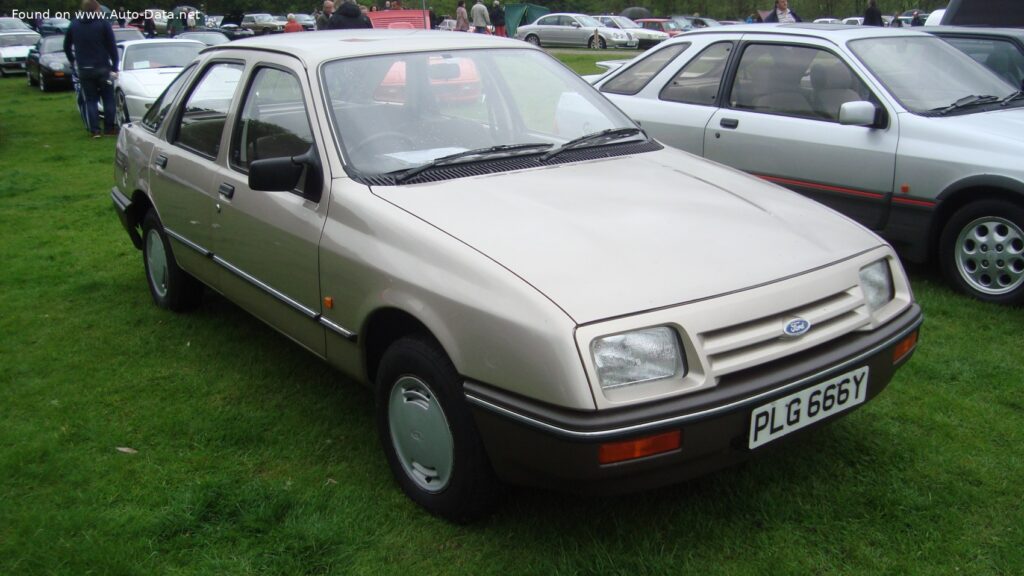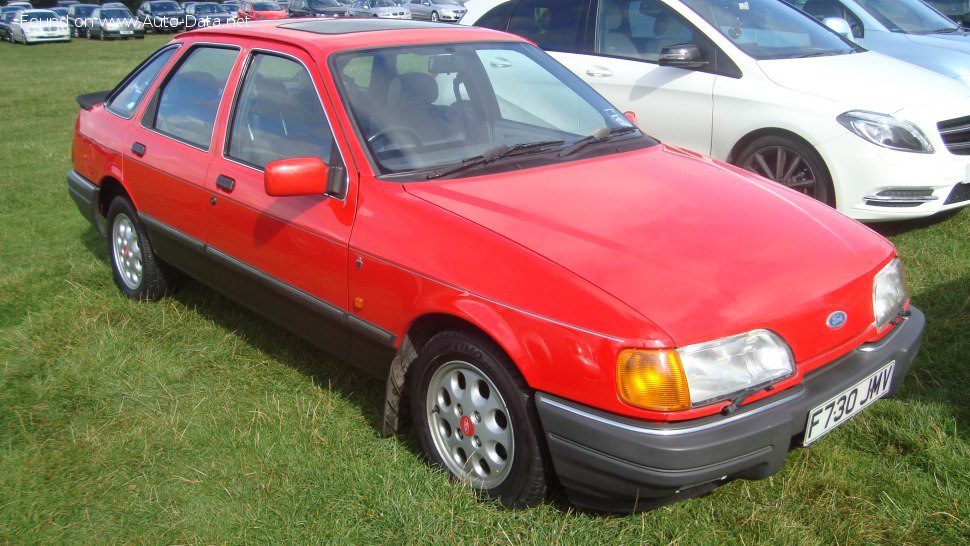
The Ford Sierra, launched in 1982, represented a significant departure for Ford of Europe, replacing the long-running and increasingly dated Cortina. The Ford Sierra Hatchback II 2.0i (101 Hp), produced from 1987 to 1993, was a key iteration of this model, offering a blend of practicality, performance, and modern styling for its time. Positioned as a mid-size family car, the Sierra aimed to compete with rivals like the Vauxhall/Opel Ascona and Volkswagen Passat, offering a more contemporary alternative to the traditionally styled British saloon.
The Ford Sierra Hatchback II: A European Success Story
While not officially sold in the United States, the Ford Sierra was a hugely important vehicle for Ford in Europe. It was designed to be a world car, and its basic platform underpinned several other models, including the Ford Scorpio. The Sierra was notable for its aerodynamic styling – a significant step forward for Ford – and its use of independent rear suspension on many models, improving handling and ride quality. The Hatchback II, specifically the 2.0i variant, offered a balance between fuel economy and performance, making it a popular choice for family buyers and company car fleets.
Engine & Performance
The Sierra 2.0i was powered by Ford’s 1993cc inline-four cylinder engine, designated as the NE5 or NEJ depending on the specific year and market. This naturally aspirated engine produced 101 horsepower at 5400 rpm and 148 Nm (109.16 lb.-ft.) of torque at 4000 rpm. While not a high-performance engine by modern standards, it provided adequate power for comfortable cruising and overtaking. The engine featured single-point fuel injection, a common technology of the era, which improved fuel efficiency compared to carbureted engines. Power per liter was rated at 50.7 hp/l. The engine’s longitudinal front-engine layout, coupled with rear-wheel drive, provided a balanced driving experience, favored by enthusiasts for its handling characteristics. The 5-speed manual transmission allowed drivers to effectively utilize the engine’s power band. Engine oil capacity was 3.75 liters (3.96 US qt / 3.3 UK qt), and it required coolant totaling 8 liters (8.45 US qt / 7.04 UK qt).
Design & Features
The Sierra Hatchback II was characterized by its distinctive, angular styling. The five-door hatchback body style offered excellent practicality, with a generous cargo area accessible through the rear tailgate. The interior was functional and reasonably well-equipped for the time, offering seating for five passengers. Safety features, while limited by the standards of the 1980s and early 1990s, included ventilated front disc brakes and disc brakes on the rear. The Sierra’s independent rear suspension, a key feature on many models, contributed to a more comfortable ride and improved handling compared to cars with a solid rear axle. The car’s dimensions – 4425 mm (174.21 in) in length, 1694 mm (66.69 in) in width, and 1407 mm (55.39 in) in height – positioned it squarely in the mid-size segment. The wheelbase measured 2608 mm (102.68 in), and the front and rear tracks were 1452 mm (57.17 in) and 1468 mm (57.8 in) respectively. The minimum turning circle was 10 meters (32.81 ft).
Technical Specifications
| Brand | Ford |
| Model | Sierra |
| Generation | Sierra Hatchback II |
| Type (Engine) | 2.0i (101 Hp) |
| Start of production | 1987 |
| End of production | 1993 |
| Powertrain Architecture | Internal Combustion engine |
| Body type | Hatchback |
| Seats | 5 |
| Doors | 5 |
| Fuel Type | Petrol (Gasoline) |
| Power | 101 Hp @ 5400 rpm |
| Power per litre | 50.7 Hp/l |
| Torque | 148 Nm @ 4000 rpm / 109.16 lb.-ft. @ 4000 rpm |
| Engine layout | Front, Longitudinal |
| Engine Model/Code | NE5, NEJ |
| Engine displacement | 1993 cm3 / 121.62 cu. in. |
| Number of cylinders | 4 |
| Engine configuration | Inline |
| Cylinder Bore | 90.8 mm / 3.57 in. |
| Piston Stroke | 77 mm / 3.03 in. |
| Number of valves per cylinder | 2 |
| Fuel injection system | Single-point injection |
| Engine aspiration | Naturally aspirated engine |
| Engine oil capacity | 3.75 l / 3.96 US qt | 3.3 UK qt |
| Coolant | 8 l / 8.45 US qt | 7.04 UK qt |
| Fuel tank capacity | 60 l / 15.85 US gal | 13.2 UK gal |
| Length | 4425 mm / 174.21 in. |
| Width | 1694 mm / 66.69 in. |
| Height | 1407 mm / 55.39 in. |
| Wheelbase | 2608 mm / 102.68 in. |
| Front track | 1452 mm / 57.17 in. |
| Rear (Back) track | 1468 mm / 57.8 in. |
| Minimum turning circle (turning diameter) | 10 m / 32.81 ft. |
| Drivetrain Architecture | The Internal combustion engine (ICE) drives the rear wheels of the vehicle. |
| Drive wheel | Rear wheel drive |
| Number of gears and type of gearbox | 5 gears, manual transmission |
| Front brakes | Ventilated discs |
| Rear brakes | Disc |
The Ford Sierra Hatchback II 2.0i, while a product of its time, represented a significant step forward for Ford in terms of design, handling, and practicality. It remains a fondly remembered car among enthusiasts, particularly for its rear-wheel-drive dynamics and relatively simple, robust engineering. Its success in Europe paved the way for the later Ford Mondeo, which continued the Sierra’s legacy as a competitive and well-rounded family car.