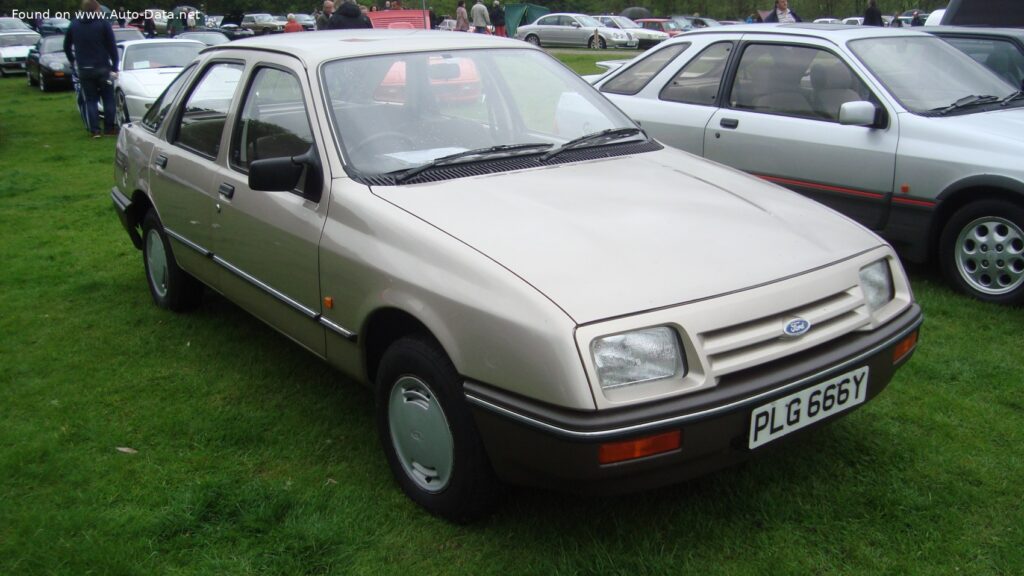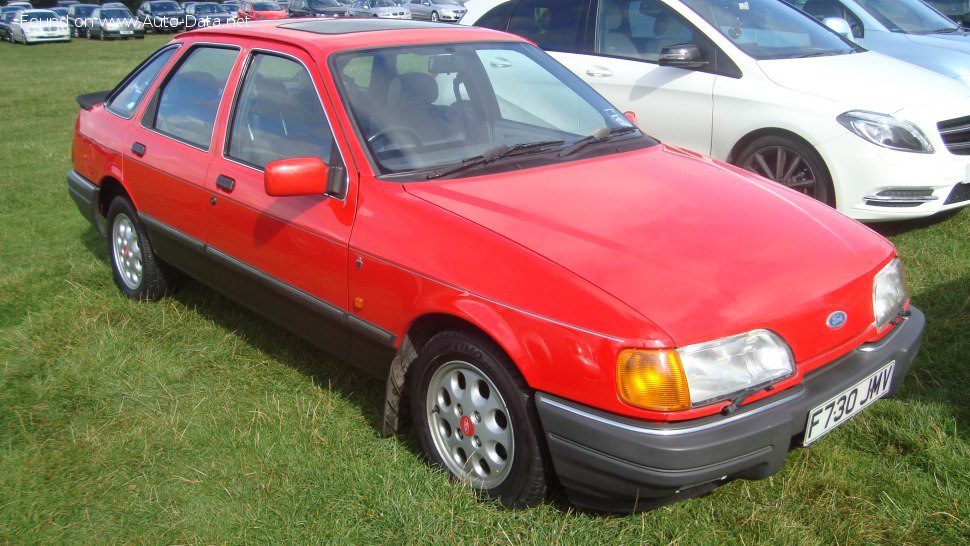
The Ford Sierra, launched in 1982, represented a significant departure for Ford of Europe, replacing the long-running and increasingly dated Cortina. The Ford Sierra Hatchback II 2.0i (120 Hp) Automatic, produced from 1989 to 1993, was a key iteration of this model, offering a blend of practicality, performance, and modern (for its time) features. While never officially sold in the United States, the Sierra was a hugely popular vehicle in Europe, competing with models like the Opel/Vauxhall Astra, Volkswagen Jetta, and Peugeot 305. It was a pivotal car for Ford, introducing a more aerodynamic design and a move towards front-wheel drive in later models, though the 2.0i retained a rear-wheel drive configuration.
The Ford Sierra Hatchback II: A European Success Story
The Sierra marked a shift in Ford’s design philosophy. The earlier Cortina had been a traditionally styled, boxy saloon. The Sierra, in contrast, boasted a more streamlined, aerodynamic shape, influenced by contemporary designs from manufacturers like Audi and BMW. This focus on aerodynamics wasn’t purely aesthetic; it aimed to improve fuel efficiency and reduce drag. The Hatchback II, specifically, built upon the initial Sierra design, refining its features and offering a more comprehensive package for European buyers. The availability of a 2.0-liter engine with automatic transmission catered to drivers seeking a comfortable and capable family car.
Engine & Performance
The heart of the Sierra 2.0i Automatic was a 1998cc (121.93 cubic inches) inline-four cylinder engine. This naturally aspirated powerplant produced 120 horsepower at 5600 rpm and 171 Newton-meters (126.12 lb.-ft.) of torque at 2500 rpm. While not a high-performance figure by modern standards, it provided adequate power for comfortable cruising and overtaking. The engine utilized multi-port fuel injection and a double overhead camshaft (DOHC) valvetrain, technologies that were becoming increasingly common in the late 1980s and early 1990s. The four-speed automatic transmission delivered smooth gear changes, enhancing the car’s usability for everyday driving. The rear-wheel drive layout, while becoming less common, provided a balanced driving experience and good handling characteristics. Power per liter was a respectable 60.1 hp/l.
Design & Features
The Sierra Hatchback II was available in both three-door and five-door configurations, offering varying levels of practicality. The hatchback body style provided a large and accessible cargo area, making it suitable for families and those needing to transport larger items. The car’s interior was functional and relatively spacious, though the design was somewhat utilitarian compared to some of its competitors. Safety features, while limited by the standards of the time, included ventilated disc brakes on the front wheels and drum brakes on the rear. Hydraulic power steering made maneuvering easier, particularly in urban environments. The Sierra’s design prioritized practicality and affordability, making it a popular choice for a wide range of buyers. The car’s relatively simple construction also meant that maintenance and repairs were generally straightforward and cost-effective.
Technical Specifications
| Brand | Ford |
| Model | Sierra |
| Generation | Sierra Hatchback II |
| Type (Engine) | 2.0i (120 Hp) Automatic |
| Start of production | 1989 |
| End of production | 1993 |
| Powertrain Architecture | Internal Combustion engine |
| Body type | Hatchback |
| Seats | 5 |
| Doors | 3/5 |
| Fuel Type | Petrol (Gasoline) |
| Power | 120 Hp @ 5600 rpm |
| Power per litre | 60.1 Hp/l |
| Torque | 171 Nm @ 2500 rpm |
| Torque (lb.-ft.) | 126.12 lb.-ft. @ 2500 rpm |
| Engine layout | Front, Longitudinal |
| Engine displacement | 1998 cm3 |
| Engine displacement (cu. in.) | 121.93 cu. in. |
| Number of cylinders | 4 |
| Engine configuration | Inline |
| Cylinder Bore | 86 mm |
| Cylinder Bore (in.) | 3.39 in. |
| Piston Stroke | 86 mm |
| Piston Stroke (in.) | 3.39 in. |
| Fuel injection system | Multi-port manifold injection |
| Engine aspiration | Naturally aspirated engine |
| Valvetrain | DOHC |
| Fuel tank capacity | 60 l |
| Fuel tank capacity (US gal) | 15.85 US gal |
| Fuel tank capacity (UK gal) | 13.2 UK gal |
| Length | 4425 mm |
| Length (in.) | 174.21 in. |
| Width | 1694 mm |
| Width (in.) | 66.69 in. |
| Height | 1407 mm |
| Height (in.) | 55.39 in. |
| Wheelbase | 2608 mm |
| Wheelbase (in.) | 102.68 in. |
| Front track | 1452 mm |
| Front track (in.) | 57.17 in. |
| Rear track | 1468 mm |
| Rear track (in.) | 57.8 in. |
| Minimum turning circle | 10 m |
| Minimum turning circle (ft.) | 32.81 ft. |
| Drivetrain Architecture | ICE drives rear wheels |
| Drive wheel | Rear wheel drive |
| Number of gears | 4 |
| Gearbox type | automatic transmission |
| Front brakes | Ventilated discs |
| Rear brakes | Drum |
| Steering type | Steering rack and pinion |
| Power steering | Hydraulic Steering |
The Ford Sierra Hatchback II 2.0i Automatic, while not a groundbreaking vehicle in terms of technological innovation, represented a solid and reliable choice for European car buyers in the late 1980s and early 1990s. Its blend of practicality, affordability, and reasonable performance ensured its success in a competitive market. It paved the way for the later, front-wheel drive Mondeo, which would ultimately replace the Sierra and become one of Ford’s best-selling models in Europe.