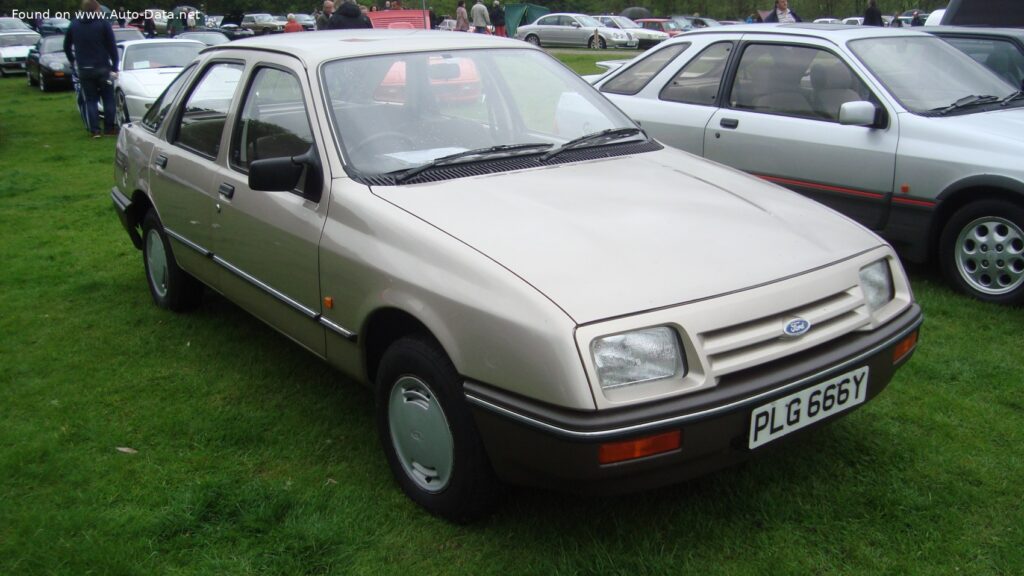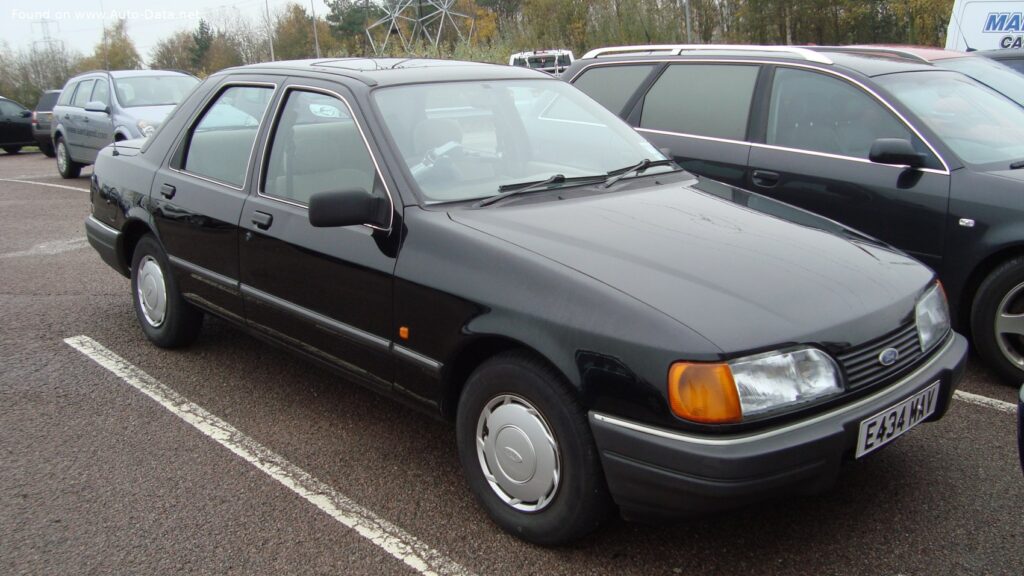
The Ford Sierra Sedan II 2.0i Automatic, produced between 1990 and 1993, represents a significant evolution in Ford of Europe’s mid-size offering. The Sierra, intended as a modern replacement for the aging Cortina and Taunus, was a departure in design and engineering for Ford. While not officially sold in the United States, the Sierra was a hugely popular vehicle in Europe, known for its aerodynamic styling and improved handling compared to its predecessors. The Sedan II variant, specifically the 2.0i model with automatic transmission, aimed to provide a comfortable and efficient driving experience for family and business users alike. It occupied the competitive mid-size sedan segment, facing rivals like the Opel/Vauxhall Vectra, Peugeot 405, and Fiat Tempra.
The Ford Sierra Sedan II: A European Success Story
The Sierra’s development was driven by a need for a more contemporary and globally competitive vehicle. Ford’s European division sought a car that would appeal to a broader range of buyers, emphasizing fuel efficiency, practicality, and a more modern aesthetic. The Sierra marked a shift towards more aerodynamic designs, a trend gaining momentum in the automotive industry during the 1980s. The Sedan II iteration brought refinements to the original Sierra, including subtle styling updates and improvements to the interior and mechanical components. The 2.0i Automatic model was positioned as a premium offering within the Sierra range, providing a balance of performance and convenience.
Engine & Performance
The heart of the Sierra Sedan II 2.0i Automatic is a 1.998-liter (121.93 cubic inches) inline-four cylinder gasoline engine. This naturally aspirated engine produces 125 horsepower at 5500 rpm and 177 Nm (130.55 lb.-ft.) of torque at 2500 rpm. The engine utilizes multi-port fuel injection and a double overhead camshaft (DOHC) valvetrain, contributing to its relatively efficient operation and respectable power output for its time. Power per liter is rated at 62.6 hp/l. The engine is longitudinally mounted at the front of the vehicle, driving the rear wheels. The four-speed automatic transmission provides smooth gear changes, making it well-suited for everyday driving. Acceleration from 0 to 100 km/h (0-62 mph) takes 9.6 seconds, while 0-60 mph is achieved in 9.1 seconds. The Sierra 2.0i Automatic has a top speed of 195 km/h (121.17 mph). The weight-to-power ratio is 9.6 kg/Hp, and the weight-to-torque ratio is 6.8 kg/Nm.
Design & Features
The Ford Sierra Sedan II is a four-door, five-seater sedan with a traditional three-box design. Its body is characterized by clean lines and a relatively low-slung profile, reflecting the aerodynamic principles employed in its design. The Sedan II received minor cosmetic updates compared to the original Sierra, primarily focused on the front and rear fascias. Inside, the Sierra offered a functional and reasonably spacious cabin. The 2.0i Automatic trim level typically included features such as cloth upholstery, power steering, and an upgraded sound system. Safety features for the era included ventilated disc brakes on the front wheels and disc brakes on the rear, along with an available Anti-lock Braking System (ABS). The trunk (boot) offers 415 liters (14.66 cubic feet) of storage space. The Sierra’s design prioritized practicality and affordability, making it a popular choice for families and commuters.
Technical Specifications
| Brand | Ford |
| Model | Sierra |
| Generation | Sierra Sedan II |
| Type (Engine) | 2.0i (125 Hp) Automatic |
| Start of production | 1990 |
| End of production | 1993 |
| Powertrain Architecture | Internal Combustion engine |
| Body type | Sedan |
| Seats | 5 |
| Doors | 4 |
| Fuel consumption (combined) | 8.4 l/100 km |
| Fuel consumption (US mpg) | 28 US mpg |
| Fuel consumption (UK mpg) | 33.6 UK mpg |
| Fuel consumption (km/l) | 11.9 km/l |
| Fuel Type | Petrol (Gasoline) |
| Acceleration 0 – 100 km/h | 9.6 sec |
| Acceleration 0 – 62 mph | 9.6 sec |
| Acceleration 0 – 60 mph | 9.1 sec |
| Maximum speed | 195 km/h (121.17 mph) |
| Weight-to-power ratio | 9.6 kg/Hp |
| Weight-to-torque ratio | 6.8 kg/Nm |
| Power | 125 Hp @ 5500 rpm |
| Power per litre | 62.6 Hp/l |
| Torque | 177 Nm @ 2500 rpm (130.55 lb.-ft. @ 2500 rpm) |
| Engine layout | Front, Longitudinal |
| Engine Model/Code | N9C |
| Engine displacement | 1998 cm3 (121.93 cu. in.) |
| Number of cylinders | 4 |
| Engine configuration | Inline |
| Cylinder Bore | 86 mm (3.39 in.) |
| Piston Stroke | 86 mm (3.39 in.) |
| Number of valves per cylinder | 2 |
| Fuel injection system | Multi-port manifold injection |
| Engine aspiration | Naturally aspirated engine |
| Valvetrain | DOHC |
| Engine oil capacity | 4.5 l (4.76 US qt | 3.96 UK qt) |
| Coolant | 7.3 l (7.71 US qt | 6.42 UK qt) |
| Kerb Weight | 1200 kg (2645.55 lbs.) |
| Trunk (boot) space – minimum | 415 l (14.66 cu. ft.) |
| Fuel tank capacity | 60 l (15.85 US gal | 13.2 UK gal) |
| Length | 4467 mm (175.87 in.) |
| Width | 1698 mm (66.85 in.) |
| Height | 1407 mm (55.39 in.) |
| Wheelbase | 2608 mm (102.68 in.) |
| Front track | 1452 mm (57.17 in.) |
| Rear (Back) track | 1468 mm (57.8 in.) |
| Minimum turning circle (turning diameter) | 10 m (32.81 ft.) |
| Drivetrain Architecture | Rear wheel drive |
| Drive wheel | Rear wheel drive |
| Number of gears and type of gearbox | 4 gears, automatic transmission |
| Front brakes | Ventilated discs |
| Rear brakes | Disc |
| Assisting systems | ABS (Anti-lock braking system) |
| Steering type | Steering rack and pinion |
| Power steering | Hydraulic Steering |
| Tires size | 185/60 R14 |
| Wheel rims size | 14 |
The Ford Sierra Sedan II 2.0i Automatic, while never officially available in the US market, remains a significant vehicle in the history of Ford of Europe. It represented a step forward in design, engineering, and overall driving experience, solidifying Ford’s position in the competitive European mid-size sedan segment. Its blend of practicality, efficiency, and comfort made it a popular choice for a wide range of buyers during its production run.