
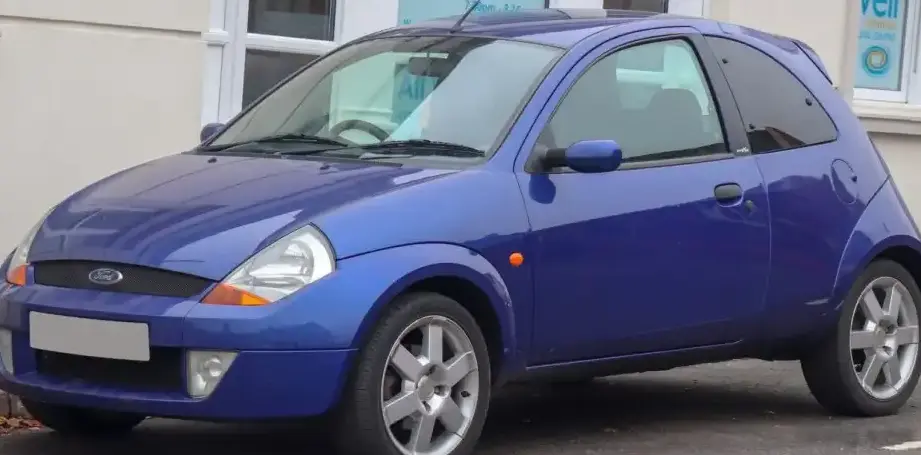
The Ford SportKa 1.6 8V, produced between 2003 and 2008, was a performance-oriented variant of the first-generation Ford Ka (model designation KB1). Positioned as the sporty flagship of the Ka range, it aimed to inject a dose of fun and style into the small city car segment. Built upon the ‘B’ platform, shared with the Fiesta, the SportKa distinguished itself with a more powerful engine, revised suspension, and distinctive cosmetic enhancements. It was primarily marketed in Europe, offering a more engaging driving experience than the standard Ka models.
Technical Specifications
| Brand | Ford |
| Model | KA |
| Generation | SportKa |
| Type (Engine) | 1.6 8V (95 Hp) |
| Start of production | 2003 |
| End of production | 2008 |
| Powertrain Architecture | Internal Combustion engine |
| Body type | Hatchback |
| Seats | 4 |
| Doors | 2 |
| Fuel consumption (urban) | 10.4 l/100 km (22.6 US mpg, 27.2 UK mpg, 9.6 km/l) |
| Fuel consumption (extra urban) | 6.0 l/100 km (39.2 US mpg, 47.1 UK mpg, 16.7 km/l) |
| Fuel consumption (combined) | 7.6 l/100 km (30.9 US mpg, 37.2 UK mpg, 13.2 km/l) |
| CO2 emissions | 182 g/km |
| Fuel Type | Petrol (Gasoline) |
| Acceleration 0 – 100 km/h | 9.7 sec |
| Acceleration 0 – 62 mph | 9.7 sec |
| Acceleration 0 – 60 mph | 9.2 sec |
| Maximum speed | 174 km/h (108.12 mph) |
| Emission standard | Euro 4 |
| Weight-to-power ratio | 10.8 kg/Hp, 92.2 Hp/tonne |
| Weight-to-torque ratio | 7.6 kg/Nm, 131.1 Nm/tonne |
| Power | 95 Hp @ 5500 rpm |
| Power per litre | 59.4 Hp/l |
| Torque | 135 Nm @ 4250 rpm (99.57 lb.-ft. @ 4250 rpm) |
| Engine layout | Front, Transverse |
| Engine displacement | 1599 cm3 (97.58 cu. in.) |
| Number of cylinders | 4 |
| Engine configuration | Inline |
| Cylinder Bore | 82.1 mm (3.23 in.) |
| Piston Stroke | 75.5 mm (2.97 in.) |
| Compression ratio | 9.5:1 |
| Number of valves per cylinder | 2 |
| Fuel injection system | Multi-port manifold injection |
| Engine aspiration | Naturally aspirated engine |
| Valvetrain | SOHC |
| Engine oil capacity | 4.35 l (4.6 US qt | 3.83 UK qt) |
| Coolant | 5.25 l (5.55 US qt | 4.62 UK qt) |
| Kerb Weight | 1030 kg (2270.76 lbs.) |
| Max. weight | 1300 kg (2866.01 lbs.) |
| Max load | 270 kg (595.25 lbs.) |
| Trunk (boot) space – minimum | 186 l (6.57 cu. ft.) |
| Trunk (boot) space – maximum | 724 l (25.57 cu. ft.) |
| Fuel tank capacity | 40 l (10.57 US gal | 8.8 UK gal) |
| Max. roof load | 75 kg (165.35 lbs.) |
| Length | 3649 mm (143.66 in.) |
| Width | 1656 mm (65.2 in.) |
| Width including mirrors | 1827 mm (71.93 in.) |
| Height | 1431 mm (56.34 in.) |
| Wheelbase | 2448 mm (96.38 in.) |
| Front track | 1417 mm (55.79 in.) |
| Rear (Back) track | 1393 mm (54.84 in.) |
| Minimum turning circle | 11.1 m (36.42 ft.) |
| Drivetrain Architecture | Front wheel drive |
| Number of gears and type of gearbox | 5 gears, manual transmission |
| Rear suspension | Torsion |
| Front brakes | Ventilated discs |
| Rear brakes | Disc |
| Assisting systems | ABS (Anti-lock braking system) |
| Steering type | Steering rack and pinion |
| Power steering | Hydraulic Steering |
| Tires size | 195/45 R16 |
| Wheel rims size | 6J x 16 |
INTRODUCTION
The Ford SportKa 1.6 8V represented a significant upgrade over the standard Ka models. Introduced in 2003, it was designed to appeal to buyers seeking a more dynamic and engaging driving experience in a compact package. The SportKa was part of the first generation Ka (KB1), which was built on Ford’s ‘B’ platform, also underpinning the Fiesta Mark V. The SportKa aimed to capitalize on the growing popularity of small, affordable performance cars, offering a blend of practicality and fun. It was discontinued in 2008 with the introduction of the second-generation Ka.
Powertrain & Engine Architecture
At the heart of the SportKa was the Duratec 1.6-liter inline-four cylinder engine. This engine, designated as the Sigma series, featured a single overhead camshaft (SOHC) and two valves per cylinder. The engine code is typically found as a variant of the Zetec-Roccam engine family. It utilized multi-port fuel injection to deliver fuel to the cylinders. The 1.6-liter engine produced 95 horsepower at 5500 rpm and 135 Nm (99.57 lb-ft) of torque at 4250 rpm. The engine’s relatively simple design contributed to its reliability and ease of maintenance. The SportKa was exclusively offered with a five-speed manual transmission, providing drivers with greater control over the engine’s power delivery. This transmission was chosen to complement the engine’s sporty character and enhance the driving experience.
Driving Characteristics
The SportKa’s driving experience was noticeably more engaging than that of the standard Ka. The 1.6-liter engine provided a significant power boost, resulting in quicker acceleration and a higher top speed. While not a sports car in the traditional sense, the SportKa offered a lively and responsive feel, particularly in urban environments. The five-speed manual transmission allowed drivers to keep the engine in its optimal power band, maximizing performance. The suspension was also revised, with stiffer springs and dampers, to reduce body roll and improve handling. The steering was direct and precise, providing good feedback to the driver. Compared to the standard Ka’s 1.3-liter engine, the SportKa’s 1.6-liter offered a substantial improvement in performance, making it more suitable for longer journeys and spirited driving. The manual transmission, while requiring more driver involvement, provided a more rewarding experience than the optional automatic transmission available on other Ka models.
Equipment & Trim Levels
The SportKa came with a relatively generous level of standard equipment for a car in its class. Key features included alloy wheels, a sports-tuned suspension, and a unique body kit consisting of side skirts and a rear spoiler. Inside, the SportKa featured sport seats with enhanced bolstering, providing better support during cornering. Air conditioning, power steering, and an AM/FM radio were also standard. Optional extras included electric windows, central locking, and a CD player. The interior trim was typically dark grey or black, with a sporty design. The dashboard layout was similar to that of the standard Ka, but with some unique styling cues to differentiate the SportKa.
Chassis & Braking
The SportKa’s chassis was based on the standard Ka’s platform, but with several modifications to enhance its handling characteristics. The suspension was revised with stiffer springs and dampers, and a thicker front stabilizer bar was added to reduce body roll. The front brakes were upgraded to ventilated discs, providing improved stopping power. The rear brakes remained solid discs. The steering system was a rack-and-pinion type with hydraulic power assistance. The SportKa’s tires were typically 195/45 R16, providing good grip and handling. These chassis and braking upgrades contributed to the SportKa’s more dynamic driving experience.
Market Reception & Comparison
The Ford SportKa was generally well-received by automotive critics, who praised its sporty handling, lively engine, and affordable price. It was seen as a fun and engaging alternative to other small city cars. However, some critics noted that the interior was somewhat basic and lacked the refinement of some competitors. Compared to other small performance cars of the time, such as the Volkswagen Polo GTI or the Renault Clio Sport, the SportKa offered a more affordable entry point into the performance car market. Its fuel economy was reasonable, averaging around 30.9 US mpg in combined driving. Reliability was generally good, although some owners reported minor issues with the engine’s cooling system.
Legacy
The Ford SportKa 1.6 8V remains a popular choice among enthusiasts looking for an affordable and fun-to-drive small car. Its simple mechanical design and readily available parts make it relatively easy to maintain. The Duratec 1.6-liter engine is known for its reliability, and the five-speed manual transmission is durable and engaging. Today, well-maintained examples of the SportKa are becoming increasingly collectible. While not a high-performance car by modern standards, the SportKa offers a unique blend of practicality, affordability, and driving enjoyment that continues to appeal to a dedicated following.
