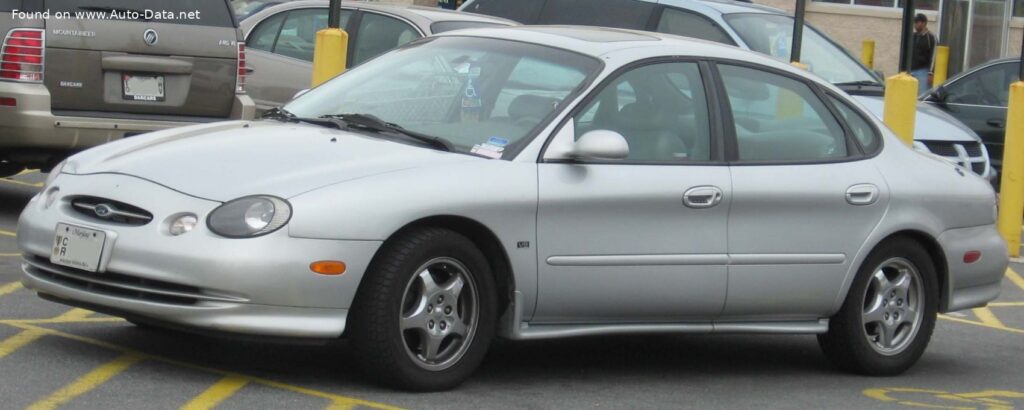
The Ford Taurus III, produced between 1995 and 1999, represented a significant evolution of Ford’s full-size sedan. Positioned as a family vehicle in the North American market, the Taurus III aimed to blend comfort, practicality, and a degree of modern styling. This generation continued the Taurus’s role as a mainstay of the Ford lineup, competing with rivals like the Chevrolet Lumina and Toyota Camry. The 3.0 V6 model, equipped with an automatic transmission, offered a balance of performance and fuel efficiency for the average driver.
Ford Taurus III 3.0 V6: An Overview
The Taurus III underwent a substantial redesign compared to its predecessor, featuring a more rounded and aerodynamic exterior. This generation focused on improving interior space and refinement, addressing criticisms of earlier models. The 3.0-liter V6 engine became a prominent powertrain option, offering a step up in performance from the base four-cylinder engine. While not a performance-oriented vehicle, the Taurus III 3.0 V6 provided adequate power for everyday driving and highway cruising.
Engine & Performance
The heart of the 1995-1999 Ford Taurus III 3.0 V6 is the Vulcan engine, a 3.0-liter (2986 cm3 or 182.22 cu. in.) naturally aspirated V6. This engine produced 145 horsepower at 5250 rpm and 230 Nm (169.64 lb.-ft.) of torque at 3250 rpm. The engine featured a single overhead camshaft (SOHC) valvetrain with two valves per cylinder and utilized multi-port fuel injection. Power delivery was smooth and predictable, making it well-suited for family transportation. The engine’s power-to-liter ratio was 48.6 hp/l.
Power was delivered to the front wheels via a four-speed automatic transmission. Acceleration from 0 to 100 km/h (0-62 mph) took approximately 10.6 seconds, while 0 to 60 mph was achieved in around 10.1 seconds. The Taurus III 3.0 V6 had a top speed of 175 km/h (108.74 mph). The weight-to-power ratio was 10.5 kg/Hp, and the weight-to-torque ratio was 6.6 kg/Nm, indicating a reasonable balance between weight and output for its class.
Design & Features
The Ford Taurus III was exclusively offered as a four-door sedan with seating for five passengers. The exterior design emphasized a softer, more rounded aesthetic compared to the boxier styling of the previous generation. The focus was on creating a visually appealing and approachable vehicle. Interior space was a key selling point, offering ample room for passengers and cargo. The trunk provided 447 liters (15.79 cu. ft.) of storage space.
Safety features for the era included an Anti-lock Braking System (ABS), which became increasingly standard on vehicles of this type. The Taurus III also featured hydraulic power steering and a steering rack and pinion system for responsive handling. Comfort and convenience features included standard air conditioning, power windows, and a basic audio system. The vehicle’s drag coefficient of 0.31 contributed to improved fuel efficiency and reduced wind noise. The minimum turning circle was 11.8 meters (38.71 ft).
Technical Specifications
| Brand | Ford |
| Model | Taurus |
| Generation | Taurus III |
| Type (Engine) | 3.0 V6 (145 Hp) Automatic |
| Start of production | 1995 |
| End of production | 1999 |
| Powertrain Architecture | Internal Combustion engine |
| Body type | Sedan |
| Seats | 5 |
| Doors | 4 |
| Fuel consumption (urban) | 13.9 l/100 km (16.9 US mpg, 20.3 UK mpg, 7.2 km/l) |
| Fuel consumption (extra urban) | 8.4 l/100 km (28 US mpg, 33.6 UK mpg, 11.9 km/l) |
| Fuel Type | Petrol (Gasoline) |
| Acceleration 0 – 100 km/h | 10.6 sec |
| Acceleration 0 – 62 mph | 10.6 sec |
| Acceleration 0 – 60 mph | 10.1 sec |
| Maximum speed | 175 km/h (108.74 mph) |
| Weight-to-power ratio | 10.5 kg/Hp |
| Weight-to-torque ratio | 6.6 kg/Nm |
| Power | 145 Hp @ 5250 rpm |
| Torque | 230 Nm @ 3250 rpm (169.64 lb.-ft. @ 3250 rpm) |
| Engine layout | Front, Transverse |
| Engine Model/Code | Vulcan |
| Engine displacement | 2986 cm3 (182.22 cu. in.) |
| Number of cylinders | 6 |
| Engine configuration | V-engine |
| Cylinder Bore | 89 mm (3.5 in.) |
| Piston Stroke | 80 mm (3.15 in.) |
| Compression ratio | 9.2:1 |
| Number of valves per cylinder | 2 |
| Fuel injection system | Multi-port manifold injection |
| Engine aspiration | Naturally aspirated engine |
| Valvetrain | SOHC |
| Engine oil capacity | 4.25 l (4.49 US qt | 3.74 UK qt) |
| Coolant capacity | 11 l (11.62 US qt | 9.68 UK qt) |
| Kerb Weight | 1518 kg (3346.62 lbs.) |
| Trunk (boot) space | 447 l (15.79 cu. ft.) |
| Fuel tank capacity | 61 l (16.11 US gal | 13.42 UK gal) |
| Length | 5016 mm (197.48 in.) |
| Width | 1854 mm (72.99 in.) |
| Height | 1400 mm (55.12 in.) |
| Wheelbase | 2756 mm (108.5 in.) |
| Front track | 1565 mm (61.61 in.) |
| Rear track | 1560 mm (61.42 in.) |
| Drag coefficient (Cd) | 0.31 |
| Minimum turning circle | 11.8 m (38.71 ft.) |
| Drivetrain Architecture | Front wheel drive |
| Number of gears | 4 |
| Gearbox type | Automatic transmission |
| Front suspension | Wishbone |
| Rear suspension | Wishbone |
| Front brakes | Ventilated discs |
| Rear brakes | Drum |
| Assisting systems | ABS (Anti-lock braking system) |
| Steering type | Steering rack and pinion |
| Power steering | Hydraulic Steering |
| Tires size | 205/65 R15 |
| Wheel rims size | 15 |
The Ford Taurus III 3.0 V6, while not a groundbreaking vehicle, represented a solid and reliable option for families seeking a comfortable and spacious sedan. Its blend of practicality, reasonable performance, and improving safety features made it a popular choice in the North American market during its production run.