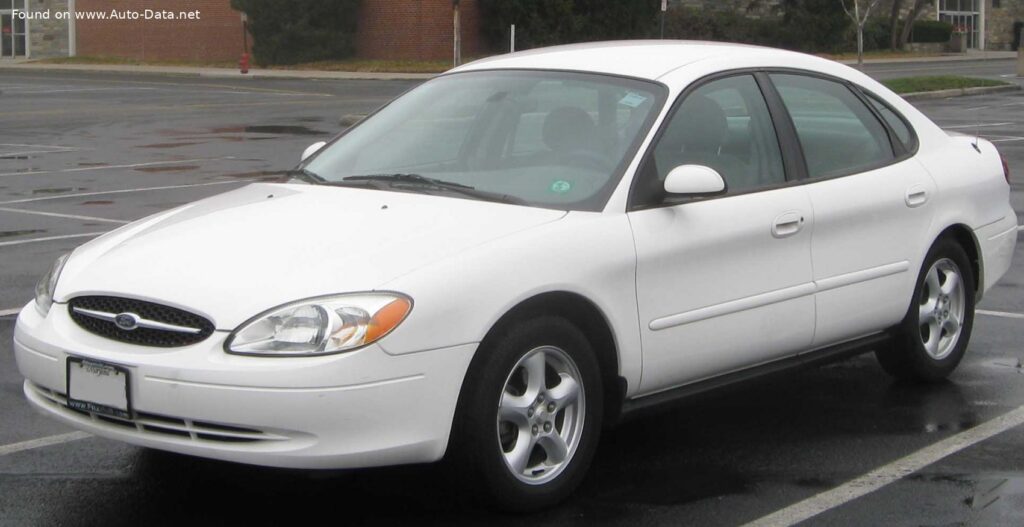
The Ford Taurus IV 3.0 V6 24V (200 Hp) Automatic represents a significant chapter in the history of Ford’s long-standing mid-size sedan, a vehicle that became an American household name. Introduced for the 2000 model year, the fourth generation Taurus aimed to refine the design and engineering elements of its predecessors, shedding some of the more polarizing styling cues of the third generation while maintaining its core appeal as a spacious, comfortable, and value-oriented family sedan. Produced from 2000 to 2003, this particular variant, equipped with the robust Duratec 30 V6 engine and an automatic transmission, was a cornerstone of Ford’s lineup, offering a blend of performance, practicality, and affordability to a broad segment of the North American market.
The Ford Taurus IV: A Refined Evolution in the American Sedan Market
The fourth-generation Ford Taurus, known internally as the “DN107” platform, arrived at a pivotal time for Ford and the automotive industry. Following the distinct, “oval-themed” design language of the third generation, which received mixed reviews, Ford opted for a more conservative yet contemporary aesthetic for the Taurus IV. This generation sought to recapture some of the mainstream appeal that had defined the first and second generations, focusing on practicality, interior space, and a more conventional silhouette that resonated with a wider audience. The Ford Taurus IV 3.0 V6 24V (200 Hp) Automatic was positioned as a sensible choice for families and individuals seeking a dependable, full-sized sedan with ample power for highway cruising and daily commutes. Its role in the market was clear: to provide a competitive offering against rivals from General Motors, Chrysler, and a growing influx of Japanese sedans, emphasizing comfort and value.
While the exterior design became more conventional, the Taurus IV retained its commitment to interior comfort and user-friendliness. The cabin was designed to be spacious and accommodating for five occupants, making it a staple for road trips and family duties. Ford continued to equip the Taurus with features that were expected in its class, including air conditioning, power windows and locks, and a capable audio system, often available with premium upgrades. The focus on practicality was evident in its generous trunk space and thoughtful storage solutions, reinforcing its identity as a workhorse of the American automotive landscape.
Engine & Performance
At the heart of this particular Ford Taurus IV was the acclaimed Duratec 30 V6 engine, a 3.0-liter, 24-valve, dual overhead camshaft (DOHC) gasoline unit. This naturally aspirated engine was a significant contributor to the vehicle’s appeal, known for its smooth operation and respectable power delivery. It produced a healthy 200 horsepower at 5650 rpm and 199.88 lb.-ft. (271 Nm) of torque at 4400 rpm. These figures provided ample motivation for the sedan, ensuring confident acceleration for merging onto highways and comfortable cruising speeds without feeling strained. The engine’s multi-port manifold injection system ensured efficient fuel delivery, contributing to its reliability and responsiveness.
The Duratec 30 V6 was transversely mounted in the front of the vehicle, driving the front wheels through a 4-speed automatic transmission. This drivetrain architecture was standard for many mid-size sedans of the era, offering a good balance of packaging efficiency, traction in adverse weather, and straightforward operation. The automatic transmission was designed for smooth shifts, prioritizing passenger comfort over aggressive performance, which aligned perfectly with the Taurus’s family-oriented mission. With a curb weight of 3373.07 lbs. (1530 kg), the Taurus IV 3.0 V6 boasted a weight-to-power ratio of 7.7 kg/Hp, or 130.7 Hp/tonne, and a weight-to-torque ratio of 5.6 kg/Nm, or 177.1 Nm/tonne. These metrics indicated a solid, if not sporty, performance profile, perfectly adequate for the demands of everyday driving in the early 2000s American market. The engine oil capacity was 5.2 liters (5.49 US qt), and the cooling system held 10 liters (10.57 US qt) of coolant, emphasizing its robust design for longevity.
Design & Features
The design of the Ford Taurus IV represented a stylistic departure from its predecessor, opting for a more conventional and less polarizing aesthetic. As a four-door sedan with seating for five, its dimensions were generous, measuring 197.6 inches (5019 mm) in length, 72.99 inches (1854 mm) in width, and 56.1 inches (1425 mm) in height. The wheelbase of 108.5 inches (2756 mm) contributed to a stable ride and a spacious cabin, a key selling point for the Taurus throughout its generations. The front and rear tracks, at 61.65 inches (1566 mm) and 62.09 inches (1577 mm) respectively, provided a wide stance that aided in handling stability.
From an aerodynamic perspective, the Taurus IV achieved a respectable drag coefficient (Cd) of 0.3, which was competitive for its class at the time and contributed to fuel efficiency and reduced wind noise at highway speeds. The vehicle’s practical nature was further highlighted by its trunk space, offering a minimum of 16.99 cubic feet (481 liters) of cargo capacity, making it suitable for family vacations or grocery runs. A fuel tank capacity of 17.96 US gallons (68 liters) provided a good cruising range, reducing the frequency of fuel stops.
In terms of chassis and safety, the Taurus IV was equipped with a suspension system featuring wishbones at both the front and rear. This setup aimed to provide a comfortable ride quality while maintaining predictable handling characteristics. Braking duties were handled by ventilated discs at the front and disc brakes at the rear, complemented by an Anti-lock Braking System (ABS) as a standard or widely available assisting system, enhancing stopping power and control in emergency situations. The steering system was a hydraulic rack and pinion setup, offering direct feedback and ease of maneuverability, with a minimum turning circle diameter of 39.7 feet (12.1 meters). The vehicle rode on 215/60 R16 tires mounted on 16-inch wheel rims, a common specification for mid-size sedans of its era, balancing ride comfort with adequate grip.
Technical Specifications
| Brand | Ford |
| Model | Taurus |
| Generation | Taurus IV |
| Type (Engine) | 3.0 V6 24V (200 Hp) Automatic |
| Start of production | 2000 year |
| End of production | 2003 year |
| Powertrain Architecture | Internal Combustion engine |
| Body type | Sedan |
| Seats | 5 |
| Doors | 4 |
| Fuel Type | Petrol (Gasoline) |
| Weight-to-power ratio | 7.7 kg/Hp, 130.7 Hp/tonne |
| Weight-to-torque ratio | 5.6 kg/Nm, 177.1 Nm/tonne |
| Power | 200 Hp @ 5650 rpm. |
| Power per liter | 67.4 Hp/l |
| Torque | 271 Nm @ 4400 rpm (199.88 lb.-ft. @ 4400 rpm) |
| Engine layout | Front, Transverse |
| Engine Model/Code | Duratec 30 |
| Engine displacement | 2967 cm3 (3.0 liters / 181.06 cu. in.) |
| Number of cylinders | 6 |
| Engine configuration | V-engine |
| Cylinder Bore | 89 mm (3.5 in.) |
| Piston Stroke | 79.5 mm (3.13 in.) |
| Compression ratio | 10:1 |
| Number of valves per cylinder | 4 |
| Fuel injection system | Multi-port manifold injection |
| Engine aspiration | Naturally aspirated engine |
| Valvetrain | DOHC |
| Engine oil capacity | 5.2 l (5.49 US qt) |
| Coolant | 10 l (10.57 US qt) |
| Kerb Weight | 1530 kg (3373.07 lbs.) |
| Trunk (boot) space – minimum | 481 l (16.99 cu. ft.) |
| Fuel tank capacity | 68 l (17.96 US gal) |
| Length | 5019 mm (197.6 in.) |
| Width | 1854 mm (72.99 in.) |
| Height | 1425 mm (56.1 in.) |
| Wheelbase | 2756 mm (108.5 in.) |
| Front track | 1566 mm (61.65 in.) |
| Rear (Back) track | 1577 mm (62.09 in.) |
| Drag coefficient (Cd) | 0.3 |
| Minimum turning circle (turning diameter) | 12.1 m (39.7 ft.) |
| Drivetrain Architecture | The Internal combustion engine (ICE) drives the front wheels of the vehicle. |
| Drive wheel | Front wheel drive |
| Number of gears and type of gearbox | 4 gears, automatic transmission |
| Front suspension | Wishbone |
| Rear suspension | Wishbone |
| Front brakes | Ventilated discs |
| Rear brakes | Disc |
| Assisting systems | ABS (Anti-lock braking system) |
| Steering type | Steering rack and pinion |
| Power steering | Hydraulic Steering |
| Tires size | 215/60 R16 |
| Wheel rims size | 16 |