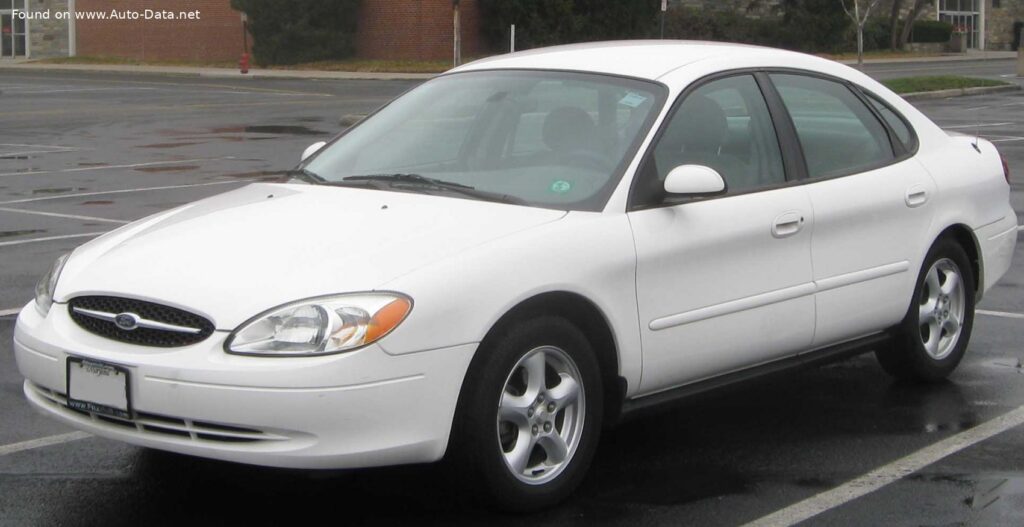
The Ford Taurus IV, produced between 2003 and 2007, represented the fourth generation of Ford’s full-size sedan. Positioned as a family vehicle in the North American market, the Taurus IV aimed to provide a comfortable and spacious interior alongside a reasonably efficient powertrain. This generation saw a continuation of the Taurus’s role as a mainstream sedan, competing with vehicles like the Toyota Camry, Honda Accord, and Chevrolet Impala. While not a performance-oriented vehicle, the Taurus IV offered a balance of practicality, affordability, and a relatively modern feature set for its time. The 3.0 V6 model, detailed here, was a popular configuration, offering a good compromise between power and fuel economy.
Ford Taurus IV 3.0 V6: An Overview
The Taurus IV underwent a significant redesign compared to its predecessor, featuring a more contemporary exterior and interior. Ford focused on improving build quality and refinement to enhance the overall driving experience. The 3.0-liter V6 engine became a mainstay of the lineup, providing adequate power for everyday driving needs. The fourth-generation Taurus continued Ford’s tradition of offering a large, comfortable sedan for American families, though it would ultimately be discontinued in 2007 as Ford shifted its focus towards crossover SUVs and other vehicle segments.
Engine & Performance
The heart of the Ford Taurus IV 3.0 V6 is the Duratec 30 engine, a 2.967-liter (181.06 cubic inches) naturally aspirated V6. This engine produces 201 horsepower at 5500 rpm and 271 Nm (199.88 lb.-ft.) of torque at 4400 rpm. The engine utilizes a multi-port fuel injection system and a double overhead camshaft (DOHC) valvetrain with four valves per cylinder. This configuration allows for a good balance of power and efficiency. Power is delivered to the front wheels via a four-speed automatic transmission. The weight-to-power ratio of 7.5 kg/Hp and a weight-to-torque ratio of 5.5 kg/Nm indicate a reasonably efficient powertrain for a vehicle of its size. The engine’s 67.7 horsepower per liter demonstrates a respectable level of specific output for a non-turbocharged engine of that era.
Design & Features
The Ford Taurus IV is a traditional four-door sedan with a five-seat configuration. Its exterior design featured a more rounded and aerodynamic profile compared to earlier Taurus models. The interior prioritized comfort and space, offering ample legroom for both front and rear passengers. Standard features typically included air conditioning, power windows and locks, and an AM/FM stereo. Safety features, increasingly important in the early 2000s, included an Anti-lock Braking System (ABS). The trunk offered a generous 481 liters (16.99 cubic feet) of cargo space, making it suitable for family road trips and everyday use. The vehicle’s dimensions – 5019 mm (197.6 in) in length, 1854 mm (72.99 in) in width, and 1425 mm (56.1 in) in height – reflect its full-size sedan classification. A drag coefficient of 0.3 contributed to reasonable aerodynamic efficiency.
Technical Specifications
| Brand | Ford |
| Model | Taurus |
| Generation | Taurus IV |
| Type (Engine) | 3.0 V6 24V (201 Hp) Automatic |
| Start of production | 2003 |
| End of production | 2007 |
| Powertrain Architecture | Internal Combustion engine |
| Body type | Sedan |
| Seats | 5 |
| Doors | 4 |
| Fuel Type | Petrol (Gasoline) |
| Weight-to-power ratio | 7.5 kg/Hp |
| Weight-to-torque ratio | 5.5 kg/Nm |
| Power | 201 Hp @ 5500 rpm |
| Power per litre | 67.7 Hp/l |
| Torque | 271 Nm @ 4400 rpm |
| Torque (lb.-ft.) | 199.88 lb.-ft. @ 4400 rpm |
| Engine layout | Front, Transverse |
| Engine Model/Code | Duratec 30 |
| Engine displacement | 2967 cm3 |
| Engine displacement (cu. in.) | 181.06 cu. in. |
| Number of cylinders | 6 |
| Engine configuration | V-engine |
| Cylinder Bore | 89 mm |
| Cylinder Bore (in.) | 3.5 in. |
| Piston Stroke | 79.5 mm |
| Piston Stroke (in.) | 3.13 in. |
| Compression ratio | 10:1 |
| Number of valves per cylinder | 4 |
| Fuel injection system | Multi-port manifold injection |
| Engine aspiration | Naturally aspirated engine |
| Valvetrain | DOHC |
| Engine oil capacity | 5.2 l |
| Engine oil capacity (US qt) | 5.49 US qt |
| Engine oil capacity (UK qt) | 4.58 UK qt |
| Coolant | 10 l |
| Coolant (US qt) | 10.57 US qt |
| Coolant (UK qt) | 8.8 UK qt |
| Kerb Weight | 1503 kg |
| Kerb Weight (lbs.) | 3313.55 lbs. |
| Trunk (boot) space – minimum | 481 l |
| Trunk (boot) space – minimum (cu. ft.) | 16.99 cu. ft. |
| Fuel tank capacity | 68 l |
| Fuel tank capacity (US gal) | 17.96 US gal |
| Fuel tank capacity (UK gal) | 14.96 UK gal |
| Length | 5019 mm |
| Length (in.) | 197.6 in. |
| Width | 1854 mm |
| Width (in.) | 72.99 in. |
| Height | 1425 mm |
| Height (in.) | 56.1 in. |
| Wheelbase | 2756 mm |
| Wheelbase (in.) | 108.5 in. |
| Front track | 1566 mm |
| Front track (in.) | 61.65 in. |
| Rear (Back) track | 1577 mm |
| Rear (Back) track (in.) | 62.09 in. |
| Drag coefficient (Cd) | 0.3 |
| Minimum turning circle (turning diameter) | 12.1 m |
| Minimum turning circle (turning diameter) (ft.) | 39.7 ft. |
| Drivetrain Architecture | Front wheel drive |
| Number of gears and type of gearbox | 4 gears, automatic transmission |
| Front suspension | Wishbone |
| Rear suspension | Wishbone |
| Front brakes | Ventilated discs |
| Rear brakes | Disc |
| Assisting systems | ABS (Anti-lock braking system) |
| Steering type | Steering rack and pinion |
| Power steering | Hydraulic Steering |
| Tires size | 215/60 R16 |
| Wheel rims size | 16 |
The Ford Taurus IV 3.0 V6, while not a groundbreaking vehicle, served as a reliable and comfortable family sedan during its production run. It represented a refinement of the Taurus formula, offering a blend of practicality, affordability, and a reasonably modern feature set. Its discontinuation in 2007 marked a shift in Ford’s product strategy, as the company increasingly focused on crossover SUVs and other vehicle segments.