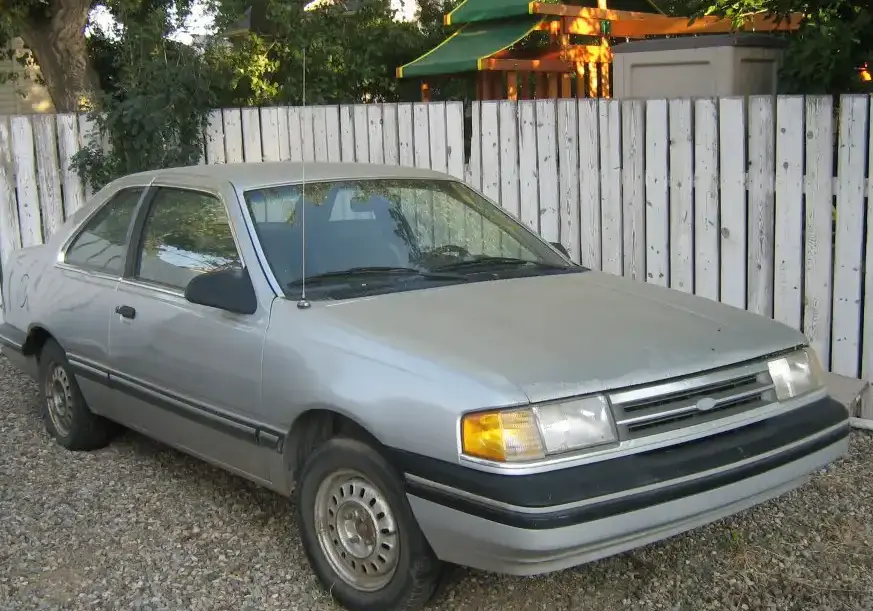
The Ford Tempo 2.3 AWD, produced from 1989 to 1995, represented a significant offering in Ford’s compact car lineup. Positioned as a more practical and all-weather capable variant of the standard Tempo, the 2.3 AWD aimed to appeal to buyers in regions experiencing inclement weather or desiring added stability. It was part of the first generation Tempo (1988-1994), a car designed to replace the aging Ford Topaz and provide a more modern, fuel-efficient alternative in the crowded compact segment. The addition of all-wheel drive was relatively uncommon for this class of vehicle at the time, setting it apart from many competitors.
Technical Specifications
| Brand | Ford |
| Model | Tempo |
| Generation | Tempo |
| Type (Engine) | 2.3 AWD (102 Hp) |
| Start of production | 1989 year |
| End of production | 1995 year |
| Powertrain Architecture | Internal Combustion engine |
| Body type | Sedan |
| Seats | 5 |
| Doors | 4 |
| Fuel consumption (economy) – urban | 11 l/100 km (21.4 US mpg, 25.7 UK mpg, 9.1 km/l) |
| Fuel consumption (economy) – extra urban | 7 l/100 km (33.6 US mpg, 40.4 UK mpg, 14.3 km/l) |
| Fuel Type | Petrol (Gasoline) |
| Maximum speed | 160 km/h (99.42 mph) |
| Weight-to-power ratio | 12.5 kg/Hp, 80 Hp/tonne |
| Weight-to-torque ratio | 7.2 kg/Nm, 138 Nm/tonne |
| Power | 102 Hp @ 4400 rpm |
| Power per litre | 44.2 Hp/l |
| Torque | 176 Nm @ 2600 rpm (129.81 lb.-ft. @ 2600 rpm) |
| Engine layout | Front, Transverse |
| Engine displacement | 2307 cm3 (140.78 cu. in.) |
| Number of cylinders | 4 |
| Engine configuration | Inline |
| Cylinder Bore | 93.5 mm (3.68 in.) |
| Piston Stroke | 84 mm (3.31 in.) |
| Compression ratio | 9:1 |
| Number of valves per cylinder | 2 |
| Fuel injection system | Multi-port manifold injection |
| Engine aspiration | Naturally aspirated engine |
| Valvetrain | OHC |
| Engine oil capacity | 4.7 l (4.97 US qt | 4.14 UK qt) |
| Coolant | 7.5 l (7.93 US qt | 6.6 UK qt) |
| Kerb Weight | 1275 kg (2810.89 lbs.) |
| Trunk (boot) space – minimum | 365 l (12.89 cu. ft.) |
| Fuel tank capacity | 54 l (14.27 US gal | 11.88 UK gal) |
| Length | 4490 mm (176.77 in.) |
| Width | 1735 mm (68.31 in.) |
| Height | 1340 mm (52.76 in.) |
| Wheelbase | 2540 mm (100 in.) |
| Front track | 1395 mm (54.92 in.) |
| Rear (Back) track | 1460 mm (57.48 in.) |
| Drive wheel | All wheel drive (4×4) |
| Number of gears and type of gearbox | 5 gears, manual transmission |
| Front suspension | Coil spring |
| Rear suspension | Coil spring |
| Front brakes | Ventilated discs |
| Rear brakes | Drum |
| Assisting systems | ABS (Anti-lock braking system) |
| Steering type | Steering rack and pinion |
| Power steering | Hydraulic Steering |
| Tires size | 185/70 R14 |
Powertrain & Engine Architecture
The heart of the Tempo 2.3 AWD was the 2.3-liter inline-four cylinder engine. This engine, part of Ford’s “Duratec” family (though early iterations predate the official Duratec branding), featured a cast iron block and an aluminum cylinder head. It utilized a multi-port fuel injection system, providing a reasonable balance of power and fuel efficiency for its time. The engine produced 102 horsepower at 4400 rpm and 176 Nm (129.81 lb-ft) of torque at 2600 rpm. The engine’s overhead camshaft (OHC) design contributed to its relatively compact size. The 2.3L engine was paired with a 5-speed manual transmission in the AWD models. The all-wheel drive system itself was a viscous coupling system, automatically distributing torque between the front and rear axles as needed, providing enhanced traction without requiring driver intervention.
Driving Characteristics
The 2.3 AWD Tempo offered a noticeable improvement in handling and stability compared to the front-wheel drive versions, particularly on slippery surfaces. While not a performance car by any means, the 102 horsepower engine provided adequate power for everyday driving. Acceleration was modest, and the 5-speed manual transmission allowed drivers to keep the engine in its optimal power band. The gear ratios were fairly widely spaced, prioritizing fuel economy over outright performance. The all-wheel drive system added weight, which slightly impacted acceleration and fuel economy compared to the FWD models. The ride quality was generally comfortable, typical of a compact sedan of the era.
Equipment & Trim Levels
The Tempo 2.3 AWD was generally positioned as a mid-range trim level. Standard equipment typically included features like air conditioning, a basic AM/FM radio, cloth upholstery, and power steering. Optional extras included upgraded sound systems, power windows and locks, and a sunroof. Interior appointments were functional and durable, rather than luxurious. The dashboard layout was straightforward and easy to use, with clearly marked controls. The AWD models often received slightly upgraded interior trim compared to the base models, but remained focused on practicality.
Chassis & Braking
The Tempo 2.3 AWD utilized a relatively simple chassis design, featuring coil spring suspension at all four corners. The front suspension employed MacPherson struts, while the rear suspension used a twist-beam setup. The AWD system necessitated modifications to the rear suspension to accommodate the rear differential. Braking duties were handled by ventilated discs at the front and drum brakes at the rear. An anti-lock braking system (ABS) was available as an option, enhancing safety. The steering system was a rack-and-pinion setup, providing responsive steering feel.
Market Reception & Comparison
The Ford Tempo 2.3 AWD received mixed reviews from automotive critics. While the all-wheel drive system was praised for its added capability, some reviewers found the engine to be underpowered, especially when coupled with the added weight of the AWD system. Fuel economy was also a point of concern, as the AWD system reduced mileage compared to the FWD models. Compared to other trims in the Tempo lineup, the 2.3 AWD offered a more secure driving experience in adverse conditions, but at the expense of performance and fuel efficiency. The 1.9L base engine Tempo offered better fuel economy, while the higher-trim models with optional equipment focused on comfort and convenience.
Legacy
The Ford Tempo 2.3 AWD, while not a groundbreaking vehicle, played a role in popularizing all-wheel drive in the compact car segment. The 2.3L engine proved to be reasonably reliable, although routine maintenance was essential to prevent issues. Today, the Tempo 2.3 AWD is a relatively uncommon sight on the road, and well-maintained examples are becoming increasingly sought after by collectors and enthusiasts. The powertrain, while dated by modern standards, is known for its durability and relative simplicity, making it a viable option for those seeking a classic, all-weather capable compact car.