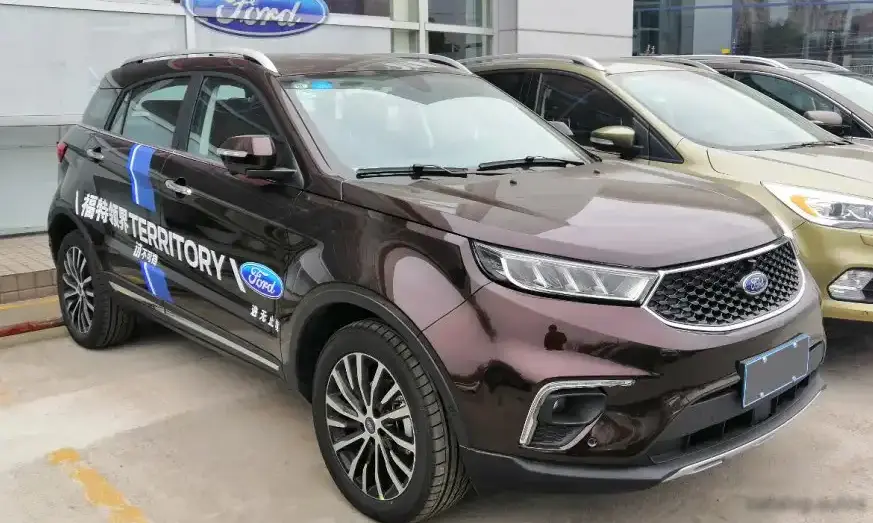
The Ford Territory I EV 60.4 kWh (163 Hp) represents Ford’s initial foray into the all-electric SUV market, specifically tailored for the Chinese market where it was first introduced in August 2019. Production continued until May 2022. This model is significant as it showcases Ford’s adaptation to the growing demand for electric vehicles and its willingness to develop vehicles specifically for regional preferences. The Territory EV is built in partnership with JMC (Jiangling Motors Corporation) and utilizes a dedicated electric vehicle platform, differing significantly from the combustion engine Territory sold in other markets. It occupies a mid-range position within Ford’s expanding EV lineup, offering a balance of range, practicality, and affordability.
Technical Specifications
| Brand | Ford |
| Model | Territory |
| Generation | Territory I |
| Type (Engine) | EV 60.4 kWh (163 Hp) |
| Start of production | August, 2019 |
| End of production | May, 2022 |
| Powertrain Architecture | BEV (Electric Vehicle) |
| Body type | SUV |
| Seats | 5 |
| Doors | 5 |
| Fuel Type | Electricity |
| Acceleration 0 – 100 km/h | 9.5 sec |
| Acceleration 0 – 62 mph | 9.5 sec |
| Acceleration 0 – 60 mph | 9 sec |
| Maximum speed | 150 km/h (93.21 mph) |
| 100 km/h – 0 | 36 m |
| Weight-to-power ratio | 10.9 kg/Hp, 92.1 Hp/tonne |
| Weight-to-torque ratio | 6.3 kg/Nm, 158.2 Nm/tonne |
| Gross battery capacity | 60.4 kWh |
| Battery technology | Lithium-ion (Li-Ion) |
| Battery location | Below the floor |
| All-electric range (NEDC) | 435 km (270.3 mi) |
| Electric motor power | 163 Hp |
| Electric motor Torque | 280 Nm (206.52 lb.-ft.) |
| Electric motor location | Front axle, Transverse |
| Electric motor type | Synchronous |
| System power | 163 Hp |
| System torque | 280 Nm (206.52 lb.-ft.) |
| Kerb Weight | 1770 kg (3902.18 lbs.) |
| Trunk (boot) space – minimum | 420 l (14.83 cu. ft.) |
| Trunk (boot) space – maximum | 1120 l (39.55 cu. ft.) |
| Length | 4580 mm (180.31 in.) |
| Width | 1936 mm (76.22 in.) |
| Height | 1674 mm (65.91 in.) |
| Wheelbase | 2716 mm (106.93 in.) |
| Drivetrain Architecture | One electric motor drives the front wheels. |
| Drive wheel | Front wheel drive |
| Number of gears and type of gearbox | 1 gears, automatic transmission |
| Front suspension | Independent type McPherson |
| Rear suspension | Independent multi-link suspension |
| Front brakes | Ventilated discs |
| Rear brakes | Disc |
| Assisting systems | ABS (Anti-lock braking system) |
| Steering type | Steering rack and pinion |
| Power steering | Electric Steering |
| Tires size | 235/50 R18 |
| Wheel rims size | 18 |
Powertrain & Engine Architecture
The Ford Territory I EV is built around a fully electric powertrain. The heart of the system is a single synchronous electric motor, positioned transversely at the front axle. This motor delivers a peak output of 163 horsepower and 280 Nm (206.52 lb.-ft.) of torque. Power is delivered to the front wheels via a single-speed automatic transmission, typical of most electric vehicles. The vehicle utilizes a 60.4 kWh lithium-ion battery pack located under the floor, contributing to a lower center of gravity and improved handling. The battery supports fast charging capabilities, though specific charging times vary depending on the charging infrastructure used. The vehicle’s electronic control unit (ECU) manages the power delivery, regenerative braking, and overall energy efficiency of the system.
Driving Characteristics
The Territory I EV offers a smooth and quiet driving experience, characteristic of electric vehicles. Acceleration from 0 to 100 km/h (0-62 mph) takes approximately 9.5 seconds, which is competitive within its segment. The instant torque delivery of the electric motor provides brisk acceleration at lower speeds, making it well-suited for urban driving. The single-speed transmission simplifies the driving experience, eliminating the need for gear changes. While not a performance-oriented vehicle, the Territory EV provides adequate power for everyday driving needs. The front-wheel-drive configuration offers predictable handling, although it may exhibit some torque steer under hard acceleration. The regenerative braking system allows for one-pedal driving in certain conditions, enhancing efficiency and driver convenience.
Equipment & Trim Levels
The Ford Territory I EV was generally well-equipped, even in its base trim levels. Standard features typically included automatic climate control, a touchscreen infotainment system with smartphone integration (Apple CarPlay and Android Auto), a rearview camera, and a suite of safety features such as ABS, electronic stability control, and airbags. Higher trim levels added features like leather upholstery, a panoramic sunroof, advanced driver-assistance systems (ADAS) such as adaptive cruise control and lane-keeping assist, and upgraded sound systems. Interior design focused on a modern aesthetic with a minimalist dashboard layout and comfortable seating. The vehicle offered a spacious cabin with ample headroom and legroom for passengers.
Chassis & Braking
The Territory I EV utilizes an independent McPherson strut suspension system at the front and an independent multi-link suspension at the rear. This setup provides a comfortable ride quality and good handling characteristics. The vehicle is equipped with ventilated disc brakes at the front and solid disc brakes at the rear, providing adequate stopping power. Electric power steering offers light and precise steering feel. The vehicle’s chassis is designed to accommodate the weight of the battery pack while maintaining a low center of gravity, contributing to improved stability. The standard tire size is 235/50 R18, providing a good balance of grip and ride comfort.
Market Reception & Comparison
The Ford Territory I EV was primarily targeted at the Chinese market, where it received a generally positive reception. Critics praised its spacious interior, comfortable ride, and competitive range. However, some reviewers noted that its acceleration was not as brisk as some of its rivals. Compared to other electric SUVs in the same price range, the Territory EV offered a good value proposition, with a well-equipped interior and a decent range. Its main competitors included models from domestic Chinese manufacturers such as BYD and Nio, as well as international brands like Volkswagen and Hyundai. The Territory EV’s fuel economy (measured in kilowatt-hours per 100 kilometers) was competitive with other electric vehicles in its class.
Legacy
The Ford Territory I EV represents an important step in Ford’s electrification strategy, demonstrating its commitment to developing electric vehicles for the global market. While production of this specific model has ended, it paved the way for future electric Ford vehicles. The powertrain technology and battery management systems developed for the Territory EV have likely influenced subsequent Ford EV models. On the used car market, the Territory I EV remains a relatively affordable option for buyers seeking an electric SUV. Its long-term reliability is generally considered to be good, although battery degradation is a factor to consider when purchasing a used electric vehicle. The Territory EV’s legacy lies in its role as a pioneering electric SUV from a major automotive manufacturer, helping to accelerate the adoption of electric vehicles in China and beyond.