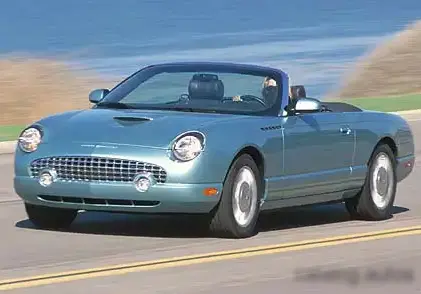
The Ford Thunderbird (Retro Birds), produced between 2002 and 2006, represented a deliberate revival of a classic American icon. This generation, designated internally as the 11th Thunderbird, aimed to capture the spirit of the original 1950s Thunderbirds while incorporating modern engineering and safety features. The 4.0 i V8 32V (283 Hp) variant occupied the top-tier position in the lineup, offering the most powerful engine option and a more luxurious experience compared to potential future, unreleased trims. It was positioned as a premium personal luxury car, competing with vehicles like the Mercedes-Benz SLK and BMW Z8.
Technical Specifications
| Brand | Ford |
| Model | Thunderbird |
| Generation | Thunderbird (Retro Birds) |
| Type (Engine) | 4.0 i V8 32V (283 Hp) |
| Start of production | 2002 |
| End of production | 2006 |
| Powertrain Architecture | Internal Combustion engine |
| Body type | Cabriolet |
| Seats | 2 |
| Doors | 2 |
| Fuel consumption (urban) | 13.8 l/100 km (17 US mpg, 20.5 UK mpg) |
| Fuel consumption (extra urban) | 10.3 l/100 km (22.8 US mpg, 27.4 UK mpg) |
| Fuel Type | Petrol (Gasoline) |
| Acceleration 0 – 100 km/h | 6.8 sec |
| Acceleration 0 – 62 mph | 6.8 sec |
| Acceleration 0 – 60 mph | 6.5 sec |
| Maximum speed | 220 km/h (136.7 mph) |
| Weight-to-power ratio | 6.2 kg/Hp, 161.9 Hp/tonne |
| Weight-to-torque ratio | 4.5 kg/Nm, 222 Nm/tonne |
| Power | 283 Hp @ 6000 rpm |
| Power per litre | 71.6 Hp/l |
| Torque | 388 Nm @ 4000 rpm (286.17 lb.-ft. @ 4000 rpm) |
| Engine layout | Front, Longitudinal |
| Engine Model/Code | AJ35 |
| Engine displacement | 3950 cm3 (241.04 cu. in.) |
| Number of cylinders | 8 |
| Engine configuration | V-engine |
| Cylinder Bore | 86 mm (3.39 in.) |
| Piston Stroke | 85 mm (3.35 in.) |
| Compression ratio | 10.8:1 |
| Number of valves per cylinder | 4 |
| Fuel injection system | Multi-port manifold injection |
| Engine aspiration | Naturally aspirated engine |
| Valvetrain | DOHC |
| Engine oil capacity | 6.2 l (6.55 US qt | 5.46 UK qt) |
| Coolant capacity | 11.3 l (11.94 US qt | 9.94 UK qt) |
| Kerb Weight | 1748 kg (3853.68 lbs.) |
| Trunk (boot) space – minimum | 190 l (6.71 cu. ft.) |
| Trunk (boot) space – maximum | 240 l (8.48 cu. ft.) |
| Fuel tank capacity | 68 l (17.96 US gal | 14.96 UK gal) |
| Length | 4730 mm (186.22 in.) |
| Width | 1829 mm (72.01 in.) |
| Height | 1323 mm (52.09 in.) |
| Wheelbase | 2723 mm (107.2 in.) |
| Front track | 1540 mm (60.63 in.) |
| Rear track | 1530 mm (60.24 in.) |
| Drivetrain Architecture | Rear wheel drive |
| Number of gears | 5 |
| Gearbox type | Automatic transmission |
| Front suspension | Coil spring |
| Rear suspension | Coil spring |
| Front brakes | Ventilated discs |
| Rear brakes | Ventilated discs |
| Assisting systems | ABS (Anti-lock braking system) |
| Steering type | Steering rack and pinion |
| Power steering | Hydraulic Steering |
| Tires size | 235/50 R17 |
Introduction
The 2002-2006 Ford Thunderbird, often referred to as the “Retro Bird,” was a significant departure from its predecessors. Built on the D2C platform (a heavily modified version of the Lincoln LS platform), it aimed to evoke the styling cues of the iconic 1955-1957 Thunderbirds, but with a thoroughly modern chassis and powertrain. The 4.0L V8 engine, coupled with a five-speed automatic transmission, was the flagship offering, representing the highest level of performance and refinement available in the lineup. This variant was intended to appeal to buyers seeking a stylish, comfortable, and relatively powerful grand tourer.
Powertrain & Engine Architecture
The heart of the Thunderbird 4.0 i is the AJ-35 4.0-liter V8 engine, a design originally developed by Jaguar during its ownership by Ford. This engine features a 90-degree V-angle, dual overhead camshafts (DOHC), and four valves per cylinder. The AJ-35 utilizes a multi-port fuel injection system, delivering fuel directly into the intake ports. The engine’s block is constructed from aluminum, contributing to a relatively lightweight design. The five-speed automatic transmission (5R55E) was a crucial component, chosen for its smooth shifting characteristics and ability to handle the engine’s 283 horsepower and 286 lb-ft of torque. The transmission featured electronic control and adaptive shifting algorithms, aiming to optimize performance and fuel efficiency based on driving conditions. The 5R55E was known for its reliability, but required regular fluid changes to maintain optimal operation.
Driving Characteristics
The 4.0L V8-powered Thunderbird offered a distinctly different driving experience compared to potential lower-trim models. Acceleration from 0-60 mph was achieved in approximately 6.5 seconds, making it a reasonably quick vehicle for its class. The automatic transmission provided smooth and seamless gear changes, although it wasn’t designed for aggressive or sporty driving. The gear ratios were tuned for comfortable cruising and effortless highway passing. Compared to a hypothetical manual transmission version (never offered), the automatic prioritized ease of use over outright performance. The rear-wheel-drive configuration contributed to a balanced feel, but the Thunderbird’s relatively heavy weight (around 3850 lbs) limited its agility in corners. The suspension, tuned for comfort, provided a smooth ride, but didn’t offer the sharp handling characteristics of a dedicated sports car.
Equipment & Trim Levels
The 4.0 i trim came standard with a generous array of features. Interior appointments included leather upholstery, power-adjustable seats with memory function, automatic climate control, and a premium sound system. Exterior features included chrome accents, alloy wheels, and a power-retractable hardtop. Optional extras included a color-matched hardtop, upgraded sound systems, and various interior trim packages. The Thunderbird’s interior was designed to evoke a sense of classic luxury, with a modern interpretation of the original’s iconic dashboard design. The overall aesthetic aimed for a blend of retro styling and contemporary comfort.
Chassis & Braking
The Thunderbird’s chassis was based on the D2C platform, shared with the Lincoln LS. The suspension utilized coil springs and independent suspension at all four wheels. The front suspension featured MacPherson struts, while the rear suspension employed a multi-link design. Braking duties were handled by ventilated disc brakes at all four corners, providing ample stopping power. An Anti-lock Braking System (ABS) was standard equipment. The Thunderbird’s chassis was designed to prioritize ride comfort and stability over outright handling prowess. The relatively wide track width contributed to a stable and predictable driving experience.
Market Reception & Comparison
The 2002-2006 Thunderbird received mixed reviews from automotive critics. While the styling was widely praised for its successful evocation of the original Thunderbird, some critics found the driving experience to be somewhat underwhelming. The 4.0L V8 engine was generally well-regarded for its smooth power delivery, but the automatic transmission was sometimes criticized for its lack of responsiveness. Compared to other vehicles in its class, the Thunderbird offered a unique blend of retro styling and modern convenience. Fuel economy was average for a V8-powered vehicle of its size, averaging around 17 mpg in the city and 23 mpg on the highway. Reliability was generally good, although some owners reported minor issues with the power-retractable hardtop mechanism.
Legacy
The 2002-2006 Ford Thunderbird, while a relatively short-lived model, left a lasting impression on automotive enthusiasts. The 4.0L V8 powertrain proved to be reasonably durable, and well-maintained examples continue to be sought after by collectors and enthusiasts. The Thunderbird’s unique styling and comfortable driving experience have ensured its place as a modern classic. In the used car market, the 4.0 i variant commands a premium over potential lower-trim models, reflecting its higher performance and more luxurious features. The Thunderbird represents a bold attempt by Ford to revive a beloved American icon, and its legacy continues to resonate with those who appreciate classic styling and modern engineering.