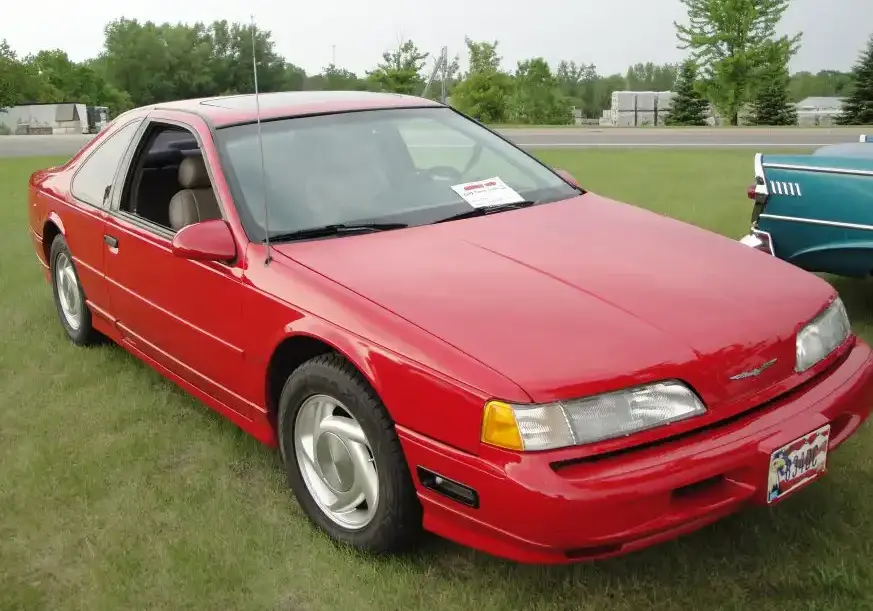
The Ford Thunderbird Super Bird, specifically the 3.8i V6 Supercharged variant, represented a significant effort by Ford to revitalize the iconic Thunderbird nameplate during the late 1980s and 1990s. Produced from 1988 through 1997, this generation (often referred to as the “Super Bird” due to its distinctive styling) aimed to blend sporty performance with the comfort and luxury expected of a grand touring coupe. This particular engine and transmission combination – the 3.8L supercharged V6 paired with a 5-speed manual – occupied a middle ground in the Thunderbird lineup, offering a compelling balance between affordability and exhilarating performance. It sat above the naturally aspirated 3.8L V6 models and below the more exclusive and powerful 5.0L V8 versions.
Technical Specifications
| Brand | Ford |
| Model | Thunderbird |
| Generation | Thunderbird (Super Birds) |
| Type (Engine) | 3.8i V6 Super (234 Hp) |
| Start of production | 1988 year |
| End of production | 1997 year |
| Powertrain Architecture | Internal Combustion engine |
| Body type | Coupe |
| Seats | 5 |
| Doors | 2 |
| Fuel Type | Petrol (Gasoline) |
| Weight-to-power ratio | 7.3 kg/Hp, 137.3 Hp/tonne |
| Weight-to-torque ratio | 3.8 kg/Nm, 262.3 Nm/tonne |
| Power | 234 Hp @ 4400 rpm |
| Power per litre | 61.6 Hp/l |
| Torque | 447 Nm @ 2500 rpm, 329.69 lb.-ft. @ 2500 rpm |
| Engine layout | Front, Longitudinal |
| Engine displacement | 3797 cm3, 231.71 cu. in. |
| Number of cylinders | 6 |
| Engine configuration | V-engine |
| Cylinder Bore | 96.8 mm, 3.81 in. |
| Piston Stroke | 86 mm, 3.39 in. |
| Compression ratio | 8.5:1 |
| Number of valves per cylinder | 2 |
| Fuel injection system | Multi-port manifold injection |
| Engine aspiration | Supercharger |
| Kerb Weight | 1704 kg, 3756.68 lbs |
| Fuel tank capacity | 72 l, 19.02 US gal | 15.84 UK gal |
| Length | 5088 mm, 200.31 in |
| Width | 1847 mm, 72.72 in |
| Height | 1333 mm, 52.48 in |
| Wheelbase | 2870 mm, 112.99 in |
| Front track | 1565 mm, 61.61 in |
| Rear (Back) track | 1530 mm, 60.24 in |
| Drivetrain Architecture | The Internal combustion engine (ICE) drives the rear wheels of the vehicle. |
| Drive wheel | Rear wheel drive |
| Number of gears and type of gearbox | 5 gears, manual transmission |
| Front suspension | Spring Strut |
| Rear suspension | Coil spring |
| Front brakes | Ventilated discs |
| Rear brakes | Ventilated discs |
| Assisting systems | ABS (Anti-lock braking system), Hydraulic Steering |
| Tires size | 225/60 R16V |
Powertrain & Engine Architecture
The heart of the Super Bird 3.8i was the 3.8-liter (3797 cc) Ford Essex V6 engine. This engine, designated as the 351 Windsor family, was significantly enhanced with an Eaton supercharger. The supercharger, a positive displacement type, provided a substantial boost in power and torque compared to the naturally aspirated versions of the same engine. Fuel delivery was managed by a multi-port fuel injection system, ensuring precise fuel metering for optimal performance and efficiency. The engine featured a two-valve per cylinder configuration and a relatively modest 8.5:1 compression ratio, a design choice intended to accommodate the increased cylinder pressures generated by the supercharger. The 5-speed manual transmission, a Borg-Warner T5, was chosen to handle the increased power output and provide a more engaging driving experience. This transmission offered well-spaced gear ratios, contributing to both acceleration and highway cruising comfort.
Driving Characteristics
The 3.8L Supercharged V6 with the 5-speed manual delivered a noticeably more spirited driving experience than the base model Thunderbirds. The supercharger provided instant torque, making for strong acceleration in everyday driving situations. While not as raw or visceral as the 5.0L V8, the supercharged V6 offered a smooth and refined power delivery. The manual transmission allowed drivers to fully exploit the engine’s capabilities, providing precise control over gear selection. The gear ratios were well-suited to both city and highway driving, with a relatively tall fifth gear for efficient cruising. Compared to the automatic transmission equipped versions, the manual offered a more direct connection to the engine and a more engaging driving experience. However, the supercharger did introduce a degree of turbo lag, noticeable at lower RPMs, before the boost kicked in.
Equipment & Trim Levels
The Super Bird 3.8i typically came standard with a respectable array of features. Interior appointments included cloth upholstery, power windows and locks, and an AM/FM stereo system. Air conditioning was a common inclusion. Optional extras included leather upholstery, a premium sound system, and a sunroof. The dashboard layout was typical of the era, featuring analog gauges and a straightforward control layout. The Super Bird trim level also included unique exterior styling cues, such as a rear spoiler and distinctive wheels, setting it apart from the base model Thunderbirds.
Chassis & Braking
The Thunderbird Super Bird utilized a traditional rear-wheel-drive layout with a front independent suspension featuring coil springs and a strut design. The rear suspension employed a solid axle with coil springs. Braking duties were handled by ventilated disc brakes on all four wheels, providing adequate stopping power for the vehicle’s weight and performance. An anti-lock braking system (ABS) was included as standard equipment, enhancing safety and control during emergency braking situations. Power steering was also standard, making the car easier to maneuver at low speeds.
Market Reception & Comparison
The Super Bird 3.8i was generally well-received by automotive critics. It was praised for its strong performance, comfortable ride, and attractive styling. However, some reviewers noted that the interior materials were not as luxurious as those found in some competing grand touring coupes. Compared to the naturally aspirated 3.8L models, the supercharged version offered a significant performance upgrade. Against the 5.0L V8, it provided a more affordable entry point into the Thunderbird’s performance range, albeit with slightly less overall power. Fuel economy was reasonable for a vehicle of its size and performance, but not exceptional. Reliability was generally good, although the supercharger did add a layer of complexity to the engine, potentially increasing maintenance costs over the long term.
Legacy
Today, the Ford Thunderbird Super Bird 3.8i V6 Supercharged holds a respectable position in the collector car market. While not as highly sought after as the 5.0L V8 models, it represents a compelling value for enthusiasts seeking a stylish and capable grand touring coupe. The 3.8L supercharged engine, when properly maintained, has proven to be relatively durable. However, potential buyers should be aware of the potential for supercharger-related issues, such as belt wear and pulley failures. Overall, the Super Bird 3.8i remains a fondly remembered example of Ford’s efforts to revive the Thunderbird legacy during the 1990s.