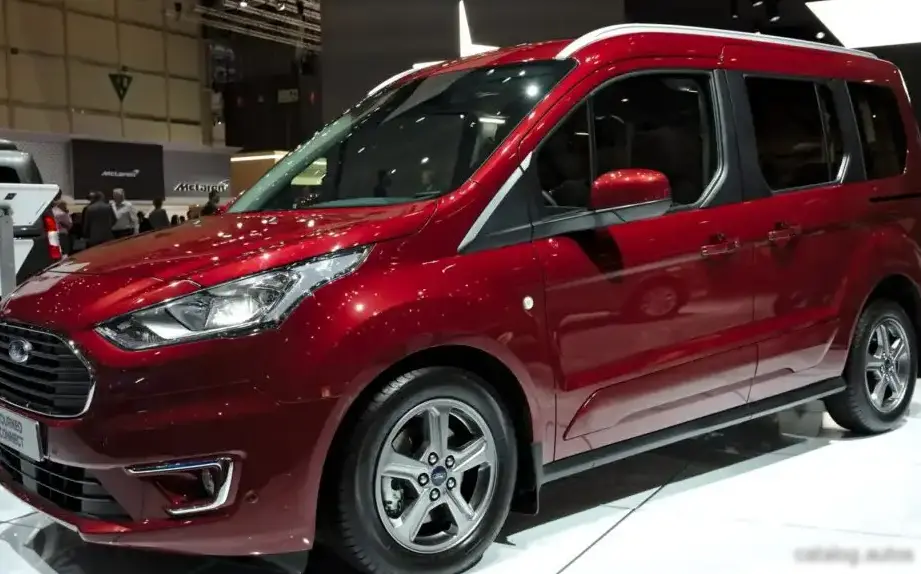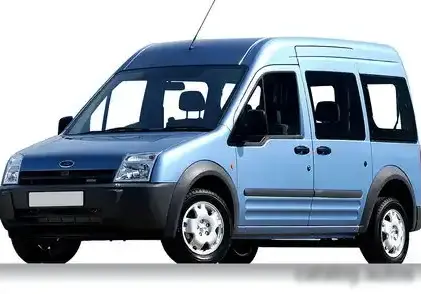
The Ford Tourneo Connect, launched in 2003, represented Ford’s entry into the compact leisure activity vehicle (LAV) segment in Europe. Based on the Ford Focus C-Max platform (internally designated as the 1HX0/A3), the Tourneo Connect aimed to provide a practical and versatile vehicle for families and businesses alike. The 1.8 TDCi L (90 hp) variant, produced from 2003 to 2013, served as the entry-level engine option, prioritizing fuel efficiency and affordability over outright performance. It was positioned as a workhorse model, appealing to buyers needing a spacious and economical vehicle for daily use.
Technical Specifications
| Brand | Ford |
| Model | Tourneo Connect |
| Generation | Tourneo Connect I |
| Type (Engine) | 1.8 TDCi L (90 Hp) |
| Start of production | 2003 |
| End of production | 2013 |
| Powertrain Architecture | Internal Combustion engine |
| Body type | Minivan |
| Seats | 5 |
| Doors | 5 |
| Fuel Type | Diesel |
| Acceleration 0 – 100 km/h | 16.3 sec |
| Acceleration 0 – 62 mph | 16.3 sec |
| Acceleration 0 – 60 mph | 15.5 sec |
| Maximum speed | 155 km/h (96.31 mph) |
| Weight-to-power ratio | 17.2 kg/Hp, 58.3 Hp/tonne |
| Weight-to-torque ratio | 7 kg/Nm, 142.4 Nm/tonne |
| Power | 90 Hp @ 4000 rpm |
| Power per litre | 51.3 Hp/l |
| Torque | 220 Nm @ 1700 rpm (162.26 lb.-ft. @ 1700 rpm) |
| Engine layout | Front, Transverse |
| Engine Model/Code | HCPA, HCPB, HCPC, HCPD |
| Engine displacement | 1753 cm3 (106.97 cu. in.) |
| Number of cylinders | 4 |
| Engine configuration | Inline |
| Cylinder Bore | 82.5 mm (3.25 in.) |
| Piston Stroke | 82 mm (3.23 in.) |
| Compression ratio | 18.5:1 |
| Number of valves per cylinder | 2 |
| Fuel injection system | Diesel Commonrail |
| Engine aspiration | Turbocharger, Intercooler |
| Engine oil capacity | 5.6 l (5.92 US qt | 4.93 UK qt) |
| Coolant | 7 l (7.4 US qt | 6.16 UK qt) |
| Kerb Weight | 1545 kg (3406.14 lbs.) |
| Max. weight | 2340 kg (5158.82 lbs.) |
| Max load | 795 kg (1752.67 lbs.) |
| Trunk (boot) space – minimum | 1400 l (49.44 cu. ft.) |
| Trunk (boot) space – maximum | 3500 l (123.6 cu. ft.) |
| Fuel tank capacity | 60 l (15.85 US gal | 13.2 UK gal) |
| Length | 4525 mm (178.15 in.) |
| Width | 1795 mm (70.67 in.) |
| Height | 1981 mm (77.99 in.) |
| Wheelbase | 2912 mm (114.65 in.) |
| Front track | 1505 mm (59.25 in.) |
| Rear (Back) track | 1552 mm (61.1 in.) |
| Drivetrain Architecture | The Internal combustion engine (ICE) drives the front wheels of the vehicle. |
| Drive wheel | Front wheel drive |
| Number of gears and type of gearbox | 5 gears, manual transmission |
| Front suspension | Wishbone |
| Rear suspension | Coil spring |
| Front brakes | Disc |
| Rear brakes | Drum |
| Assisting systems | ABS (Anti-lock braking system) |
| Steering type | Steering rack and pinion |
| Power steering | Hydraulic Steering |
| Tires size | 195/65 R15 |
Powertrain & Engine Architecture
The 1.8 TDCi engine, specifically the HCPA, HCPB, HCPC, and HCPD engine codes, is a four-cylinder, inline diesel engine. It utilizes a common rail direct injection system, a technology that significantly improved fuel efficiency and reduced noise compared to older diesel injection methods. The engine is turbocharged and intercooled, enhancing power output and torque delivery. The intercooler cools the compressed air from the turbocharger, increasing its density and allowing for more efficient combustion. The engine features two valves per cylinder (SOHC) and a compression ratio of 18.5:1. The 90 hp variant was typically paired with a five-speed manual transmission, although a four-speed automatic transmission was also available, albeit less common. The automatic transmission was a conventional torque converter type, prioritizing smooth shifts over sporty responsiveness.
Driving Characteristics
The 1.8 TDCi 90 hp engine in the Tourneo Connect offered adequate, but not exhilarating, performance. Acceleration from 0-60 mph took around 15.5 seconds, and top speed was limited to 155 km/h (96 mph). The engine’s strength lay in its low-end torque, making it suitable for carrying loads and navigating urban environments. The automatic transmission, while providing convenience, did detract from the overall responsiveness. Gear changes were relatively slow, and the transmission sometimes hunted for the right gear, particularly under heavy load or on inclines. Compared to the higher-output 110 hp version of the 1.8 TDCi, or the more powerful 2.0-liter petrol engines, the 90 hp variant felt noticeably slower and less refined.
Equipment & Trim Levels
The “L” trim level, as indicated in the model designation, represented the base specification for the Tourneo Connect. Standard equipment typically included power steering, ABS brakes, a driver’s airbag, and basic cloth upholstery. Air conditioning, alloy wheels, and a radio/CD player were often optional extras. The interior was functional and durable, prioritizing practicality over luxury. The rear seats could be folded or removed to create a larger cargo area, enhancing the vehicle’s versatility. Higher trim levels, such as the “LX” and “Titanium,” offered additional features like electric windows, remote central locking, and upgraded interior trim.
Chassis & Braking
The Tourneo Connect utilized a front-wheel-drive layout with a MacPherson strut front suspension and a coil spring rear suspension. The suspension was tuned for comfort rather than sporty handling. The front brakes were disc brakes, providing adequate stopping power, while the rear brakes were typically drum brakes on the base “L” trim. Stabilizer bars were fitted to both the front and rear axles to reduce body roll during cornering. The vehicle’s relatively high center of gravity and soft suspension setup meant that it wasn’t particularly engaging to drive on winding roads.
Market Reception & Comparison
The 1.8 TDCi 90 hp Tourneo Connect was generally well-received as a practical and economical vehicle. Critics praised its spacious interior, versatile cargo area, and fuel efficiency. However, the engine’s lack of power and the automatic transmission’s sluggishness were common criticisms. Compared to other compact LAVs on the market, such as the Renault Kangoo and Citroën Berlingo, the Tourneo Connect offered a competitive package in terms of price and practicality. The 1.8 TDCi 90 hp version typically achieved fuel economy figures in the range of 45-55 mpg, making it an attractive option for budget-conscious buyers. The manual transmission version generally offered slightly better fuel economy and performance.
Legacy
The 1.8 TDCi engine, in its various iterations, proved to be a relatively reliable unit. Common issues included turbocharger failure and injector problems, but these were not widespread. The automatic transmission, however, was known to be less durable than the manual gearbox. Today, the Tourneo Connect I 1.8 TDCi 90 hp can be found on the used car market at affordable prices. It remains a practical and economical option for those needing a versatile vehicle for work or family use, but potential buyers should be aware of the potential for transmission issues and the engine’s limited power output.