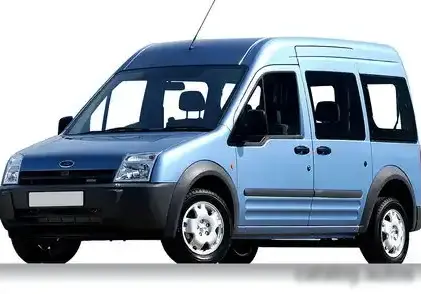
The Ford Tourneo Custom, specifically the L2 variant equipped with the 2.0 TDCi engine producing 105 horsepower, represents a significant offering in the European and increasingly, North American, commercial vehicle market. Introduced with the 2018 facelift of the first-generation Tourneo Custom (launched originally in 2012), this configuration was produced through 2023. Positioned as an entry-to-mid-range option within the Tourneo Custom lineup, it catered to buyers prioritizing practicality, fuel efficiency, and a lower initial purchase price over outright performance. The L2 designation indicates a long wheelbase, providing increased cargo and passenger space compared to the standard-length version. This model served as a popular choice for families, shuttle services, and small businesses needing a versatile and spacious vehicle.
Technical Specifications
| Brand | Ford |
| Model | Tourneo Custom |
| Generation | Tourneo Custom I (facelift 2018) L2 |
| Type (Engine) | 2.0 TDCi (105 Hp) |
| Start of production | 2018 |
| End of production | 2023 |
| Powertrain Architecture | Internal Combustion engine |
| Body type | Van |
| Seats | 8-9 |
| Doors | 5 |
| Fuel consumption (urban) | 7.2 l/100 km (32.7 US mpg) |
| Fuel consumption (extra urban) | 5.8 l/100 km (40.6 US mpg) |
| Fuel consumption (combined) | 6.3 l/100 km (37.3 US mpg) |
| CO2 emissions | 164 g/km |
| Fuel Type | Diesel |
| Maximum speed | 150 km/h (93.21 mph) |
| Emission standard | Euro 6b |
| Weight-to-power ratio | 22.5 kg/Hp |
| Weight-to-torque ratio | 6.6 kg/Nm |
| Power | 105 Hp @ 3500 rpm |
| Torque | 360 Nm @ 1375-2000 rpm (265.52 lb.-ft.) |
| Engine layout | Front, Transverse |
| Engine Model/Code | YLFS, YLF6 |
| Engine displacement | 1995 cm3 (121.74 cu. in.) |
| Number of cylinders | 4 |
| Engine configuration | Inline |
| Number of valves per cylinder | 4 |
| Fuel injection system | Diesel Commonrail |
| Engine aspiration | Turbocharger, Intercooler |
| Engine oil capacity | 9.8 l (10.36 US qt | 8.62 UK qt) |
| Coolant capacity | 11.2 l (11.83 US qt | 9.85 UK qt) |
| Kerb Weight | 2361 kg (5205.11 lbs.) |
| Max. weight | 3190 kg (7032.75 lbs.) |
| Max load | 829 kg (1827.63 lbs.) |
| Trunk (boot) space – minimum | 1900 l (67.1 cu. ft.) |
| Fuel tank capacity | 70 l (18.49 US gal | 15.4 UK gal) |
| AdBlue tank | 21 l (5.55 US gal | 4.62 UK gal) |
| Permitted trailer load with brakes (12%) | 1900 kg (4188.78 lbs.) |
| Permitted trailer load without brakes | 750 kg (1653.47 lbs.) |
| Length | 5340 mm (210.24 in.) |
| Width | 2032 mm (80 in.) |
| Height | 1977 mm (77.83 in.) |
| Wheelbase | 3300 mm (129.92 in.) |
| Minimum turning circle | 12.8 m (41.99 ft.) |
| Drivetrain | Front wheel drive |
| Number of gears | 6 |
| Gearbox type | Manual transmission |
| Front brakes | Ventilated discs |
| Rear brakes | Ventilated discs |
| Tire size | 215/65 R16 |
| Wheel rims size | 16 |
Powertrain & Engine Architecture
The heart of this Tourneo Custom variant is the 2.0-liter TDCi diesel engine, specifically utilizing the YLFS or YLF6 engine code depending on the exact production year and market. This engine is a four-cylinder, inline configuration, employing a turbocharger with intercooling to enhance power and efficiency. The engine utilizes a common-rail direct fuel injection system, delivering fuel directly into the combustion chamber at extremely high pressure for optimized combustion. The 105 horsepower output is achieved at 3500 rpm, while the substantial 360 Nm (265.52 lb.-ft.) of torque is available from a low 1375 rpm, providing good pulling power for a vehicle of this size. The engine features four valves per cylinder, contributing to improved breathing and overall performance. Paired with this engine is a six-speed manual transmission, chosen for its efficiency and lower cost compared to an automatic option.
Driving Characteristics
The 105 hp 2.0 TDCi with a manual transmission in the Tourneo Custom L2 delivers a practical, if not exhilarating, driving experience. Acceleration is adequate for everyday driving, but it won’t be winning any races. The strength of this powertrain lies in its mid-range torque, making it well-suited for carrying passengers or cargo. The six-speed gearbox is well-matched to the engine, allowing for comfortable cruising on highways. Compared to higher-output versions of the 2.0 TDCi (like the 170 hp variant), this version feels noticeably less powerful, especially when fully loaded. However, it offers significantly better fuel economy. The manual transmission provides more driver engagement than an automatic, but requires more effort in stop-and-go traffic.
Equipment & Trim Levels
The 105 hp Tourneo Custom L2 typically came with a base level of equipment, focusing on functionality and practicality. Standard features generally included air conditioning, power steering, electric front windows, a basic audio system with USB connectivity, and a driver’s airbag. Interior upholstery was typically durable cloth. Optional extras included features like rear air conditioning, upgraded audio systems, parking sensors, navigation systems, and alloy wheels. Trim levels varied by market, but generally offered progressively more features and comfort options as you moved up the range. The L2 wheelbase provided ample space for up to nine passengers, depending on the seating configuration.
Chassis & Braking
The Tourneo Custom utilizes a front-wheel-drive layout with a MacPherson strut front suspension and a twist-beam rear suspension. This setup provides a good balance between ride comfort and handling. The braking system consists of ventilated discs on all four wheels, providing adequate stopping power for the vehicle’s weight. Anti-lock Braking System (ABS) is standard. The suspension is tuned for comfort rather than sporty handling, prioritizing a smooth ride over dynamic cornering. Stabilizer bars are fitted to both the front and rear axles to reduce body roll.
Market Reception & Comparison
The 105 hp Tourneo Custom L2 was generally well-received as a practical and affordable option in the commercial vehicle segment. Critics praised its spacious interior, fuel efficiency, and competitive pricing. However, some reviewers noted that the engine could feel underpowered when fully loaded or driving uphill. Compared to the more powerful 170 hp version, the 105 hp model offered significantly better fuel economy, making it a popular choice for businesses focused on minimizing operating costs. The 1.8L petrol versions were less common and generally offered poorer fuel economy and less torque. The diesel engine, even in this lower-powered guise, was favored for its durability and long-term reliability.
Legacy
The 2.0 TDCi engine, in various iterations, has proven to be a robust and reliable powertrain. While not without its potential issues (such as diesel particulate filter problems if not properly maintained), the engine is generally considered durable and capable of high mileage. In the used car market, the 105 hp Tourneo Custom L2 represents a good value proposition for buyers seeking a spacious and practical vehicle. Its lower initial price and good fuel economy make it an attractive option for families and businesses alike. Regular maintenance, including timely servicing and AdBlue refills, is crucial to ensure the long-term reliability of this powertrain.