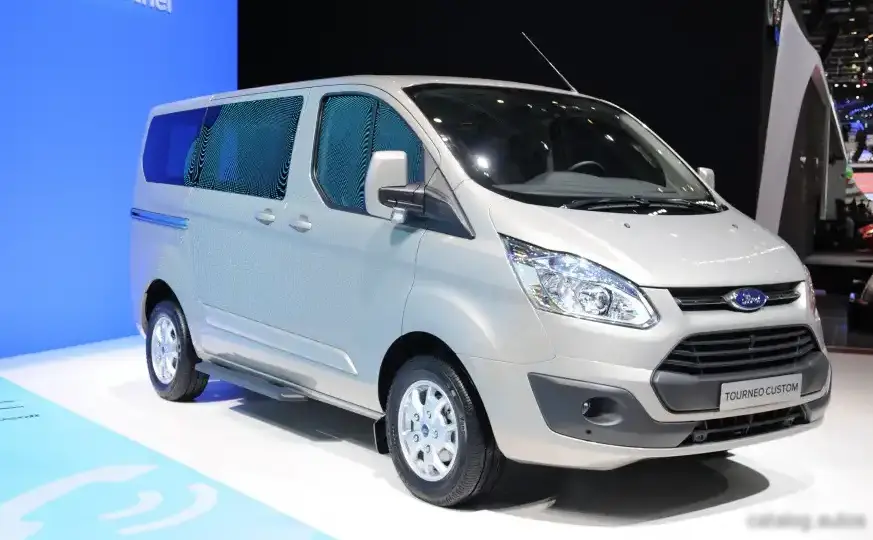
The Ford Tourneo Custom I L1 2.2 Duratorq TDCi, produced from 2012 to 2017, represents Ford’s entry into the European and global one-ton van market. This variant, equipped with the 2.2-liter Duratorq TDCi engine producing 125 horsepower, served as a core model within the first generation Tourneo Custom (often referred to as the FK81). Positioned as a versatile people-mover and light commercial vehicle, it aimed to provide a balance between practicality, fuel efficiency, and affordability. The L1 designation indicates the short wheelbase version, making it more maneuverable in urban environments. It was a key competitor to vehicles like the Volkswagen Transporter, Citroën Dispatch, and Peugeot Expert.
Technical Specifications
| Brand | Ford |
| Model | Tourneo Custom |
| Generation | Tourneo Custom I L1 |
| Type (Engine) | 2.2 Duratorq TDCi (125 Hp) |
| Start of production | 2012 |
| End of production | 2017 |
| Powertrain Architecture | Internal Combustion engine |
| Body type | Van |
| Seats | 8-9 |
| Doors | 5 |
| Fuel consumption (urban) | 7.3 l/100 km (32.2 US mpg) |
| Fuel consumption (extra urban) | 6.1 l/100 km (38.6 US mpg) |
| Fuel consumption (combined) | 6.5 l/100 km (36.2 US mpg) |
| CO2 emissions | 172 g/km |
| Fuel Type | Diesel |
| Maximum speed | 157 km/h (97.56 mph) |
| Emission standard | Euro 5 |
| Weight-to-power ratio | 16.8 kg/Hp |
| Weight-to-torque ratio | 6 kg/Nm |
| Power | 125 Hp @ 3500 rpm |
| Torque | 350 Nm @ 1450 rpm (258.15 lb.-ft. @ 1450 rpm) |
| Engine layout | Front, Transverse |
| Engine Model/Code | CYFF |
| Engine displacement | 2198 cm3 (134.13 cu. in.) |
| Number of cylinders | 4 |
| Engine configuration | Inline |
| Cylinder Bore | 86 mm (3.39 in.) |
| Piston Stroke | 94.6 mm (3.72 in.) |
| Number of valves per cylinder | 4 |
| Fuel injection system | Diesel Commonrail |
| Engine aspiration | Turbocharger, Intercooler |
| Valvetrain | DOHC |
| Engine oil capacity | 6.2 l (6.55 US qt | 5.46 UK qt) |
| Coolant capacity | 10 l (10.57 US qt | 8.8 UK qt) |
| Kerb Weight | 2104 kg (4638.53 lbs.) |
| Max. weight | 3000 kg (6613.87 lbs.) |
| Max load | 896 kg (1975.34 lbs.) |
| Fuel tank capacity | 80 l (21.13 US gal | 17.6 UK gal) |
| Permitted trailer load (braked) | 2150 kg (4739.94 lbs.) |
| Permitted trailer load (unbraked) | 750 kg (1653.47 lbs.) |
| Length | 4972 mm (195.75 in.) |
| Width | 1986 mm (78.19 in.) |
| Width including mirrors | 2272 mm (89.45 in.) |
| Height | 1827-1984 mm (71.93 – 78.11 in.) |
| Wheelbase | 2933 mm (115.47 in.) |
| Minimum turning circle | 11.6 m (38.06 ft.) |
| Drivetrain | Front wheel drive |
| Number of gears | 6 |
| Gearbox type | Manual transmission |
| Front brakes | Ventilated discs |
| Rear brakes | Disc |
| Tire size | 215/65 R15; 215/65 R16 |
| Wheel rim size | 6.5J x 15; 6.5J x 16 |
Powertrain & Engine Architecture
The heart of the Tourneo Custom I L1 2.2 Duratorq TDCi is the Ford CYFF engine, a 2.2-liter inline-four cylinder diesel. This engine belongs to the Duratorq family, known for its robust construction and relatively simple design. The CYFF utilizes a common-rail direct fuel injection system, delivering fuel at extremely high pressure for improved combustion efficiency and reduced emissions. A turbocharger with an intercooler is employed to boost power output and torque. The engine features a double overhead camshaft (DOHC) valvetrain with four valves per cylinder, optimizing gas flow for enhanced performance. This specific 125 horsepower version of the 2.2 Duratorq was tuned for fuel economy and smooth operation rather than outright performance. The engine is transversely mounted in the front of the vehicle, driving the front wheels. The six-speed manual transmission was the standard offering for this variant, providing a good balance between fuel efficiency and drivability.
Driving Characteristics
The 125 hp 2.2 Duratorq TDCi, paired with the six-speed manual transmission, offered a practical, if not exhilarating, driving experience. Acceleration was adequate for everyday driving, but it wasn’t particularly quick, especially when fully loaded with passengers or cargo. The engine produced a respectable 350 Nm (258 lb-ft) of torque at a low 1450 rpm, providing good pulling power for overtaking and climbing hills. The gear ratios were well-chosen to maximize fuel efficiency and keep the engine within its optimal operating range. Compared to the higher-output versions of the 2.2 Duratorq (typically around 155 hp), this variant felt noticeably less powerful. However, it also offered better fuel economy and a more relaxed driving experience. The manual transmission allowed for greater driver control, but some drivers preferred the convenience of an automatic gearbox, which was available on higher trim levels.
Equipment & Trim Levels
The Tourneo Custom I L1 2.2 Duratorq TDCi was typically offered in base and mid-level trim configurations. Standard equipment generally included power steering, central locking, electric front windows, and a basic audio system. Safety features such as ABS (Anti-lock Braking System) and driver/passenger airbags were also standard. Higher trim levels added features like air conditioning, alloy wheels, rear parking sensors, and upgraded interior trim. Interior upholstery was typically cloth, with options for more durable materials for commercial use. The dashboard layout was functional and straightforward, prioritizing practicality over luxury. Optional extras included navigation systems, Bluetooth connectivity, and various seating configurations.
Chassis & Braking
The Tourneo Custom I L1 utilized a front-wheel-drive chassis with independent MacPherson strut suspension at the front and a semi-independent twist beam suspension at the rear. This setup provided a comfortable ride quality, although it wasn’t particularly sporty. The front brakes were ventilated discs, offering good stopping power, while the rear brakes were solid discs. The steering was hydraulic power-assisted, providing a reasonable level of feedback. Stabilizer bars were fitted to both the front and rear axles to reduce body roll during cornering. The suspension was tuned to prioritize comfort and load-carrying capacity over handling precision.
Market Reception & Comparison
The Ford Tourneo Custom I L1 2.2 Duratorq TDCi was generally well-received by critics and buyers alike. It was praised for its practicality, versatility, and fuel efficiency. The 125 hp engine was considered adequate for most users, although some reviewers noted that it could feel underpowered when fully loaded. Compared to the higher-output versions, this variant offered a more affordable price point and better fuel economy. However, it lacked the performance of its more powerful siblings. In terms of reliability, the Duratorq engine proved to be generally robust, although some owners reported issues with the fuel injection system and turbocharger. Overall, the Tourneo Custom I L1 2.2 Duratorq TDCi represented a solid and dependable choice in the one-ton van segment.
Legacy
The Ford Tourneo Custom I L1 2.2 Duratorq TDCi has proven to be a relatively reliable and durable vehicle in the used car market. The 2.2 Duratorq engine, while not without its potential issues, is generally considered to be a robust and long-lasting unit. Regular maintenance, including oil changes and filter replacements, is crucial for ensuring its longevity. Parts availability is generally good, and repair costs are reasonable. Today, these vans are still commonly seen on the roads, serving as workhorses for businesses and families alike. The combination of practicality, affordability, and reliability has ensured its continued popularity in the used vehicle market.