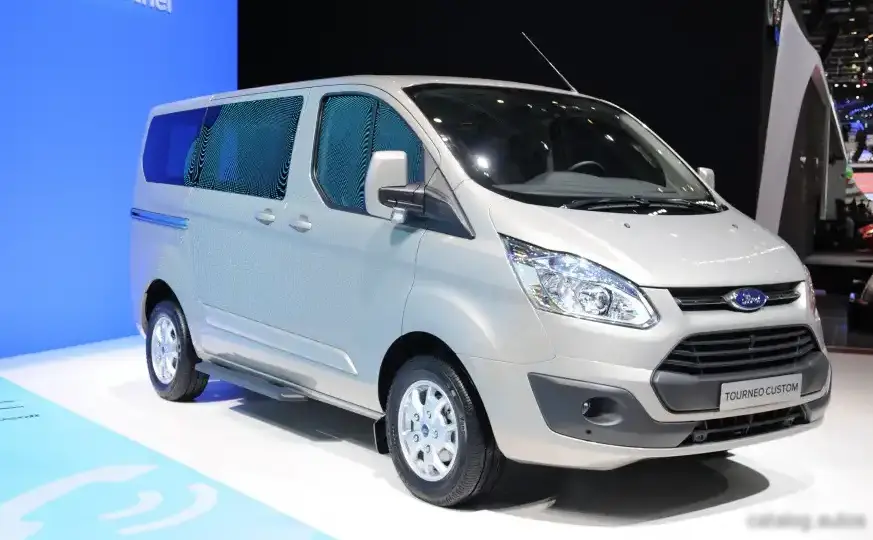
The Ford Tourneo Custom I L1 2.2 Duratorq TDCi, produced from 2012 to 2017, represents Ford’s entry into the European and global one-tonne van segment. This variant, equipped with the 2.2-liter Duratorq TDCi engine producing 155 horsepower, served as a versatile option within the Tourneo Custom lineup, catering to both passenger and commercial needs. It was built on the Ford Transit platform, specifically the first generation of the Tourneo Custom (code-named Tourneo Custom I), and offered a balance between practicality, fuel efficiency, and affordability. The ‘L1’ designation indicates the short wheelbase version of the van.
Technical Specifications
| Brand | Ford |
| Model | Tourneo Custom |
| Generation | Tourneo Custom I L1 |
| Type (Engine) | 2.2 Duratorq TDCi (155 Hp) |
| Start of production | 2012 |
| End of production | 2017 |
| Powertrain Architecture | Internal Combustion engine |
| Body type | Van |
| Seats | 8-9 |
| Doors | 5 |
| Fuel consumption (urban) | 7.3 l/100 km (32.2 US mpg) |
| Fuel consumption (extra urban) | 6.1 l/100 km (38.6 US mpg) |
| Fuel consumption (combined) | 6.5 l/100 km (36.2 US mpg) |
| CO2 emissions | 172 g/km |
| Fuel Type | Diesel |
| Maximum speed | 157 km/h (97.56 mph) |
| Emission standard | Euro 5 |
| Weight-to-power ratio | 13.6 kg/Hp |
| Weight-to-torque ratio | 5.5 kg/Nm |
| Power | 155 Hp @ 3500 rpm |
| Torque | 385 Nm @ 1600 rpm (283.96 lb.-ft. @ 1600 rpm) |
| Engine layout | Front, Transverse |
| Engine Model/Code | CVFF |
| Engine displacement | 2198 cm3 (134.13 cu. in.) |
| Number of cylinders | 4 |
| Engine configuration | Inline |
| Cylinder Bore | 86 mm (3.39 in.) |
| Piston Stroke | 94.6 mm (3.72 in.) |
| Number of valves per cylinder | 4 |
| Fuel injection system | Diesel Commonrail |
| Engine aspiration | Turbocharger, Intercooler |
| Valvetrain | DOHC |
| Engine oil capacity | 6.2 l (6.55 US qt | 5.46 UK qt) |
| Coolant capacity | 10 l (10.57 US qt | 8.8 UK qt) |
| Kerb Weight | 2104 kg (4638.53 lbs.) |
| Max. weight | 3000 kg (6613.87 lbs.) |
| Max load | 896 kg (1975.34 lbs.) |
| Fuel tank capacity | 80 l (21.13 US gal | 17.6 UK gal) |
| Permitted trailer load (braked) | 2150 kg (4739.94 lbs.) |
| Permitted trailer load (unbraked) | 750 kg (1653.47 lbs.) |
| Length | 4972 mm (195.75 in.) |
| Width | 1986 mm (78.19 in.) |
| Width including mirrors | 2272 mm (89.45 in.) |
| Height | 1827-1984 mm (71.93 – 78.11 in.) |
| Wheelbase | 2933 mm (115.47 in.) |
| Minimum turning circle | 11.6 m (38.06 ft.) |
| Drivetrain | Front wheel drive |
| Number of gears | 6 |
| Gearbox type | Manual transmission |
| Front brakes | Ventilated discs |
| Rear brakes | Disc |
| Tire size | 215/65 R15; 215/65 R16 |
| Wheel rim size | 6.5J x 15; 6.5J x 16 |
Powertrain & Engine Architecture
The heart of the Tourneo Custom I L1 2.2 Duratorq TDCi is the CVFF engine, a 2.2-liter inline-four cylinder diesel. This engine belongs to the Duratorq family, known for its robust construction and relatively simple design. The 2.2-liter variant utilizes a common-rail direct fuel injection system, delivering fuel at extremely high pressure for improved combustion efficiency and reduced emissions. A turbocharger with an intercooler is employed to increase power output and torque. The engine features a double overhead camshaft (DOHC) valvetrain with four valves per cylinder, optimizing airflow for enhanced performance. The 155 horsepower version of the 2.2 Duratorq was specifically tuned for a balance of power and fuel economy, making it suitable for a wide range of applications. The standard transmission for this variant was a six-speed manual gearbox, providing precise control and efficient power delivery.
Driving Characteristics
The 155 hp 2.2 Duratorq TDCi, paired with the six-speed manual transmission, offered a practical and capable driving experience. While not exceptionally quick, it provided sufficient power for everyday driving, even when fully loaded. Acceleration was adequate, and the engine delivered a healthy amount of torque from relatively low RPMs, making it easy to navigate city streets and maintain highway speeds. Compared to the higher-output versions of the 2.2 Duratorq, or the more economical 2.0-liter options, this variant struck a middle ground. The manual transmission allowed for greater driver control, but the gear ratios were optimized for fuel efficiency rather than outright performance. The relatively long gearing contributed to good highway cruising, but required more frequent downshifts when tackling steep inclines or overtaking.
Equipment & Trim Levels
The Tourneo Custom I L1 2.2 Duratorq TDCi was typically offered in several trim levels, with the base models providing essential features and higher trims adding more comfort and convenience items. Standard equipment generally included power steering, ABS brakes, driver and passenger airbags, and a basic audio system. Higher trim levels often featured air conditioning, electric windows, central locking, and upgraded interior upholstery. Optional extras included navigation systems, parking sensors, alloy wheels, and various seating configurations. Interior materials were generally durable and practical, reflecting the van’s commercial origins. The dashboard layout was functional and straightforward, prioritizing ease of use.
Chassis & Braking
The Tourneo Custom I L1 utilized a front-wheel-drive layout with a MacPherson strut front suspension and a leaf spring rear suspension. This configuration provided a good balance between ride comfort and load-carrying capacity. The front brakes were ventilated discs, offering good stopping power, while the rear brakes were solid discs. ABS (Anti-lock Braking System) was standard, enhancing safety during emergency braking situations. The suspension was tuned to prioritize stability and comfort, even when the van was heavily loaded. Stabilizer bars were fitted to both the front and rear axles to reduce body roll during cornering.
Market Reception & Comparison
The Ford Tourneo Custom I L1 2.2 Duratorq TDCi was generally well-received by critics and buyers alike. It was praised for its practicality, versatility, and fuel efficiency. The 155 hp engine offered a good compromise between performance and economy, making it a popular choice for both private and commercial customers. Compared to the lower-powered 2.0-liter TDCi variants, the 2.2-liter engine provided more effortless performance, particularly when carrying a full load. However, it was slightly less fuel-efficient. Compared to the higher-output 2.2-liter versions, the 155 hp model offered a more affordable price point. Reliability was generally good, although some owners reported issues with the diesel particulate filter (DPF) system, a common concern with modern diesel engines.
Legacy
The Ford Tourneo Custom I L1 2.2 Duratorq TDCi has proven to be a durable and reliable workhorse. In the used car market, these vans continue to be popular due to their practicality and affordability. The 2.2 Duratorq engine, while not the most technologically advanced, is known for its robustness and relatively straightforward maintenance. Regular servicing and attention to the DPF system are crucial for long-term reliability. The Tourneo Custom I L1 2.2 Duratorq TDCi remains a viable option for those seeking a versatile and dependable van for both commercial and personal use, offering a blend of practicality, fuel efficiency, and affordability that continues to appeal to a wide range of buyers.