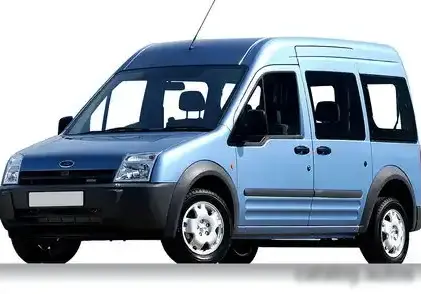
The Ford Tourneo Custom I L2 2.2 Duratorq TDCi, producing 100 horsepower, was a popular configuration of Ford’s versatile passenger van sold primarily in Europe from 2012 to 2017. Positioned as an entry-level to mid-range option within the Tourneo Custom lineup, it catered to buyers seeking a practical and economical multi-passenger vehicle. The L2 designation indicates the long wheelbase version, offering increased cargo and passenger space compared to the standard-length model. This variant played a significant role in Ford’s commercial vehicle sales, offering a balance between affordability, functionality, and fuel efficiency.
Technical Specifications
| Brand | Ford |
| Model | Tourneo Custom |
| Generation | Tourneo Custom I L2 |
| Type (Engine) | 2.2 Duratorq TDCi (100 Hp) |
| Start of production | 2012 |
| End of production | 2017 |
| Powertrain Architecture | Internal Combustion engine |
| Body type | Van |
| Seats | 8-9 |
| Doors | 5 |
| Fuel consumption (urban) | 7.3 l/100 km (32.2 US mpg) |
| Fuel consumption (extra urban) | 6.1 l/100 km (38.6 US mpg) |
| Fuel consumption (combined) | 6.5 l/100 km (36.2 US mpg) |
| CO2 emissions | 172 g/km |
| Fuel Type | Diesel |
| Maximum speed | 147 km/h (91.34 mph) |
| Emission standard | Euro 5 |
| Weight-to-power ratio | 21.8 kg/Hp |
| Weight-to-torque ratio | 7 kg/Nm |
| Power | 100 Hp @ 3500 rpm |
| Torque | 310 Nm @ 1300 rpm (228.64 lb.-ft. @ 1300 rpm) |
| Engine layout | Front, Transverse |
| Engine Model/Code | DRFF |
| Engine displacement | 2198 cm3 (134.13 cu. in.) |
| Number of cylinders | 4 |
| Engine configuration | Inline |
| Cylinder Bore | 86 mm (3.39 in.) |
| Piston Stroke | 94.6 mm (3.72 in.) |
| Number of valves per cylinder | 4 |
| Fuel injection system | Diesel Commonrail |
| Engine aspiration | Turbocharger, Intercooler |
| Valvetrain | DOHC |
| Engine oil capacity | 6.2 l (6.55 US qt | 5.46 UK qt) |
| Coolant capacity | 10 l (10.57 US qt | 8.8 UK qt) |
| Kerb Weight | 2178 kg (4801.67 lbs.) |
| Max. weight | 3000 kg (6613.87 lbs.) |
| Max load | 822 kg (1812.2 lbs.) |
| Fuel tank capacity | 80 l (21.13 US gal | 17.6 UK gal) |
| Permitted trailer load (braked) | 1400 kg (3086.47 lbs.) |
| Permitted trailer load (unbraked) | 750 kg (1653.47 lbs.) |
| Length | 5339 mm (210.2 in.) |
| Width | 1986 mm (78.19 in.) |
| Width including mirrors | 2272 mm (89.45 in.) |
| Height | 1827-1977 mm (71.93 – 77.83 in.) |
| Wheelbase | 3300 mm (129.92 in.) |
| Minimum turning circle | 12.8 m (41.99 ft.) |
| Drivetrain | Front wheel drive |
| Number of gears | 6 |
| Gearbox type | Manual transmission |
| Front brakes | Ventilated discs |
| Rear brakes | Disc |
| Tire size | 215/65 R15; 215/65 R16 |
| Wheel rim size | 6.5J x 15; 6.5J x 16 |
INTRODUCTION
The Ford Tourneo Custom I L2 2.2 Duratorq TDCi (100 hp) was introduced in 2012 as part of the first generation of the Tourneo Custom range. Built on the 1HX0 platform (shared with the Transit Custom), it represented a significant step forward in Ford’s light commercial vehicle offerings, moving away from the older, body-on-frame designs. The L2 variant, with its extended wheelbase, provided increased interior space, making it suitable for larger families, shuttle services, or businesses requiring ample cargo capacity. This 100 horsepower diesel engine option was designed to provide a balance of fuel economy and usability for everyday driving.
Powertrain & Engine Architecture
The heart of this Tourneo Custom variant is the 2.2-liter Duratorq TDCi diesel engine, specifically the DRFF engine code. This engine is a four-cylinder, inline configuration, utilizing a common-rail direct fuel injection system. The common-rail system, operating at very high pressures, ensures precise fuel delivery for optimized combustion and reduced emissions. A turbocharger with an intercooler is employed to boost power output and improve torque across a wider RPM range. The engine features a double overhead camshaft (DOHC) valvetrain, operating four valves per cylinder, enhancing breathing and contributing to improved performance. The 100 horsepower output is achieved at 3500 rpm, while the peak torque of 310 Nm (228.64 lb-ft) is available from a low 1300 rpm, providing good pulling power. This engine was paired with a six-speed manual transmission, chosen for its efficiency and driver control. While an automatic transmission was available on other Tourneo Custom trims, it wasn’t offered with this specific 100hp engine.
Driving Characteristics
The 100 hp 2.2 Duratorq TDCi in the Tourneo Custom L2 delivers adequate, but not exhilarating, performance. Acceleration is modest, particularly when fully loaded with passengers or cargo. The engine’s strength lies in its low-end torque, making it suitable for urban driving and navigating hilly terrain. The six-speed manual transmission allows drivers to keep the engine in its optimal power band. Compared to the higher-output versions of the 2.2 Duratorq (125 hp and 155 hp), this variant feels noticeably slower, especially during overtaking maneuvers. The gear ratios are tuned for fuel efficiency rather than outright speed. The long wheelbase of the L2 model contributes to a comfortable ride, but also results in a slightly less agile handling experience compared to the shorter wheelbase versions.
Equipment & Trim Levels
The 100 hp Tourneo Custom L2 typically came with a reasonable level of standard equipment, focusing on practicality and functionality. Standard features generally included power steering, ABS brakes, driver and passenger airbags, and a basic audio system. Interior upholstery was typically cloth, with durable plastics used throughout the cabin. Trim levels varied depending on the market, but common options included air conditioning, electric windows, central locking, and a trip computer. Optional extras could include alloy wheels, parking sensors, a navigation system, and upgraded audio systems. The L2 model’s spacious interior was a key selling point, offering flexible seating configurations to accommodate up to nine passengers.
Chassis & Braking
The Tourneo Custom L2 utilizes a front-wheel-drive layout with independent MacPherson strut suspension at the front and a semi-independent twist beam suspension at the rear. The front brakes are ventilated discs, providing good stopping power, while the rear brakes are solid discs. ABS (Anti-lock Braking System) is standard, enhancing safety during emergency braking situations. The suspension setup is tuned for comfort and load-carrying capacity, rather than sporty handling. Stabilizer bars are fitted to both the front and rear axles to reduce body roll during cornering. The chassis is a monocoque construction, providing a good balance of strength and weight.
Market Reception & Comparison
The Ford Tourneo Custom I L2 2.2 Duratorq TDCi (100 hp) was generally well-received by critics as a practical and economical multi-purpose vehicle. It was praised for its spacious interior, comfortable ride, and relatively low running costs. However, some reviewers noted that the 100 hp engine could feel underpowered, especially when the vehicle was fully loaded. Compared to the 125 hp and 155 hp versions, the 100 hp model offered lower purchase price and slightly better fuel economy, but at the expense of performance. The 1.9 TDI versions of competitor vans, like the Volkswagen Transporter, offered similar fuel economy and torque, but often at a higher price point. The Tourneo Custom’s competitive pricing and spaciousness made it a popular choice in the European market.
Legacy
The 2.2 Duratorq TDCi engine, in its various iterations, proved to be a relatively reliable powertrain. While not without its issues (such as potential problems with the dual-mass flywheel and turbocharger), it generally offered good longevity with proper maintenance. Today, used examples of the Tourneo Custom I L2 2.2 Duratorq TDCi (100 hp) are readily available and represent a relatively affordable option for those seeking a spacious and practical passenger van. The 100 hp version, while not the fastest, remains a viable choice for buyers prioritizing fuel economy and low running costs. Its simplicity and robust construction contribute to its continued appeal in the used car market.