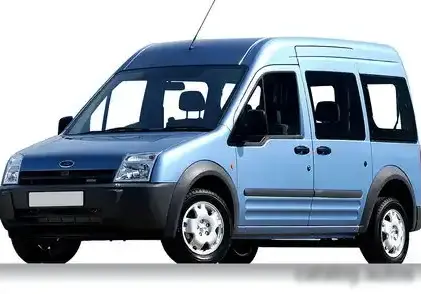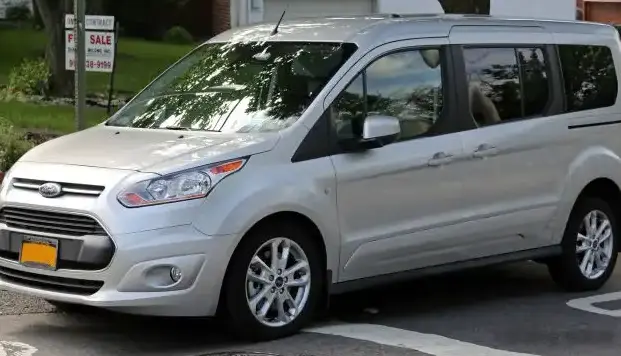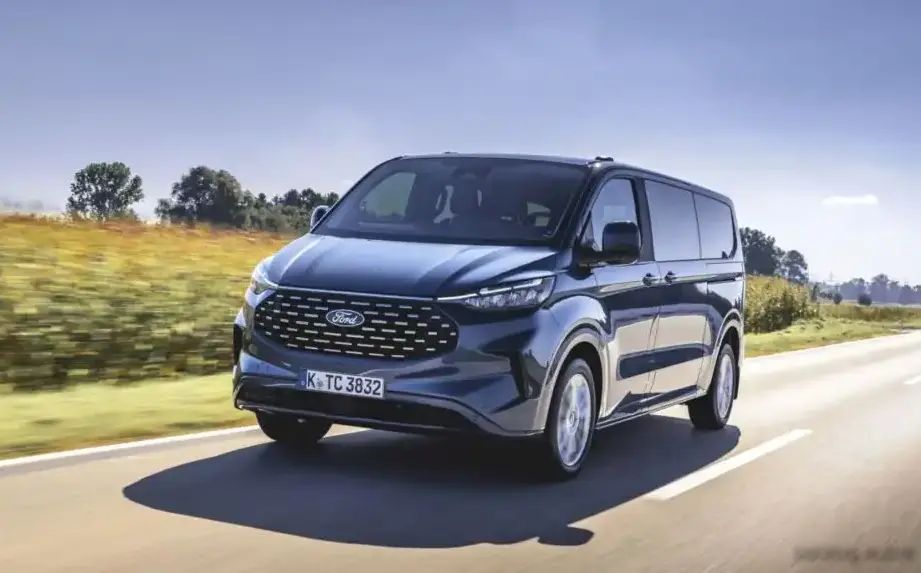
The Ford Tourneo Custom II L2 2.0 EcoBlue (136 Hp) AWD Automatic represents a significant iteration in Ford’s European van lineup, introduced in July 2023. Positioned as a versatile passenger vehicle, the Tourneo Custom II builds upon the success of its predecessor, offering increased space, improved efficiency, and enhanced technology. The “L2” designation indicates a long wheelbase version, maximizing interior volume. This particular variant, equipped with the 2.0 EcoBlue diesel engine producing 136 horsepower and paired with an eight-speed automatic transmission and all-wheel drive, aims to balance practicality, fuel economy, and all-weather capability for families and commercial users alike. It sits in the mid-range of the Tourneo Custom II offerings, providing a step up in performance and features from the base engine options while remaining more accessible than the higher-powered variants.
Technical Specifications
| Brand | Ford |
| Model | Tourneo Custom |
| Generation | Tourneo Custom II L2 |
| Type (Engine) | 2.0 EcoBlue (136 Hp) AWD Automatic |
| Start of production | July, 2023 |
| Powertrain Architecture | Internal Combustion engine |
| Body type | Van |
| Seats | 8-9 |
| Doors | 4-5 |
| Fuel consumption at Low speed (WLTP) | 11.1-12.4 l/100 km (21.2 – 19 US mpg, 25.4 – 22.8 UK mpg, 9 – 8.1 km/l) |
| Fuel consumption at Medium speed (WLTP) | 8.1-9.8 l/100 km (29 – 24 US mpg, 34.9 – 28.8 UK mpg, 12.3 – 10.2 km/l) |
| Fuel consumption at high speed (WLTP) | 7.2-9.6 l/100 km (32.7 – 24.5 US mpg, 39.2 – 29.4 UK mpg, 13.9 – 10.4 km/l) |
| Fuel consumption at very high speed (WLTP) | 9.2-13.3 l/100 km (25.6 – 17.7 US mpg, 30.7 – 21.2 UK mpg, 10.9 – 7.5 km/l) |
| Combined fuel consumption (WLTP) | 8.6-11.3 l/100 km (27.4 – 20.8 US mpg, 32.8 – 25 UK mpg, 11.6 – 8.8 km/l) |
| CO2 emissions (WLTP) | 225-296 g/km |
| Fuel Type | Diesel |
| Emission standard | Euro 6.2 |
| Weight-to-power ratio | 17.5 kg/Hp, 57.2 Hp/tonne |
| Weight-to-torque ratio | 6.6 kg/Nm, 151.4 Nm/tonne |
| Power | 136 Hp |
| Power per litre | 68.1 Hp/l |
| Torque | 360 Nm (265.52 lb.-ft.) |
| Engine layout | Front, Transverse |
| Engine Model/Code | BJAA |
| Engine displacement | 1996 cm3 (121.8 cu. in.) |
| Number of cylinders | 4 |
| Engine configuration | Inline |
| Cylinder Bore | 84.01 mm (3.31 in.) |
| Piston Stroke | 90.03 mm (3.54 in.) |
| Compression ratio | 16.5:1 |
| Number of valves per cylinder | 4 |
| Fuel injection system | Diesel Commonrail |
| Engine aspiration | Turbocharger, Intercooler |
| Valvetrain | DOHC |
| Engine oil capacity | 9.6 l (10.14 US qt | 8.45 UK qt) |
| Coolant | 12.7 l (13.42 US qt | 11.17 UK qt) |
| Kerb Weight | 2378-2402 kg (5242.59 – 5295.5 lbs.) |
| Max. weight | 3300 kg (7275.25 lbs.) |
| Max load | 898-922 kg (1979.75 – 2032.66 lbs.) |
| Trunk (boot) space – minimum | 819 l (28.92 cu. ft.) |
| Trunk (boot) space – maximum | 5472 l (193.24 cu. ft.) |
| Fuel tank capacity | 55 l (14.53 US gal | 12.1 UK gal) |
| AdBlue tank | 20 l (5.28 US gal | 4.4 UK gal) |
| Permitted trailer load with brakes (12%) | 2400 kg (5291.09 lbs.) |
| Permitted trailer load without brakes | 750 kg (1653.47 lbs.) |
| Length | 5450 mm (214.57 in.) |
| Width | 2032 mm (80 in.) |
| Width with mirrors folded | 2148 mm (84.57 in.) |
| Width including mirrors | 2275 mm (89.57 in.) |
| Height | 1963-2031 mm (77.28 – 79.96 in.) |
| Wheelbase | 3500 mm (137.8 in.) |
| Front track | 1730 mm (68.11 in.) |
| Rear (Back) track | 1721 mm (67.76 in.) |
| Front overhang | 958 mm (37.72 in.) |
| Rear overhang | 992 mm (39.06 in.) |
| Ride height (ground clearance) | 140 mm (5.51 in.) |
| Minimum turning circle (turning diameter) | 12.8 m (41.99 ft.) |
| Approach angle | 17.2° |
| Departure angle | 16.4° |
| Drivetrain Architecture | The Internal combustion engine (ICE) drives the front wheels permanently, and the rear wheels are driven through an electrically or mechanically operated clutch if necessary. |
| Drive wheel | All wheel drive (4×4) |
| Number of gears and type of gearbox | 8 gears, automatic transmission |
| Front suspension | Independent, type McPherson with coil spring and anti-roll bar |
| Rear suspension | Independent coil spring, Trailing arm |
| Front brakes | Ventilated discs, 308 mm |
| Rear brakes | Ventilated discs, 304 mm |
| Assisting systems | ABS (Anti-lock braking system) |
| Steering type | Steering rack and pinion |
| Power steering | Electric Steering |
| Tires size | 215/60 R17 |
| Wheel rims size | 6.5J x 17 |
Powertrain & Engine Architecture
The heart of this Tourneo Custom variant is the Ford 2.0 EcoBlue diesel engine, specifically the BJAA code. This engine is a four-cylinder, inline configuration, utilizing a turbocharger with intercooling to boost power and efficiency. The 2.0 EcoBlue family is known for its advanced combustion technology, including high-pressure fuel injection and sophisticated exhaust gas recirculation (EGR) systems to minimize emissions. The engine boasts a compression ratio of 16.5:1, contributing to its thermal efficiency. The diesel commonrail fuel injection system delivers precise fuel metering for optimal combustion. Paired with this engine is an eight-speed automatic transmission, designed to provide smooth gear changes and efficient power delivery. This transmission is crucial for managing the engine’s torque output and optimizing fuel economy, especially when fully loaded or traversing varied terrain. The all-wheel-drive system engages the rear wheels when traction is needed, enhancing stability and control in slippery conditions.
Driving Characteristics
The 136 horsepower and 360 Nm (265.52 lb.-ft.) of torque offered by this powertrain configuration provide adequate performance for everyday driving and moderate loads. While not as brisk as the higher-powered EcoBlue variants, the 2.0L engine delivers a usable amount of power for highway cruising and city driving. The eight-speed automatic transmission helps to keep the engine in its optimal power band, providing responsive acceleration. The all-wheel-drive system adds a layer of confidence, particularly in inclement weather. Compared to a manual transmission version, the automatic offers greater convenience, especially in stop-and-go traffic. However, it may result in a slight reduction in fuel economy and a less engaging driving experience for some drivers. The gear ratios are tuned for a balance between acceleration and fuel efficiency, prioritizing usability over outright performance.
Equipment & Trim Levels
The Tourneo Custom II L2 2.0 EcoBlue (136 Hp) AWD Automatic typically comes equipped with a range of standard features, including air conditioning, power windows, central locking, and a basic audio system. Higher trim levels add features such as a touchscreen infotainment system with navigation, Apple CarPlay and Android Auto compatibility, and advanced driver-assistance systems (ADAS) like adaptive cruise control and lane-keeping assist. Interior upholstery is typically cloth, with options for leather upgrades. The L2 wheelbase provides ample space for passengers and cargo, with flexible seating configurations available. Optional extras often include parking sensors, a rearview camera, and upgraded sound systems.
Chassis & Braking
The Tourneo Custom II utilizes an independent suspension setup, with McPherson struts at the front and a trailing arm configuration at the rear. This setup provides a comfortable ride quality and good handling characteristics. The vehicle is equipped with ventilated disc brakes on all four wheels, providing ample stopping power. An Anti-lock Braking System (ABS) is standard, enhancing safety during emergency braking maneuvers. The electric power steering provides light and precise steering feel. The chassis is designed to accommodate the vehicle’s weight and provide a stable platform for carrying passengers and cargo.
Market Reception & Comparison
The Ford Tourneo Custom II L2 2.0 EcoBlue (136 Hp) AWD Automatic has been generally well-received in the European market as a practical and versatile passenger vehicle. Critics have praised its spacious interior, comfortable ride, and improved fuel efficiency compared to older models. Compared to the higher-powered EcoBlue variants, this 136 hp version offers a more affordable entry point into the Tourneo Custom II range. It also provides better fuel economy than the more powerful engines. However, some reviewers have noted that the performance can feel somewhat strained when the vehicle is fully loaded or traveling uphill. Compared to competitors like the Volkswagen Multivan and Mercedes-Benz Vito, the Tourneo Custom II offers a competitive combination of price, space, and features.
Legacy
The 2.0 EcoBlue engine family has proven to be relatively reliable, with good long-term durability. The eight-speed automatic transmission has also demonstrated a good track record. However, as with any diesel engine, proper maintenance is crucial to ensure longevity. Regular oil changes, filter replacements, and AdBlue refills are essential. In the used car market, the Tourneo Custom II L2 2.0 EcoBlue (136 Hp) AWD Automatic is likely to hold its value reasonably well, particularly if it has been well-maintained and has a full service history. Its versatility and practicality make it a desirable option for families and businesses alike.