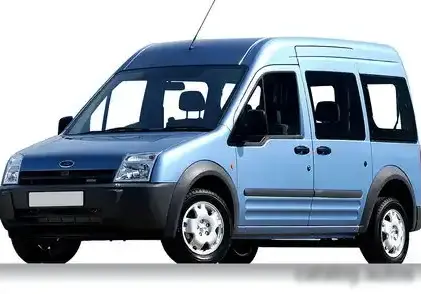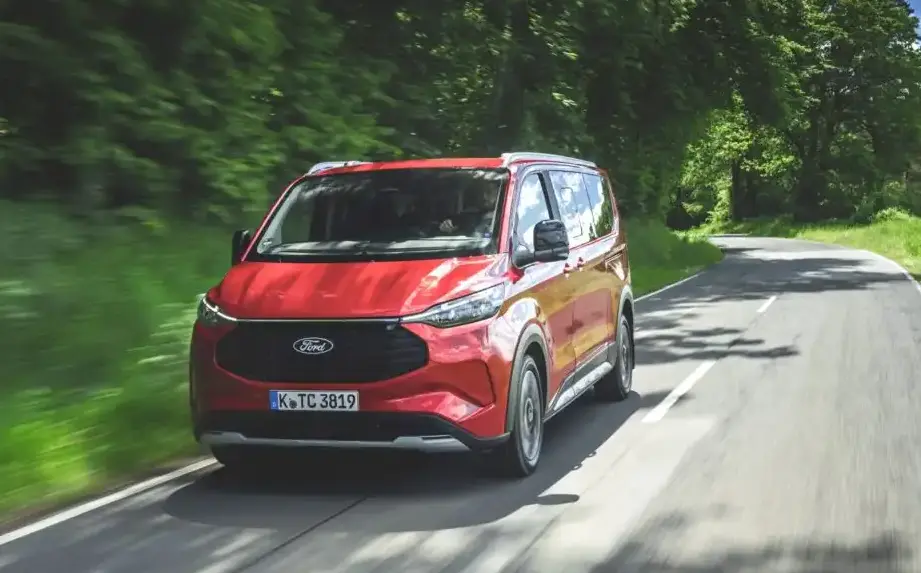
The Ford Tourneo Custom II L2 2.5 Duratec (233 Hp) Plug-in Hybrid CVT, introduced in March 2024, represents Ford’s entry into the increasingly popular plug-in hybrid van segment. This variant is part of the second generation Tourneo Custom (launched in 2023), specifically the long-wheelbase (L2) configuration, designed to offer a balance of passenger capacity, cargo space, and improved fuel efficiency. Positioned as a premium offering within the Tourneo Custom lineup, it caters to both commercial and family users seeking a versatile and environmentally conscious vehicle. The Tourneo Custom II builds upon the foundation of the 1HX0/A3 platform, shared with other Ford and Stellantis vehicles, but distinguishes itself with its advanced hybrid powertrain.
Technical Specifications
| Brand | Ford |
| Model | Tourneo Custom |
| Generation | Tourneo Custom II L2 |
| Type (Engine) | 2.5 Duratec (233 Hp) Plug-in Hybrid CVT |
| Start of production | March, 2024 |
| Powertrain Architecture | PHEV (Plug-in Hybrid Electric Vehicle) |
| Body type | Van |
| Seats | 8-9 |
| Doors | 4-5 |
| Combined fuel consumption (WLTP) | 1.8-2.9 l/100 km (130.7 – 81.1 US mpg, 156.9 – 97.4 UK mpg, 55.6 – 34.5 km/l) |
| CO2 emissions (WLTP) | 40-65 g/km |
| Fuel Type | Petrol / electricity |
| Emission standard | Euro 6.2 |
| Gross battery capacity | 16.5 kWh |
| Net (usable) battery capacity | 11.8 kWh |
| Battery technology | Lithium nickel manganese cobalt oxides (Li-NMC) |
| Battery location | Below the floor |
| All-electric range (WLTP) | 40-51 km (24.85 – 31.69 mi) |
| Average Energy consumption (WLTP) | 19.9-26.2 kWh/100 km (32.03 – 42.16 kWh/100 mi, 105 – 80 MPGe, 5 – 3.8 km/kWh, 3.1 – 2.4 mi/kWh) |
| Electric motor power | 152 Hp |
| Electric motor Torque | 320 Nm (236.02 lb.-ft.) |
| Electric motor location | Integrated into the transmission |
| Electric motor type | Synchronous |
| System power | 233 Hp |
| Internal combustion engine specs Power | 118 Hp |
| Power per litre | 47.4 Hp/l |
| Torque | 205 Nm (151.2 lb.-ft.) |
| Engine layout | Front, Transverse |
| Engine Model/Code | BGFA |
| Engine displacement | 2488 cm3 (151.83 cu. in.) |
| Number of cylinders | 4 |
| Engine configuration | Inline |
| Cylinder Bore | 89 mm (3.5 in.) |
| Piston Stroke | 100 mm (3.94 in.) |
| Compression ratio | 13:1 |
| Number of valves per cylinder | 4 |
| Fuel injection system | Multi-port manifold injection |
| Engine aspiration | Naturally aspirated engine |
| Valvetrain | DOHC, VCT |
| Trunk (boot) space – minimum | 819 l (28.92 cu. ft.) |
| Trunk (boot) space – maximum | 5472 l (193.24 cu. ft.) |
| Fuel tank capacity | 63 l (16.64 US gal | 13.86 UK gal) |
| Permitted trailer load with brakes (12%) | 1850 kg (4078.55 lbs.) |
| Length | 5450 mm (214.57 in.) |
| Width | 2032 mm (80 in.) |
| Width with mirrors folded | 2148 mm (84.57 in.) |
| Width including mirrors | 2275 mm (89.57 in.) |
| Height | 1963-2031 mm (77.28 – 79.96 in.) |
| Wheelbase | 3500 mm (137.8 in.) |
| Front track | 1730 mm (68.11 in.) |
| Rear (Back) track | 1721 mm (67.76 in.) |
| Front overhang | 958 mm (37.72 in.) |
| Rear overhang | 992 mm (39.06 in.) |
| Ride height (ground clearance) | 140 mm (5.51 in.) |
| Minimum turning circle (turning diameter) | 12.8-13.6 m (41.99 – 44.62 ft.) |
| Approach angle | 17.2° |
| Departure angle | 16.4° |
| Drivetrain Architecture | The Internal combustion engine (ICE) and electric motor drive the front wheels of the car with the ability to work in full electric or mixed mode. |
| Drive wheel | Front wheel drive |
| Number of gears and type of gearbox | automatic transmission CVT |
| Front suspension | Independent, type McPherson with coil spring and anti-roll bar |
| Rear suspension | Independent coil spring, Trailing arm |
| Front brakes | Ventilated discs, 308 mm |
| Rear brakes | Ventilated discs, 304 mm |
| Assisting systems | ABS (Anti-lock braking system) |
| Steering type | Steering rack and pinion |
| Power steering | Electric Steering |
| Tires size | 215/65 R16; 215/60 R17; 235/50 R19 |
| Wheel rims size | 6.5J x 16; 6.5J x 17; 7.5J x 19 |
Powertrain & Engine Architecture
The Tourneo Custom II L2 2.5 Duratec Plug-in Hybrid utilizes a sophisticated powertrain combining a 2.5-liter Duratec four-cylinder gasoline engine (BGFA engine code) with an electric motor and a 16.5 kWh lithium-ion battery pack. The gasoline engine produces 118 horsepower and 205 Nm (151.2 lb-ft) of torque. The electric motor contributes an additional 152 horsepower and 320 Nm (236.02 lb-ft) of torque. Combined, the system delivers a total output of 233 horsepower. The engine employs multi-port fuel injection and a double overhead camshaft (DOHC) valvetrain with variable camshaft timing (VCT) to optimize efficiency and performance. The continuously variable transmission (CVT) is specifically tuned to work seamlessly with both the internal combustion engine and the electric motor, providing smooth and efficient power delivery. The battery pack is located under the floor, minimizing impact on passenger and cargo space.
Driving Characteristics
The 2.5 Duratec Plug-in Hybrid CVT offers a unique driving experience. In pure electric mode, the van provides silent and emission-free operation, suitable for urban environments and short trips. The all-electric range of 40-51 km (24.85 – 31.69 mi) allows for significant reduction in fuel consumption for daily commutes. When the battery is depleted or requires assistance during acceleration, the gasoline engine seamlessly kicks in. The CVT transmission, while prioritizing efficiency, can feel less responsive than traditional automatic transmissions, particularly during aggressive acceleration. However, it effectively manages the power delivery from both the engine and the electric motor. Compared to non-hybrid Tourneo Custom variants, this plug-in hybrid model offers superior fuel economy and reduced emissions, albeit with a slightly higher initial cost.
Equipment & Trim Levels
The Tourneo Custom II L2 2.5 Duratec Plug-in Hybrid CVT typically comes well-equipped, reflecting its position as a premium trim. Standard features often include air conditioning, a touchscreen infotainment system with smartphone integration (Apple CarPlay and Android Auto), a rearview camera, and various driver-assistance systems such as lane-keeping assist and automatic emergency braking. Interior upholstery is typically cloth or a combination of cloth and leatherette. Optional extras can include a panoramic sunroof, upgraded sound system, navigation system, and premium leather upholstery. The L2 long-wheelbase configuration provides ample space for up to nine passengers or a significant amount of cargo.
Chassis & Braking
The Tourneo Custom II L2 features an independent suspension setup, with McPherson struts at the front and a trailing arm configuration at the rear. This setup provides a comfortable ride quality, even when fully loaded. Ventilated disc brakes are used on all four wheels, ensuring adequate stopping power. The electronic stability control (ESC) system and anti-lock braking system (ABS) are standard, enhancing safety and control. The steering is electrically assisted, providing light and precise steering feel.
Market Reception & Comparison
The Ford Tourneo Custom II L2 2.5 Duratec Plug-in Hybrid CVT has been generally well-received by critics for its fuel efficiency, practicality, and comfortable ride. Its plug-in hybrid powertrain offers a compelling alternative to traditional diesel-powered vans, particularly in urban areas with emission restrictions. Compared to the standard gasoline and diesel Tourneo Custom variants, the plug-in hybrid model offers significantly improved fuel economy and reduced emissions, but comes at a higher price point. Compared to competitors like the Mercedes-Benz Vito E-Cell and the Volkswagen Multivan eHybrid, the Tourneo Custom offers a competitive combination of price, features, and practicality.
Legacy
As a relatively new model (introduced in 2024), the long-term reliability of the Tourneo Custom II L2 2.5 Duratec Plug-in Hybrid CVT is still being established. However, Ford has a generally good reputation for building durable and reliable vehicles. The Duratec engine family has proven to be robust, and the hybrid powertrain components are covered by a comprehensive warranty. In the used car market, this variant is expected to hold its value well due to its fuel efficiency and environmentally friendly credentials. The increasing demand for electric and hybrid vehicles is likely to further enhance its appeal in the years to come.