Technical Specifications
| Brand | Ford |
| Model | Transit Connect |
| Generation | Transit Connect II (facelift 2018) Panel Van L2 |
| Type (Engine) | 1.5 EcoBlue (120 Hp) |
| Start of production | 2018 |
| End of production | 2023 |
| Powertrain Architecture | Internal Combustion engine |
| Body type | Minivan |
| Seats | 2-3 |
| Doors | 4-5 |
| Fuel consumption (urban) | 5.2-5.3 l/100 km (45.2 – 44.4 US mpg) |
| Fuel consumption (extra urban) | 4.4-4.6 l/100 km (53.5 – 51.1 US mpg) |
| Fuel consumption (combined) | 4.7-5 l/100 km (50 – 47 US mpg) |
| CO2 emissions | 124-130 g/km |
| Fuel Type | Diesel |
| Emission standard | Euro 6d-TEMP-EVAP-ISC |
| Weight-to-power ratio | 12.9 kg/Hp |
| Weight-to-torque ratio | 5.7 kg/Nm |
| Power | 120 Hp |
| Torque | 270 Nm (199.14 lb.-ft.) |
| Engine layout | Front, Transverse |
| Engine Model/Code | ZTGA |
| Engine displacement | 1498 cm3 (91.41 cu. in.) |
| Number of cylinders | 4 |
| Engine configuration | Inline |
| Cylinder Bore | 75 mm (2.95 in.) |
| Piston Stroke | 84.8 mm (3.34 in.) |
| Number of valves per cylinder | 4 |
| Fuel injection system | Diesel Commonrail |
| Engine aspiration | Turbocharger, Intercooler |
| Valvetrain | DOHC |
| Engine oil capacity | 6 l (6.34 US qt | 5.28 UK qt) |
| Coolant capacity | 7 l (7.4 US qt | 6.16 UK qt) |
| Kerb Weight | 1545-1600 kg (3406.14 – 3527.4 lbs.) |
| Max. weight | 2255-2405 kg (4971.42 – 5302.12 lbs.) |
| Max load | 710-805 kg (1565.28 – 1774.72 lbs.) |
| Trunk (boot) space – minimum | 3200 l (113.01 cu. ft.) |
| Trunk (boot) space – maximum | 4400 l (155.38 cu. ft.) |
| Fuel tank capacity | 60 l (15.85 US gal | 13.2 UK gal) |
| AdBlue tank | 17 l (4.49 US gal | 3.74 UK gal) |
| Permitted trailer load (braked) | 1500 kg (3306.93 lbs.) |
| Permitted trailer load (unbraked) | 750 kg (1653.47 lbs.) |
| Length | 4825 mm (189.96 in.) |
| Width | 1835 mm (72.24 in.) |
| Width with mirrors folded | 1967 mm (77.44 in.) |
| Width including mirrors | 2137 mm (84.13 in.) |
| Height | 1828 mm (71.97 in.) |
| Wheelbase | 3062 mm (120.55 in.) |
| Front track | 1568 mm (61.73 in.) |
| Rear track | 1582 mm (62.28 in.) |
| Drivetrain | Front wheel drive |
| Number of gears | 6 |
| Gearbox type | Manual |
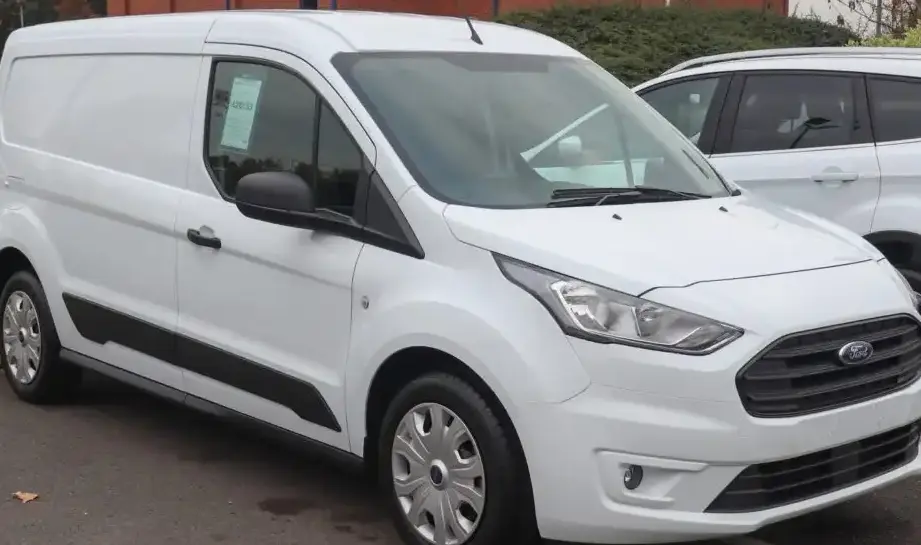
The Ford Transit Connect II, specifically the L2 Panel Van configuration powered by the 1.5 EcoBlue 120 horsepower engine, represents a significant iteration in Ford’s compact commercial vehicle lineup. Introduced with the 2018 facelift and continuing through 2023, this variant aimed to balance fuel efficiency, practicality, and affordability for businesses and tradespeople in the North American and European markets. Positioned as a mid-range offering within the Transit Connect II series, it slotted between the lower-powered diesel options and the more expensive, higher-output engines. The L2 designation indicates the long wheelbase version, providing increased cargo capacity compared to the standard L1 model. This generation of the Transit Connect, built on the Ford global C/B platform, shared engineering with the Focus, offering a more car-like driving experience than traditional vans.
Powertrain & Engine Architecture
The heart of this Transit Connect variant is the 1.5-liter EcoBlue turbocharged diesel engine, designated with the engine code ZTGA. This engine is part of Ford’s EcoBlue family, designed for improved efficiency and reduced emissions. The 1.5L EcoBlue utilizes a common-rail direct fuel injection system, delivering fuel directly into the combustion chamber at extremely high pressure for optimized combustion. A single turbocharger with an intercooler provides forced induction, boosting power output. The engine features a Dual Overhead Camshaft (DOHC) valvetrain with four valves per cylinder, enhancing breathing and contributing to its power delivery. The 6-speed manual transmission was standard, offering a balance between fuel economy and driver control. The EcoBlue engine also incorporates features like a particulate filter to meet stringent Euro 6d-TEMP emission standards.
Driving Characteristics
The 120 horsepower EcoBlue engine, paired with the 6-speed manual transmission, provides adequate performance for typical commercial use. Acceleration is not brisk, but sufficient for merging onto highways and maintaining speed with a moderate load. The gear ratios are tuned for fuel efficiency, meaning the engine operates at lower RPMs during cruising. Compared to higher-output versions of the Transit Connect, this variant feels less powerful, particularly when fully loaded. However, the lower power output also contributes to better fuel economy. The manual transmission allows for greater driver control and engagement compared to an automatic, and the relatively light weight of the vehicle helps to offset the modest horsepower figure.
Equipment & Trim Levels
The L2 Panel Van 1.5 EcoBlue (120 Hp) typically came with a functional, work-oriented interior. Standard features included a driver’s airbag, anti-lock brakes (ABS), and basic steel wheels. The cabin was designed for durability and ease of cleaning, with hard-wearing plastics and vinyl upholstery. Higher trim levels offered options such as air conditioning, a basic audio system with Bluetooth connectivity, power windows, and upgraded seating. The L2 configuration provided a substantial cargo area, making it ideal for businesses requiring ample space for goods or equipment. Optional features included parking sensors, a rearview camera, and a navigation system.
Chassis & Braking
The Transit Connect II utilizes an independent McPherson strut front suspension, providing a comfortable ride and predictable handling. The rear suspension employs a semi-dependent beam axle with a stabilizer bar, offering a good balance between load-carrying capacity and stability. The front brakes are ventilated discs, while the rear brakes are discs. The electric power steering provides light and responsive steering feel. The tires are typically sized 205/60 R16 or 215/55 R16, depending on the trim level.
Market Reception & Comparison
The 1.5 EcoBlue 120 horsepower Transit Connect was generally well-received by critics as a practical and fuel-efficient work vehicle. It was praised for its spacious interior, car-like driving dynamics, and competitive fuel economy. Compared to the higher-powered diesel options, this variant offered a lower purchase price and slightly better fuel efficiency, making it attractive to budget-conscious buyers. However, some reviewers noted that the engine could feel underpowered when fully loaded or when driving uphill. Compared to gasoline-powered alternatives, the diesel engine provided significantly better fuel economy, particularly for high-mileage applications.
Legacy
The 1.5 EcoBlue engine has proven to be a relatively reliable powertrain, with few widespread issues reported. The Transit Connect II, in general, has established a reputation for durability and low running costs. On the used car market, these models remain popular choices for small businesses and tradespeople seeking a dependable and affordable commercial vehicle. The combination of fuel efficiency, practicality, and relatively low maintenance costs ensures that the 1.5 EcoBlue 120 horsepower Transit Connect L2 continues to be a viable option for those needing a compact van.