Technical Specifications
| Brand | Ford |
| Model | Transit Connect |
| Generation | Transit Connect II Panel Van L1 |
| Type (Engine) | 1.5 TDCi (100 Hp) Start-Stop |
| Start of production | 2015 |
| End of production | 2018 |
| Powertrain Architecture | Internal Combustion engine |
| Body type | Minivan |
| Seats | 2-3 |
| Doors | 4-5 |
| Fuel consumption (urban) | 4.8 l/100 km (49 US mpg, 58.9 UK mpg, 20.8 km/l) |
| Fuel consumption (extra urban) | 4.3 l/100 km (54.7 US mpg, 65.7 UK mpg, 23.3 km/l) |
| Fuel consumption (combined) | 4.4 l/100 km (53.5 US mpg, 64.2 UK mpg, 22.7 km/l) |
| CO2 emissions | 115 g/km |
| Fuel Type | Diesel |
| Emission standard | Euro 6 |
| Weight-to-power ratio | 13.9 kg/Hp, 71.8 Hp/tonne |
| Weight-to-torque ratio | 5.6 kg/Nm, 179.6 Nm/tonne |
| Power | 100 Hp |
| Power per litre | 66.7 Hp/l |
| Torque | 250 Nm @ 2000-2500 rpm (184.39 lb.-ft. @ 2000-2500 rpm) |
| Engine layout | Front, Transverse |
| Engine Model/Code | Duratorq / XVGA, XVGB |
| Engine displacement | 1499 cm3 (91.47 cu. in.) |
| Number of cylinders | 4 |
| Engine configuration | Inline |
| Cylinder Bore | 73.5 mm (2.89 in.) |
| Piston Stroke | 88.3 mm (3.48 in.) |
| Number of valves per cylinder | 2 |
| Fuel injection system | Diesel Commonrail |
| Engine aspiration | Turbocharger, Intercooler |
| Valvetrain | SOHC |
| Engine oil capacity | 6.2 l (6.55 US qt | 5.46 UK qt) |
| Coolant capacity | 6 l (6.34 US qt | 5.28 UK qt) |
| Kerb Weight | 1392-1435 kg (3068.83 – 3163.63 lbs.) |
| Max. weight | 2005-2215 kg (4420.27 – 4883.24 lbs.) |
| Max load | 613-780 kg (1351.43 – 1719.61 lbs.) |
| Trunk (boot) space – minimum | 2630 l (92.88 cu. ft.) |
| Trunk (boot) space – maximum | 3700 l (130.66 cu. ft.) |
| Fuel tank capacity | 60 l (15.85 US gal | 13.2 UK gal) |
| Permitted trailer load (braked) | 1300 kg (2866.01 lbs.) |
| Permitted trailer load (unbraked) | 720 kg (1587.33 lbs.) |
| Length | 4418 mm (173.94 in.) |
| Width | 1835 mm (72.24 in.) |
| Width (including mirrors) | 2137 mm (84.13 in.) |
| Height | 1861 mm (73.27 in.) |
| Wheelbase | 2662 mm (104.8 in.) |
| Front track | 1568 mm (61.73 in.) |
| Rear track | 1584-1585 mm (62.36 – 62.4 in.) |
| Front overhang | 878 mm (34.57 in.) |
| Rear overhang | 878 mm (34.57 in.) |
| Ride height (ground clearance) | 152 mm (5.98 in.) |
| Turning circle | 11.7 m (38.39 ft.) |
| Drivetrain | Front wheel drive |
| Number of gears | 5 |
| Gearbox type | Manual transmission |
| Front suspension | Independent, McPherson with coil spring and anti-roll bar |
| Rear suspension | Coil spring, Torsion |
| Front brakes | Ventilated discs, 300 mm |
| Rear brakes | Disc, 280 mm |
| Assisting systems | ABS (Anti-lock braking system) |
| Steering type | Steering rack and pinion |
| Power steering | Electric |
| Tires size | 205/60 R16 |
| Wheel rims size | 6.5J x 16 |
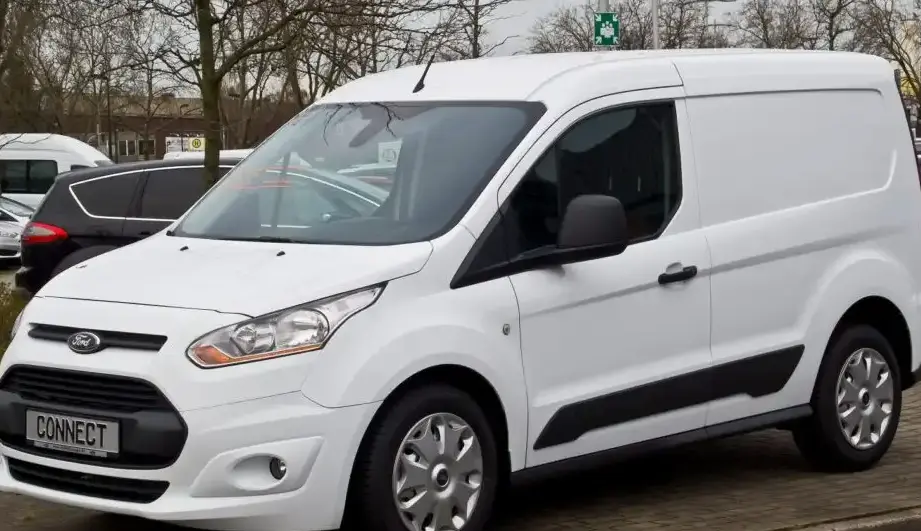
The Ford Transit Connect II Panel Van L1 1.5 TDCi (100 hp) Start-Stop, produced from 2015 to 2018, represents a key iteration in Ford’s compact commercial vehicle lineup. Positioned as an entry-level offering within the second-generation Transit Connect range (based on the Ford C2 platform, shared with the Focus), this variant aimed to provide a fuel-efficient and practical solution for businesses and tradespeople. It primarily served as a workhorse vehicle in both European and North American markets, balancing affordability with functionality. This specific configuration, with the 1.5-liter diesel engine and a five-speed manual transmission, was a popular choice for those prioritizing lower running costs over outright performance.
Powertrain & Engine Architecture
The core of this Transit Connect variant is the 1.5-liter Duratorq TDCi diesel engine, identified by the engine codes XVGA or XVGB depending on the specific build. This engine features a four-cylinder, inline configuration with a single overhead camshaft (SOHC) valvetrain operating two valves per cylinder. A turbocharger, coupled with an intercooler, enhances power and efficiency, delivering 100 horsepower and 250 Nm (184 lb-ft) of torque between 2000 and 2500 rpm. The engine utilizes a diesel common rail direct injection system, optimizing fuel delivery for improved combustion and reduced emissions. The standard transmission was a five-speed manual, providing a straightforward and durable drivetrain. The inclusion of a Start-Stop system further contributes to fuel economy by automatically shutting down the engine when stationary and instantly restarting it upon clutch engagement.
Driving Characteristics
The combination of the 1.5 TDCi 100 hp engine and the five-speed manual gearbox delivers a practical, though not particularly exhilarating, driving experience. Acceleration is sufficient for typical urban and highway driving, but the van isn’t geared for quick overtaking maneuvers. The gear ratios are optimized for fuel efficiency, requiring the engine to be revved to reach its peak power output. Compared to higher-output Transit Connect models, such as those equipped with the 1.6-liter EcoBoost gasoline engine, this diesel variant feels noticeably slower. However, the diesel’s low-end torque provides ample pulling power for carrying loads. The manual transmission offers precise control, although the shift quality isn’t as refined as some competitors.
Equipment & Trim Levels
The L1 1.5 TDCi typically came equipped with a functional, albeit basic, set of standard features. These included power steering, ABS, driver and passenger airbags, and a basic audio system. Interior upholstery was generally durable cloth. Optional extras, available for an additional cost, included air conditioning, a trip computer, electric windows, and rear parking sensors. The van’s interior design prioritized practicality, utilizing hard-wearing materials and maximizing cargo space. Trim levels were relatively limited, with most customization options offered as individual upgrades.
Chassis & Braking
The Transit Connect II employed a front-wheel-drive layout with an independent McPherson strut suspension at the front and a semi-independent torsion beam suspension at the rear. This configuration strikes a balance between ride comfort and handling. The front brakes are ventilated discs, while the rear brakes are solid discs. ABS (Anti-lock Braking System) is standard, enhancing safety during emergency braking situations. The suspension tuning prioritizes load-carrying capacity, resulting in a slightly firmer ride compared to typical passenger vehicles.
Market Reception & Comparison
The Ford Transit Connect II 1.5 TDCi (100 hp) Start-Stop generally received positive reviews for its fuel efficiency and practicality. Critics often praised its compact size, making it easy to maneuver in urban environments. However, some reviewers noted the engine’s limited power and the relatively basic interior appointments. When compared to other small vans in its class, such as the Volkswagen Caddy and the Citroën Berlingo, the Transit Connect offered a competitive price point and a generous cargo area. Its fuel economy was comparable to its rivals, and its reliability proved to be generally good, although some owners reported occasional issues with the diesel particulate filter (DPF).
Legacy
The 1.5 TDCi engine, while not renowned for exceptional power, has proven to be a relatively durable and reliable unit when properly maintained. The Transit Connect II, as a whole, has earned a reputation as a dependable workhorse. In the used car market, these vans remain relatively affordable and are popular choices among small businesses and tradespeople. The diesel particulate filter (DPF) remains a potential maintenance concern, particularly for vehicles primarily used for short trips. However, with regular servicing and careful driving habits, the 1.5 TDCi engine can provide many years of reliable service.