Technical Specifications
| Brand | Ford |
| Model | Transit Connect |
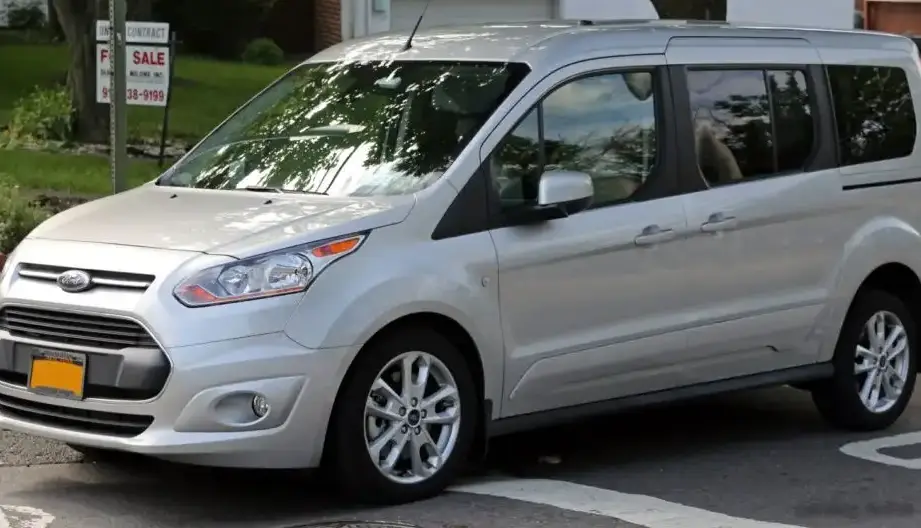
| Generation | Transit Connect II Wagon L2 |
| Type (Engine) | 1.5 TDCi (120 Hp) |
| Start of production | 2015 |
| End of production | 2018 |
| Powertrain Architecture | Internal Combustion engine |
| Body type | Minivan |
| Seats | 5-7 |
| Doors | 5 |
| Fuel consumption (economy) – urban (NEDC) | 4.9 l/100 km (48 US mpg, 57.6 UK mpg, 20.4 km/l) |
| Fuel consumption (economy) – extra urban (NEDC) | 4.4 l/100 km (53.5 US mpg, 64.2 UK mpg, 22.7 km/l) |
| Fuel consumption (economy) – combined (NEDC) | 4.6 l/100 km (51.1 US mpg, 61.4 UK mpg, 21.7 km/l) |
| CO2 emissions (NEDC) | 119 g/km |
| Fuel Type | Diesel |
| Emission standard | Euro 6 |
| Weight-to-power ratio | 12.9 kg/Hp, 77.7 Hp/tonne |
| Weight-to-torque ratio | 5.7 kg/Nm, 174.9 Nm/tonne |
| Power | 120 Hp |
| Power per litre | 80.1 Hp/l |
| Torque | 270 Nm @ 1750-2500 rpm (199.14 lb.-ft. @ 1750-2500 rpm) |
| Engine layout | Front, Transverse |
| Engine Model/Code | Duratorq / XWGA |
| Engine displacement | 1499 cm3 (91.47 cu. in.) |
| Number of cylinders | 4 |
| Engine configuration | Inline |
| Cylinder Bore | 73.5 mm (2.89 in.) |
| Piston Stroke | 88.3 mm (3.48 in.) |
| Number of valves per cylinder | 2 |
| Fuel injection system | Diesel Commonrail |
| Engine aspiration | Turbocharger, Intercooler |
| Valvetrain | SOHC |
| Engine oil capacity | 6.2 l (6.55 US qt | 5.46 UK qt) |
| Coolant | 6 l (6.34 US qt | 5.28 UK qt) |
| Kerb Weight | 1544-1593 kg (3403.94 – 3511.96 lbs.) |
| Max. weight | 2300 kg (5070.63 lbs.) |
| Max load | 707-756 kg (1558.67 – 1666.69 lbs.) |
| Trunk (boot) space – minimum | 322 l (11.37 cu. ft.) |
| Trunk (boot) space – maximum | 2761 l (97.5 cu. ft.) |
| Fuel tank capacity | 60 l (15.85 US gal | 13.2 UK gal) |
| Permitted trailer load with brakes (12%) | 1200 kg (2645.55 lbs.) |
| Permitted trailer load without brakes | 750 kg (1653.47 lbs.) |
| Length | 4818 mm (189.69 in.) |
| Width | 1835 mm (72.24 in.) |
| Width including mirrors | 2137 mm (84.13 in.) |
| Height | 1828-1845 mm (71.97 – 72.64 in.) |
| Wheelbase | 3062 mm (120.55 in.) |
| Front track | 1568 mm (61.73 in.) |
| Rear (Back) track | 1584 mm (62.36 in.) |
| Front overhang | 878 mm (34.57 in.) |
| Rear overhang | 878 mm (34.57 in.) |
| Ride height (ground clearance) | 163 mm (6.42 in.) |
| Minimum turning circle (turning diameter) | 12.5 m (41.01 ft.) |
| Drivetrain Architecture | The Internal combustion engine (ICE) drives the front wheels of the vehicle. |
| Drive wheel | Front wheel drive |
| Number of gears and type of gearbox | 6 gears, manual transmission |
| Front suspension | Independent, type McPherson with coil spring and anti-roll bar |
| Rear suspension | Coil spring, Torsion |
| Front brakes | Ventilated discs, 320×25 mm |
| Rear brakes | Disc, 280×11 mm |
| Assisting systems | ABS (Anti-lock braking system) |
| Steering type | Steering rack and pinion |
| Power steering | Electric Steering |
| Tires size | 205/60 R16 |
| Wheel rims size | 6.5J x 16 |
The Ford Transit Connect II Wagon L2 1.5 TDCi, launched in 2015, built upon the success of the first-generation Transit Connect, offering a more refined and efficient package. Based on the global Ford C/MPV platform (also underpinning the Ford Focus and C-Max), the L2 variant distinguished itself with its extended wheelbase, providing a substantial increase in cargo and passenger space. This model year saw the introduction of the 1.5-liter Duratorq diesel engine, replacing the previous 1.6-liter unit, aiming for improved fuel economy and reduced emissions. The Transit Connect II was never officially sold in the United States in wagon form; the US market received only the cargo van version.
Powertrain & Engine Architecture
The heart of the Transit Connect II Wagon L2 1.5 TDCi is the Duratorq engine, specifically the XWGA code. This 1.5-liter inline-four cylinder diesel engine utilizes a common-rail direct fuel injection system, delivering fuel at extremely high pressure for optimized combustion. A turbocharger with an intercooler further enhances performance by forcing more air into the cylinders. The engine features a single overhead camshaft (SOHC) valvetrain, operating two valves per cylinder. The 120 horsepower output is achieved at a relatively modest engine speed, prioritizing fuel efficiency over outright performance. The engine is transversely mounted at the front of the vehicle. The six-speed manual transmission was the standard offering, chosen for its efficiency and driver engagement. The transmission’s gear ratios are tuned for maximizing fuel economy, with a taller final drive contributing to lower engine speeds at highway cruising.
Driving Characteristics
The 1.5 TDCi 120 hp engine in the Transit Connect L2 provides adequate, though not exhilarating, performance. Acceleration is best described as steady, with a 0-60 mph time estimated around 12-13 seconds. The engine’s torque peak of 270 Nm (199 lb-ft) available from 1750-2500 rpm provides sufficient pulling power for everyday driving and moderate loads. Compared to higher-output versions of the Transit Connect (which were not commonly available in wagon form), this variant prioritizes fuel economy. The manual transmission offers precise shifts, but the gear ratios are geared towards efficiency rather than sporty acceleration. The long wheelbase of the L2 model contributes to a comfortable ride, but also introduces a noticeable amount of body roll during cornering. Steering is light and precise, making it easy to maneuver in urban environments.
Equipment & Trim Levels
The Transit Connect II Wagon L2 1.5 TDCi typically came equipped with a reasonable level of standard features. These included air conditioning, power windows, power mirrors, a basic audio system with USB connectivity, and ABS brakes. Higher trim levels, such as the “Trend” or “Titanium” (depending on the market), added features like alloy wheels, upgraded audio systems, cruise control, rear parking sensors, and a trip computer. Interior upholstery was typically cloth, with options for upgraded materials on higher trims. Optional extras included a panoramic sunroof, navigation system, and various driver assistance features.
Chassis & Braking
The Transit Connect II Wagon L2 utilizes an independent McPherson strut suspension at the front, providing a comfortable ride and predictable handling. The rear suspension employs a torsion beam setup, which is cost-effective and space-efficient. Braking duties are handled by ventilated discs at the front and solid discs at the rear. ABS (Anti-lock Braking System) is standard, enhancing safety during emergency braking situations. The steering system is a rack and pinion type with electric power assistance, providing light and precise steering feel. The vehicle’s weight distribution is relatively balanced, contributing to stable handling characteristics.
Market Reception & Comparison
The Ford Transit Connect II Wagon L2 1.5 TDCi was generally well-received by automotive critics for its practicality, fuel efficiency, and versatility. It was often praised as a sensible choice for families and small businesses needing a spacious and economical vehicle. Compared to other compact MPVs in the European market, the Transit Connect offered a compelling combination of cargo capacity, fuel economy, and affordability. The 1.5 TDCi engine was considered a good compromise between performance and efficiency, although some reviewers noted that it could feel underpowered when fully loaded. Reliability reports suggest that the Duratorq engine is generally robust, but regular maintenance is crucial to prevent issues with the diesel particulate filter (DPF) and fuel injection system.
Legacy
The Ford Transit Connect II Wagon L2 1.5 TDCi remains a popular choice in the used car market, particularly in Europe. Its reputation for reliability, fuel efficiency, and practicality continues to attract buyers. The Duratorq engine, while requiring diligent maintenance, has proven to be a durable and long-lasting unit. The availability of spare parts is generally good, and the vehicle’s relatively simple mechanical design makes it relatively easy to repair. However, potential buyers should be aware of the potential for DPF issues and the importance of using high-quality diesel fuel. The Transit Connect II Wagon L2 1.5 TDCi represents a practical and versatile vehicle that continues to offer good value for money.