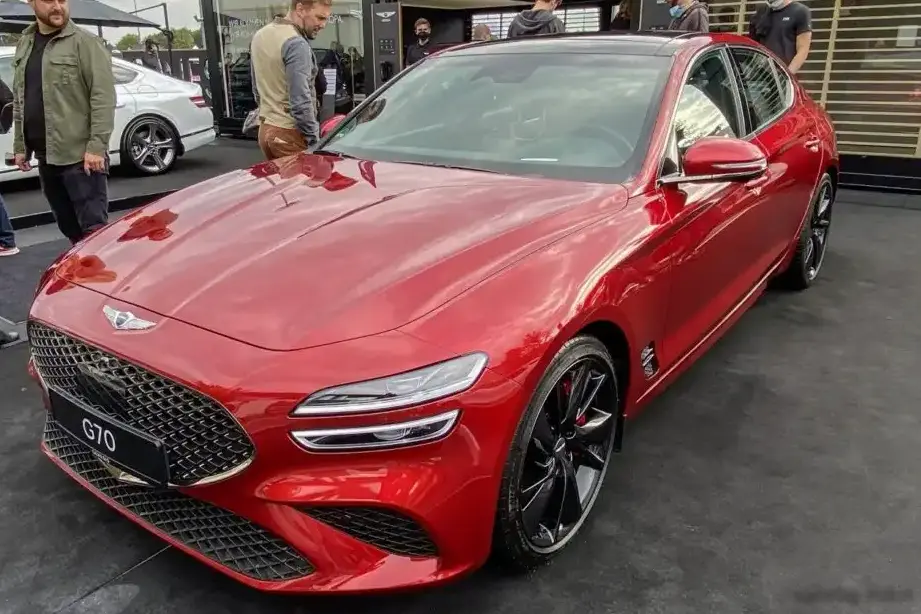
Technical Specifications
| Brand | Genesis |
| Model | G70 |
| Generation | G70 (facelift 2020) |
| Type (Engine) | 2.0 T-GDi (197 Hp) Automatic |
| Start of production | November, 2021 |
| Powertrain Architecture | Internal Combustion engine |
| Body type | Sedan |
| Seats | 5 |
| Doors | 4 |
| Fuel consumption at Low speed (WLTP) | 12.8-13.2 l/100 km (18.4 – 17.8 US mpg, 22.1 – 21.4 UK mpg, 7.8 – 7.6 km/l) |
| Fuel consumption at Medium speed (WLTP) | 7.8-8.5 l/100 km (30.2 – 27.7 US mpg, 36.2 – 33.2 UK mpg, 12.8 – 11.8 km/l) |
| Fuel consumption at high speed (WLTP) | 6.5-7.4 l/100 km (36.2 – 31.8 US mpg, 43.5 – 38.2 UK mpg, 15.4 – 13.5 km/l) |
| Fuel consumption at very high speed (WLTP) | 7.4-8.5 l/100 km (31.8 – 27.7 US mpg, 38.2 – 33.2 UK mpg, 13.5 – 11.8 km/l) |
| Combined fuel consumption (WLTP) | 7.9-8.8 l/100 km (29.8 – 26.7 US mpg, 35.8 – 32.1 UK mpg, 12.7 – 11.4 km/l) |
| CO2 emissions (WLTP) | 181-201 g/km |
| Fuel Type | Petrol (Gasoline) |
| Acceleration 0 – 100 km/h | 8.8 sec |
| Acceleration 0 – 62 mph | 8.8 sec |
| Acceleration 0 – 60 mph | 8.4 sec |
| Maximum speed | 224 km/h (139.19 mph) |
| Emission standard | Euro 6d |
| Weight-to-power ratio | 8.5 kg/Hp, 117.6 Hp/tonne |
| Weight-to-torque ratio | 4.7 kg/Nm, 210.7 Nm/tonne |
| Power | 197 Hp @ 6200 rpm |
| Power per litre | 98.6 Hp/l |
| Torque | 353 Nm @ 3500 rpm (260.36 lb.-ft. @ 3500 rpm) |
| Engine layout | Front, Longitudinal |
| Engine Model/Code | Theta II / G4KL |
| Engine displacement | 1998 cm3 (121.93 cu. in.) |
| Number of cylinders | 4 |
| Engine configuration | Inline |
| Cylinder Bore | 86 mm (3.39 in.) |
| Piston Stroke | 86 mm (3.39 in.) |
| Compression ratio | 10:1 |
| Number of valves per cylinder | 4 |
| Fuel injection system | Direct injection |
| Engine aspiration | Turbocharger, Intercooler |
| Engine oil capacity | 5.7 l (6.02 US qt | 5.02 UK qt) |
| Coolant | 7.27 l (7.68 US qt | 6.4 UK qt) |
| Engine systems | Start & Stop System, Particulate filter |
| Kerb Weight | 1675 kg (3692.74 lbs.) |
| Max. weight | 2140 kg (4717.89 lbs.) |
| Max load | 465 kg (1025.15 lbs.) |
| Trunk (boot) space – minimum | 330 l (11.65 cu. ft.) |
| Fuel tank capacity | 60 l (15.85 US gal | 13.2 UK gal) |
| Permitted trailer load with brakes (12%) | 1500 kg (3306.93 lbs.) |
| Permitted trailer load without brakes | 750 kg (1653.47 lbs.) |
| Length | 4685 mm (184.45 in.) |
| Width | 1850 mm (72.83 in.) |
| Height | 1400 mm (55.12 in.) |
| Wheelbase | 2835 mm (111.61 in.) |
| Front track | 1592 mm (62.68 in.) |
| Rear (Back) track | 1596 mm (62.83 in.) |
| Front overhang | 805 mm (31.69 in.) |
| Rear overhang | 1045 mm (41.14 in.) |
| Ride height (ground clearance) | 130 mm (5.12 in.) |
| Drag coefficient (Cd) | 0.28 |
| Minimum turning circle (turning diameter) | 11 m (36.09 ft.) |
| Drivetrain Architecture | The Internal combustion engine (ICE) drives the rear wheels of the vehicle. |
| Drive wheel | Rear wheel drive |
| Number of gears and type of gearbox | 8 gears, automatic transmission |
| Front suspension | Independent type McPherson |
| Rear suspension | Independent multi-link suspension |
| Front brakes | Ventilated discs, 345-350 mm |
| Rear brakes | Ventilated discs, 330-340 mm |
| Assisting systems | ABS (Anti-lock braking system) |
| Steering type | Steering rack and pinion |
| Power steering | Electric Steering |
| Tires size | Front wheel tires: 225/45 R18; 225/40 ZR19 Rear wheel tires: 225/45 R18; 255/35 ZR19 |
| Wheel rims size | Front wheel rims: 8.0J x 18; 8.0J x 19 Rear wheel rims: 8.0J x 18; 8.5J x 19 |
The Genesis G70 2.0 T-GDi Automatic, launched in late 2021 as part of the model’s facelift, is a four-door, five-passenger luxury sport sedan. It builds upon the foundation laid by the original G70, refining its design and enhancing its technology. This variant utilizes a 2.0-liter turbocharged four-cylinder engine paired with a smooth-shifting eight-speed automatic transmission, delivering a balance of performance and fuel efficiency. It’s positioned as the entry-level model in the G70 range, offering a more accessible price point compared to the higher-performance 3.3T versions. The G70 competes with established players in the compact luxury segment, such as the BMW 3 Series, Mercedes-Benz C-Class, and Audi A4.
Powertrain & Engine Architecture
At the heart of the G70 2.0 T-GDi is the Hyundai-Kia Theta II engine, specifically the G4KL code. This 1998cc (121.93 cu. in.) inline-four cylinder engine features direct fuel injection and is coupled with a twin-scroll turbocharger and intercooler. This configuration allows for a broad torque curve and responsive acceleration. The engine produces 197 horsepower at 6200 rpm and 260 lb-ft of torque at 3500 rpm. The eight-speed automatic transmission, sourced from ZF, is known for its quick and precise shifts. It features a torque converter for smooth low-speed operation and offers both automatic and manual shift modes. The powertrain is longitudinally mounted, driving the rear wheels, contributing to the car’s balanced handling characteristics.
Driving Characteristics
The G70 2.0 T-GDi Automatic delivers a comfortable and engaging driving experience. While not as overtly sporty as the 3.3T model, the 2.0-liter engine provides ample power for everyday driving and highway passing. The eight-speed automatic transmission is well-tuned, offering smooth gear changes and quick responses to driver input. The rear-wheel-drive layout contributes to a balanced feel, and the suspension is tuned to provide a good compromise between comfort and handling. Compared to the manual transmission version, the automatic offers greater convenience, particularly in urban traffic. However, some driving enthusiasts may prefer the more direct control offered by the manual gearbox. The gear ratios are optimized for both fuel efficiency and acceleration, with a relatively tall final drive to improve highway cruising.
Equipment & Trim Levels
The G70 2.0 T-GDi Automatic typically comes standard with a comprehensive list of features, including leather upholstery, a 10.25-inch touchscreen infotainment system with Apple CarPlay and Android Auto compatibility, a premium sound system, and a suite of advanced driver-assistance systems (ADAS) such as forward collision avoidance assist, lane keeping assist, and adaptive cruise control. Optional extras often include a panoramic sunroof, ventilated front seats, and a Lexicon premium audio system. Interior trim options typically include various color combinations for the leather upholstery and accents. The dashboard layout is driver-focused, with intuitive controls and a clean design.
Chassis & Braking
The G70 utilizes a McPherson strut front suspension and a multi-link rear suspension, providing a comfortable ride and responsive handling. The suspension is tuned to balance comfort and performance, offering a good compromise for everyday driving. The braking system consists of ventilated discs on all four wheels, providing ample stopping power. ABS (Anti-lock Braking System) is standard, along with other electronic stability control systems. The G70’s chassis is designed to be rigid, contributing to its precise handling and overall stability. The standard tire size is typically 225/45 R18 or 225/40 ZR19, depending on the trim level.
Market Reception & Comparison
The Genesis G70 2.0 T-GDi Automatic has been generally well-received by automotive critics. It’s praised for its stylish design, comfortable interior, and engaging driving dynamics. Compared to its competitors, the G70 offers a compelling value proposition, providing a similar level of luxury and performance at a lower price point. Fuel economy is competitive within its class, with combined WLTP figures ranging from 7.9 to 8.8 l/100 km. Reliability has been generally good, although long-term data is still being collected. Compared to the 3.3T model, the 2.0 T-GDi offers a more fuel-efficient and affordable option, albeit with slightly less power and performance.
Legacy
The Genesis G70 2.0 T-GDi Automatic represents a significant step forward for the Genesis brand, establishing it as a serious contender in the luxury sport sedan segment. The Theta II engine and ZF eight-speed automatic transmission have proven to be reliable and durable powertrains. As the G70 ages, these models are likely to become increasingly attractive on the used car market, offering a blend of luxury, performance, and value. The G70’s impact lies in demonstrating that a new brand can successfully compete with established luxury automakers by offering a compelling product at a competitive price.