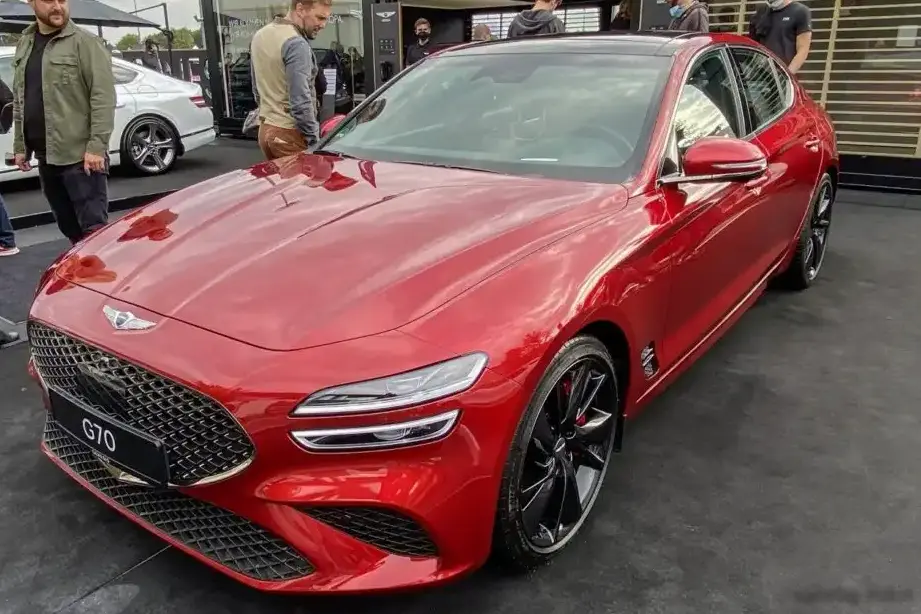
Technical Specifications
| Brand | Genesis |
| Model | G70 |
| Generation | G70 (facelift 2020) |
| Type (Engine) | 2.0 T-GDi (252 Hp) Automatic |
| Start of production | October, 2020 |
| Powertrain Architecture | Internal Combustion engine |
| Body type | Sedan |
| Seats | 5 |
| Doors | 4 |
| Fuel consumption (urban) | 10.5-11.1 l/100 km (22.4 – 21.2 US mpg) |
| Fuel consumption (extra urban) | 7.9-8.1 l/100 km (29.8 – 29 US mpg) |
| Fuel consumption (combined) | 9.3-9.6 l/100 km (25.3 – 24.5 US mpg) |
| CO2 emissions | 158-163 g/km |
| Fuel Type | Petrol (Gasoline) |
| Weight-to-power ratio | 6.4 kg/Hp, 157 Hp/tonne |
| Weight-to-torque ratio | 4.5 kg/Nm, 219.9 Nm/tonne |
| Power | 252 Hp @ 6200 rpm |
| Power per litre | 126.1 Hp/l |
| Torque | 353 Nm @ 1400-4000 rpm (260.36 lb.-ft. @ 1400-4000 rpm) |
| Engine layout | Front, Longitudinal |
| Engine Model/Code | Theta II / G4KL |
| Engine displacement | 1998 cm3 (121.93 cu. in.) |
| Number of cylinders | 4 |
| Engine configuration | Inline |
| Fuel injection system | Direct injection |
| Engine oil capacity | 5.7 l (6.02 US qt | 5.02 UK qt) |
| Coolant capacity | 7.27 l (7.68 US qt | 6.4 UK qt) |
| Kerb Weight | 1605-1620 kg (3538.42 – 3571.49 lbs.) |
| Fuel tank capacity | 60 l (15.85 US gal | 13.2 UK gal) |
| Length | 4685 mm (184.45 in.) |
| Width | 1850 mm (72.83 in.) |
| Height | 1400 mm (55.12 in.) |
| Wheelbase | 2835 mm (111.61 in.) |
| Front track | 1596 mm (62.83 in.) |
| Rear track | 1604-1632 mm (63.15 – 64.25 in.) |
| Front overhang | 805 mm (31.69 in.) |
| Rear overhang | 1045 mm (41.14 in.) |
| Drivetrain | Rear wheel drive |
| Number of gears | 8 |
| Gearbox type | Automatic transmission |
| Front brakes | Ventilated discs |
| Rear brakes | Ventilated discs |
| Front tires | 225/40 R19 |
| Rear tires | 225/45 R18; 255/35 R19 |
The Genesis G70 2.0T-GDi, specifically the facelifted model introduced in October 2020, represents a compelling entry point into the luxury sport sedan segment. Positioned as the base engine option within the G70 lineup, it offered a balance of performance and efficiency, appealing to buyers seeking a premium driving experience without the higher price tag of the 3.3T models. This variant, characterized by its turbocharged four-cylinder engine and eight-speed automatic transmission, played a crucial role in establishing Genesis as a serious competitor against established European and Japanese brands in the North American market. The G70 itself is built on a rear-wheel drive platform (though all-wheel drive was an option) and shares its underpinnings with the Kia Stinger, aiming to deliver a sporty and engaging driving experience.
Powertrain & Engine Architecture
At the heart of the G70 2.0T-GDi lies the Hyundai-Kia Theta II engine, specifically the G4KL variant. This 1.998-liter, turbocharged inline-four engine utilizes direct injection technology to maximize efficiency and power output. The engine benefits from a twin-scroll turbocharger, which minimizes turbo lag and provides a more responsive driving experience. The Theta II engine is known for its relatively robust design, though early versions of this engine family did experience some issues with oil consumption, which were largely addressed in later iterations like the one found in the 2020 facelifted G70. The eight-speed automatic transmission, sourced from ZF, is a key component of this powertrain. It offers smooth and quick shifts, contributing to both performance and fuel economy. This transmission is known for its durability and responsiveness, and it’s a common choice in many luxury vehicles.
Driving Characteristics
The 252 horsepower and 260 lb-ft of torque delivered by the 2.0T-GDi engine provide adequate performance for most driving situations. While not as exhilarating as the 3.3T’s V6, the turbocharged four-cylinder offers a respectable 0-60 mph time in the low-to-mid 6-second range. The eight-speed automatic transmission is well-tuned, providing seamless gear changes and keeping the engine in its optimal power band. Compared to the six-speed manual transmission available on some G70 models, the automatic prioritizes comfort and ease of use over outright driver engagement. The rear-wheel-drive configuration contributes to a balanced chassis and sporty handling characteristics, although all-wheel drive was available for those seeking enhanced traction.
Equipment & Trim Levels
The 2.0T-GDi typically served as the entry-level trim for the G70, offering a comprehensive suite of standard features. These included leather upholstery, a touchscreen infotainment system with Apple CarPlay and Android Auto compatibility, a suite of advanced driver-assistance systems (ADAS) such as forward collision avoidance assist, lane keeping assist, and driver attention warning, and automatic climate control. Optional extras included a larger touchscreen display, a premium sound system, ventilated front seats, and a sunroof. The interior design emphasized a sporty and luxurious aesthetic, with a driver-focused cockpit and high-quality materials.
Chassis & Braking
The G70’s chassis is designed for a balance of comfort and handling. It features a multi-link suspension setup at all four corners, providing a controlled and comfortable ride. The 2.0T-GDi models typically came equipped with ventilated disc brakes on all four wheels, offering ample stopping power. The steering is precise and well-weighted, providing good feedback to the driver. Stabilizer bars are fitted front and rear to minimize body roll during cornering. The suspension tuning is slightly softer than the 3.3T models, prioritizing ride comfort over ultimate track performance.
Market Reception & Comparison
Critics generally praised the G70 2.0T-GDi for its stylish design, comfortable interior, and engaging driving dynamics. However, some reviewers noted that the four-cylinder engine, while capable, lacked the refinement and power of its competitors’ offerings, such as the BMW 330i or the Audi A4. Fuel economy was generally considered competitive for the segment, with combined MPG figures in the mid-20s. Reliability ratings were generally average, with some reports of minor issues with the infotainment system and engine oil consumption. Compared to the G70 3.3T, the 2.0T-GDi offered a more affordable entry point into the G70 lineup, appealing to a broader range of buyers.
Legacy
The Genesis G70 2.0T-GDi (2020 facelift) has established itself as a solid contender in the used luxury sport sedan market. Its combination of style, features, and performance makes it an attractive option for buyers seeking a premium vehicle at a reasonable price. The Theta II engine, while not without its potential issues, has proven to be generally reliable when properly maintained. As Genesis continues to refine its brand image and expand its model lineup, the G70 2.0T-GDi will likely be remembered as a pivotal model that helped establish the brand as a legitimate player in the luxury automotive segment.