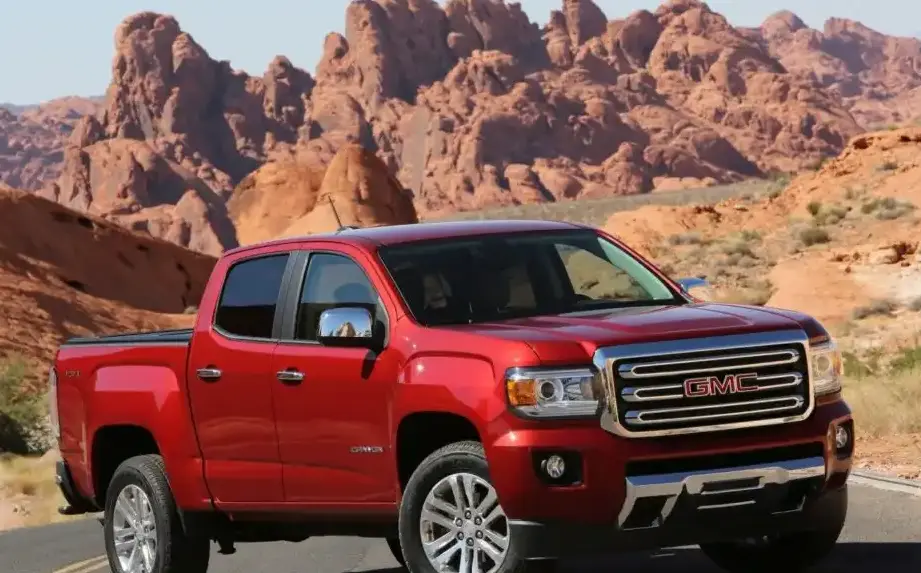
The GMC Canyon II Crew Cab, specifically the variant equipped with the 2.8-liter Duramax turbodiesel engine producing 186 horsepower and paired with a four-wheel-drive system and automatic transmission, was produced for the 2018 and 2019 model years. This configuration occupied a middle ground within the Canyon II lineup, offering a balance between capability, fuel efficiency, and everyday usability. It represented GMC’s entry into the diesel mid-size truck market, aimed at buyers seeking a more refined and fuel-conscious alternative to gasoline-powered options. The Canyon II itself was part of the second generation of the Colorado/Canyon platform, sharing its underpinnings with the Chevrolet Colorado.
Technical Specifications
| Brand | GMC |
| Model | Canyon |
| Generation | Canyon II Crew Cab |
| Type (Engine) | 2.8 Duramax TD (186 Hp) 4WD Automatic |
| Start of production | 2018 |
| End of production | 2020 |
| Powertrain Architecture | Internal Combustion engine |
| Body type | Pick-up |
| Seats | 5 |
| Doors | 4 |
| Fuel consumption (urban) | 11.8 l/100 km (19.9 US mpg) |
| Fuel consumption (extra urban) | 8.4 l/100 km (28 US mpg) |
| Fuel Type | Diesel |
| Power | 186 Hp @ 3400 rpm |
| Torque | 500 Nm @ 2000 rpm (368.78 lb.-ft. @ 2000 rpm) |
| Maximum engine speed | 5000 rpm |
| Engine layout | Front, Longitudinal |
| Engine Model/Code | LWN |
| Engine displacement | 2776 cm3 (169.4 cu. in.) |
| Number of cylinders | 4 |
| Engine configuration | Inline |
| Cylinder Bore | 94 mm (3.7 in.) |
| Piston Stroke | 100 mm (3.94 in.) |
| Compression ratio | 16.5:1 |
| Number of valves per cylinder | 4 |
| Fuel injection system | Diesel Commonrail |
| Engine aspiration | Turbocharger |
| Valvetrain | DOHC |
| Engine oil capacity | 5.6 l (5.92 US qt | 4.93 UK qt) |
| Coolant capacity | 10.5 l (11.1 US qt | 9.24 UK qt) |
| Trunk (boot) space – maximum | 1169 l (41.28 cu. ft.) |
| Fuel tank capacity | 79 l (20.87 US gal | 17.38 UK gal) |
| AdBlue tank capacity | 20.4 l (5.39 US gal | 4.49 UK gal) |
| Permitted trailer load with brakes (12%) | 3447 kg (7599.33 lbs.) |
| Length | 5395 mm (212.4 in.) |
| Width | 1886 mm (74.25 in.) |
| Height | 1794 mm (70.63 in.) |
| Wheelbase | 3258 mm (128.27 in.) |
| Front track | 1586 mm (62.44 in.) |
| Rear track | 1586 mm (62.44 in.) |
| Ride height (ground clearance) | 208 mm (8.19 in.) |
| Minimum turning circle | 12.6 m (41.34 ft.) |
| Drivetrain Architecture | All wheel drive (4×4) |
| Number of gears and type of gearbox | 6 gears, automatic transmission Hydra-Matic |
| Front suspension | Independent coil spring |
| Rear suspension | Rigid axle suspension, Leaf spring |
| Front brakes | Disc, 310×27 mm |
| Rear brakes | Disc, 324×18 mm |
| Assisting systems | ABS (Anti-lock braking system) |
| Steering type | Steering rack and pinion |
| Power steering | Electric Steering |
| Tires size | 265/70 R16; 255/65 R17; 265/60 R18 |
| Wheel rims size | 7J x 16; 8J x 17; 8.5J x 18 |
Introduction
The 2018-2020 GMC Canyon II Crew Cab 2.8L Duramax TD 4WD Automatic represented a significant offering in the increasingly popular mid-size truck segment. Built on the GMT-31XX platform (shared with the Chevrolet Colorado), the Canyon aimed to provide a more premium experience than its Chevrolet sibling, with enhanced interior appointments and a distinct exterior styling. The 2.8-liter Duramax diesel engine, coupled with the six-speed Hydra-Matic automatic transmission and four-wheel drive, was positioned as a versatile option for buyers needing towing capacity and improved fuel economy compared to the standard gasoline engines.
Powertrain & Engine Architecture
The heart of this Canyon variant is the 2.8-liter (2776 cc) inline-four cylinder Duramax turbodiesel engine, designated with the engine code LWN. This engine utilizes a common-rail direct fuel injection system, delivering fuel at extremely high pressures for optimized combustion. The engine features a single variable geometry turbocharger (VGT) to enhance both low-end torque and high-end power. The double overhead camshaft (DOHC) valvetrain, with four valves per cylinder, contributes to efficient engine breathing. The six-speed Hydra-Matic automatic transmission, a General Motors design, provides smooth and responsive shifting. This transmission is known for its durability and ability to handle the engine’s torque output. The 4WD system is a part-time system, allowing the driver to switch between two-wheel drive and four-wheel drive modes as needed.
Driving Characteristics
The 186 horsepower and 368 lb-ft of torque produced by the 2.8L Duramax, while not overwhelming, provided ample power for everyday driving and moderate towing. The automatic transmission was tuned for smooth operation, prioritizing fuel efficiency over aggressive shifting. Compared to the 2.5L four-cylinder or 3.6L V6 gasoline engines offered in the Canyon, the Duramax delivered significantly more low-end torque, making it easier to accelerate from a standstill and maintain speed while towing. However, it lacked the outright acceleration of the V6. The gear ratios in the Hydra-Matic transmission were optimized for both on-road comfort and off-road capability, providing a balance between fuel economy and pulling power. The 4WD system offered enhanced traction in slippery conditions, making it suitable for light to moderate off-road use.
Equipment & Trim Levels
The 2.8L Duramax engine was typically offered on the SLE and SLT trim levels of the Canyon Crew Cab. Standard equipment on these trims included features like an 8-inch touchscreen infotainment system with Apple CarPlay and Android Auto compatibility, a rearview camera, keyless entry, and power windows and locks. The SLT trim added features such as leather upholstery, heated front seats, a Bose premium audio system, and automatic climate control. Optional extras included a trailering package, off-road suspension, and a spray-in bedliner. Interior upholstery typically consisted of cloth on the SLE and leather on the SLT. The dashboard layout was functional and well-designed, with easy-to-read gauges and intuitive controls.
Chassis & Braking
The Canyon II utilized a body-on-frame construction, providing a robust and durable platform. The front suspension consisted of independent coil springs, while the rear suspension employed a traditional leaf spring setup. This configuration balanced ride comfort with load-carrying capacity. Braking duties were handled by disc brakes on all four wheels, with the front discs measuring 310x27mm and the rear discs measuring 324x18mm. An Anti-lock Braking System (ABS) was standard. The Canyon’s chassis was tuned to provide a comfortable ride while maintaining good handling characteristics. Stabilizer bars were included to reduce body roll during cornering.
Market Reception & Comparison
The GMC Canyon II 2.8L Duramax was generally well-received by automotive critics. It was praised for its fuel efficiency, towing capacity, and refined driving experience. Compared to the Chevrolet Colorado, the Canyon was often seen as a more upscale and comfortable option. However, some critics noted that the Duramax engine could be noisy and that the Canyon’s interior, while well-appointed, wasn’t as spacious as some of its full-size truck competitors. Fuel economy figures typically ranged from 19-28 mpg, depending on driving conditions and load. Reliability reports indicated that the Duramax engine was generally reliable, although some owners reported issues with the diesel particulate filter (DPF) system.
Legacy
The 2.8L Duramax-powered GMC Canyon II has established itself as a capable and reliable mid-size truck in the used car market. The powertrain, while not without its quirks (such as potential DPF issues requiring periodic regeneration or replacement), has proven to be durable with proper maintenance. These Canyons continue to be sought after by buyers looking for a versatile truck with good fuel economy and towing capacity. The combination of the Duramax engine, automatic transmission, and four-wheel drive makes it a practical choice for both work and recreational use. As a result, well-maintained examples of this Canyon variant hold their value relatively well in the used market.