
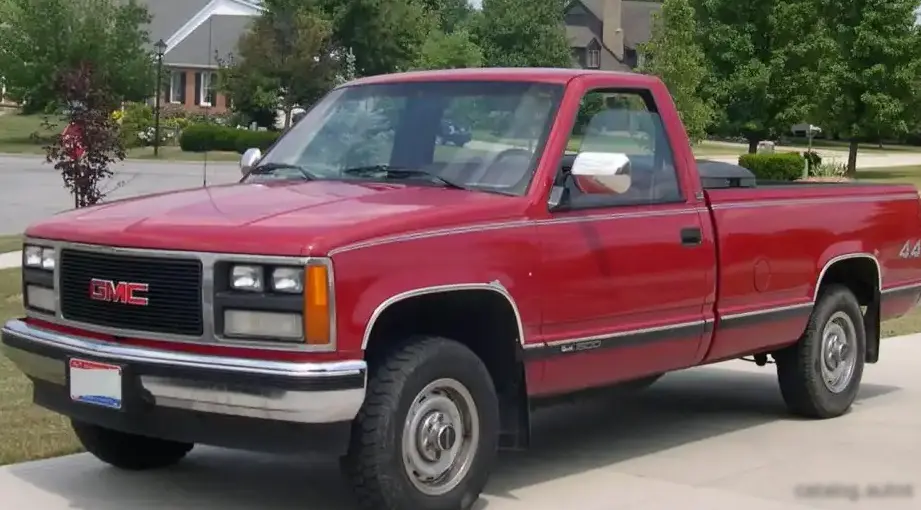
Technical Specifications
| Brand | GMC |
| Model | Sierra 1500 |
| Generation | Sierra 1500 I (GMT400) Regular cab LWB Wideside |
| Type (Engine) | 5.0 V8 (175 Hp) Automatic |
| Start of production | 1988 |
| End of production | 1992 |
| Powertrain Architecture | Internal Combustion engine |
| Body type | Pick-up |
| Seats | 3 |
| Doors | 2 |
| Fuel Type | Petrol (Gasoline) |
| Power | 175 Hp @ 4000 rpm |
| Torque | 366 Nm @ 2400 rpm / 269.95 lb.-ft. @ 2400 rpm |
| Engine layout | Front, Longitudinal |
| Number of cylinders | 8 |
| Engine configuration | V-engine |
| Cylinder Bore | 95 mm / 3.74 in. |
| Piston Stroke | 88.39 mm / 3.48 in. |
| Compression ratio | 9.3:1 |
| Fuel injection system | Single-point injection |
| Engine aspiration | Naturally aspirated engine |
| Max. weight | 2767 kg / 6100.19 lbs |
| Fuel tank capacity | 129 l / 34.08 US gal | 28.38 UK gal |
| Length | 5547 mm / 218.39 in. |
| Width | 1951 mm / 76.81 in. |
| Height | 1788 mm / 70.39 in. |
| Wheelbase | 3340 mm / 131.5 in. |
| Front overhang | 886 mm / 34.88 in. |
| Rear overhang | 1321 mm / 52.01 in. |
| Drivetrain Architecture | The Internal combustion engine (ICE) drives the rear wheels of the vehicle. |
| Drive wheel | Rear wheel drive |
| Number of gears and type of gearbox | 4 gears, automatic transmission |
| Front suspension | Independent coil spring |
| Rear suspension | Rigid axle suspension, Leaf spring |
| Front brakes | Disc |
| Rear brakes | Drum |
| Tires size | 225/75 R15 |
The GMC Sierra 1500, in its first generation (GMT400), marked GMC’s significant entry into the competitive full-size pickup truck market. Produced from 1988 through 1992, this Sierra generation was designed to offer a robust and capable work vehicle, directly challenging offerings from Ford and Chevrolet. The Regular Cab Long Wheelbase Wideside configuration, powered by the 5.0-liter V8 engine and paired with an automatic transmission, was a common sight on American roads and job sites during this period. This specific combination represented a sweet spot between affordability and capability, appealing to buyers who needed a dependable truck without the added expense of higher trim levels or more powerful engine options.
Powertrain & Engine Architecture
At the heart of this Sierra 1500 lay the 5.0-liter (305 cubic inch) small-block Chevrolet V8 engine. This engine utilized a throttle body injection (TBI) system, a relatively simple fuel injection setup compared to the emerging multi-port injection systems of the time. The TBI system employed two injectors positioned within the throttle body, providing a more efficient fuel delivery than a carburetor, but less precise than later fuel injection technologies. The engine generated 175 horsepower at 4000 rpm and 366 Nm (269.95 lb-ft) of torque at 2400 rpm. The 4L40 four-speed automatic transmission was the sole transmission option available with this engine and configuration. This transmission was well-regarded for its durability and relatively smooth shifting characteristics, although it wasn’t specifically tuned for exceptional fuel economy or rapid acceleration. The engine’s longitudinal front-mount configuration was standard practice for rear-wheel-drive trucks of this era.
Driving Characteristics
The combination of the 175 hp V8 and the four-speed automatic transmission delivered adequate, though not particularly exciting, performance. Acceleration was moderate, and overtaking maneuvers required careful planning. The automatic transmission’s gear ratios were optimized for towing and hauling applications, rather than prioritizing quick acceleration. The truck performed best when cruising at highway speeds, where the engine could operate efficiently. In comparison to the available 5.7-liter V8, the 5.0-liter offered less power and torque, making it less ideal for heavy-duty work or frequent towing. However, it did provide a noticeable improvement in fuel economy. The ride quality was typical for a full-size truck of the period – firm but generally comfortable, particularly when carrying a load in the bed. The leaf spring rear suspension contributed to a somewhat bouncy ride when the truck was unladen.
Equipment & Trim Levels
The base-level Sierra 1500 Regular Cab LWB Wideside, equipped with the 5.0L V8 and automatic transmission, was positioned as the entry-level offering within the Sierra lineup. Standard features included a basic vinyl bench seat, a straightforward dashboard with analog gauges, and manual windows and locks. Air conditioning was frequently an optional extra, as was an AM/FM radio. The “Wideside” designation indicated the width of the truck bed, providing a larger cargo area compared to the narrower “Narrowside” option. Optional extras included upgraded interior trim, cruise control, and a tilt steering wheel. The interior design prioritized functionality and durability over luxury.
Chassis & Braking
The GMT400 chassis incorporated an independent coil spring front suspension and a traditional rigid axle with leaf springs in the rear. This setup provided a reasonable balance between ride comfort and load-carrying capacity. The front brakes were disc brakes, offering superior stopping power compared to drum brakes, while the rear brakes were drum brakes. Steering was managed by a recirculating ball steering system, which provided a solid feel but lacked the precision of more modern rack-and-pinion steering systems. The truck’s substantial weight and modest braking system resulted in longer stopping distances compared to contemporary vehicles. The standard tire size was 225/75R15, offering a compromise between ride comfort and durability.
Market Reception & Comparison
The 5.0-liter V8 and automatic transmission combination in the Sierra 1500 was generally well-received as a practical and affordable option for truck buyers. Critics acknowledged its sufficient power for everyday tasks and its improved fuel economy compared to the larger V8 engines. However, it was often criticized for its lack of brisk acceleration and its somewhat outdated single-point fuel injection system. When compared to the Chevrolet C/K 1500 (which shared the same engine and transmission), the Sierra offered a slightly more refined interior and exterior aesthetic. In contrast to Ford’s F-150, the Sierra was often perceived as a more comfortable and refined option, although the F-150 offered a broader selection of engine and trim choices.
Legacy
The GMT400 Sierra 1500, particularly the 5.0-liter V8 automatic variant, has gained popularity among classic truck enthusiasts. The 305 V8 engine is renowned for its reliability and relative simplicity, making it relatively straightforward to maintain and repair. While not a performance-oriented machine, these trucks provide a comfortable and capable driving experience. Today, well-preserved examples command reasonable prices in the used car market, and parts availability remains relatively good. The truck’s enduring appeal stems from its rugged construction, classic styling, and its representation of a simpler era in American truck design. The 4L40 transmission, while not known for being the most fuel-efficient, has proven to be remarkably durable over the years, contributing to the longevity of these vehicles.

