
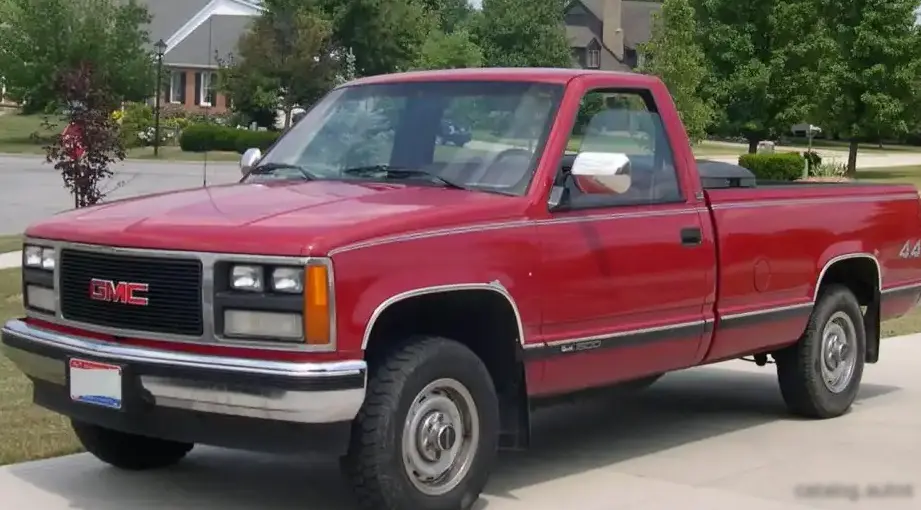
The GMC Sierra 1500, in its first generation (GMT400 platform) produced from 1988 to 1992, represented GMC’s entry into the increasingly popular full-size pickup truck market. This generation marked a significant departure from the earlier C/K series trucks, offering a more modern design and improved features. Within the GMT400 lineup, the Regular Cab Long Wheelbase (LWB) Wideside configuration with the 6.2-liter diesel V8 engine and four-speed automatic transmission occupied a specific niche, aimed at buyers needing a robust work truck with the added capability of four-wheel drive. This variant was positioned as a durable, if not particularly fast, option for those prioritizing towing and hauling over outright performance.
Technical Specifications
| Brand | GMC |
| Model | Sierra 1500 |
| Generation | Sierra 1500 I (GMT400) Regular cab LWB Wideside |
| Type (Engine) | 6.2 diesel V8 (140 Hp) 4WD Automatic |
| Start of production | 1988 |
| End of production | 1992 |
| Powertrain Architecture | Internal Combustion engine |
| Body type | Pick-up |
| Seats | 3 |
| Doors | 2 |
| Fuel Type | Diesel |
| Power | 140 Hp @ 3600 rpm |
| Torque | 335 Nm @ 2000 rpm / 247.08 lb.-ft. @ 2000 rpm |
| Engine layout | Front, Longitudinal |
| Number of cylinders | 8 |
| Engine configuration | V-engine |
| Cylinder Bore | 101.09 mm / 3.98 in. |
| Piston Stroke | 97.03 mm / 3.82 in. |
| Compression ratio | 21.3:1 |
| Fuel injection system | Precombustion chamber injection |
| Engine aspiration | Naturally aspirated engine |
| Engine oil capacity | 6.6 l / 6.97 US qt | 5.81 UK qt |
| Coolant | 23.5 l / 24.83 US qt | 20.68 UK qt |
| Fuel tank capacity | 129 l / 34.08 US gal | 28.38 UK gal |
| Length | 5547 mm / 218.39 in. |
| Width | 1951 mm / 76.81 in. |
| Height | 1788 mm / 70.39 in. |
| Wheelbase | 3340 mm / 131.5 in. |
| Front overhang | 886 mm / 34.88 in. |
| Rear overhang | 1321 mm / 52.01 in. |
| Drivetrain Architecture | The Internal combustion engine (ICE) drives the rear wheels permanently, and the front wheels are driven through an electrically or mechanically operated clutch if necessary. |
| Drive wheel | All wheel drive (4×4) |
| Number of gears and type of gearbox | 4 gears, automatic transmission |
| Front suspension | Independent torsion bar, double wishbone |
| Rear suspension | Rigid axle suspension, Leaf spring |
| Front brakes | Disc |
| Rear brakes | Drum |
| Tires size | 225/75 R16 |
Powertrain & Engine Architecture
The heart of this Sierra 1500 variant was the 6.2-liter (379 cubic inch) diesel V8 engine. This engine, designated as a Detroit Diesel 6.2L, was known for its durability and relatively simple design. It employed precombustion chamber injection, a system where fuel is injected into a small pre-chamber before entering the main combustion chamber, aiding in cold-weather starting and more complete combustion. The engine produced 140 horsepower at 3600 rpm and 247 lb-ft of torque at 2000 rpm. While the horsepower figure was modest by contemporary standards, the diesel engine’s strength lay in its low-end torque, making it well-suited for hauling and towing. The engine was paired with a four-speed automatic transmission, a TH700R4 (4L60) unit, which was a common choice for GM trucks of the era. This transmission was known for its reliability, but its four-speed configuration meant that the engine often operated at higher rpm during highway cruising, potentially contributing to increased noise and fuel consumption.
Driving Characteristics
The 6.2L diesel and automatic transmission combination delivered a driving experience focused on utility rather than excitement. Acceleration was slow, particularly when compared to gasoline-powered Sierra 1500s. The automatic transmission’s gear ratios were optimized for towing and hauling, resulting in a relatively low first gear and a higher final drive ratio. This setup provided ample low-end grunt for getting heavy loads moving, but it also meant that the engine would rev up quickly under hard acceleration. On the highway, the truck felt stable and capable, but the lack of an overdrive gear meant that engine speeds were higher than ideal, impacting fuel economy and potentially increasing engine wear over long distances. The four-wheel drive system, when engaged, provided enhanced traction in slippery conditions, making this truck a capable performer in off-road or inclement weather scenarios.
Equipment & Trim Levels
The Regular Cab LWB Wideside trim level was generally considered the base work truck configuration. Standard features typically included a vinyl bench seat, basic instrumentation, and manual windows and locks. Air conditioning and an upgraded stereo system were often optional extras. The interior was functional and durable, designed to withstand the rigors of daily work use. The “Wideside” designation referred to the wider bed, offering increased cargo capacity. Options available for this trim included various towing packages, heavy-duty suspension upgrades, and different axle ratios to tailor the truck to specific hauling needs.
Chassis & Braking
The GMT400 Sierra 1500 featured a body-on-frame construction, providing a robust and durable platform. The front suspension utilized an independent torsion bar setup with double wishbone components, offering a reasonable ride quality for a truck of its size. The rear suspension employed a traditional leaf spring setup, which was well-suited for carrying heavy loads. Braking duties were handled by disc brakes at the front and drum brakes at the rear. While adequate for the truck’s weight and intended use, the braking system wasn’t particularly sophisticated by modern standards. The 4WD system employed a part-time transfer case, allowing the driver to switch between two-wheel drive and four-wheel drive as needed.
Market Reception & Comparison
The 6.2L diesel Sierra 1500 was generally well-received by buyers who prioritized durability and low-end torque over outright performance. Critics noted the engine’s lack of horsepower compared to gasoline alternatives, but praised its reliability and fuel efficiency, particularly when hauling heavy loads. Compared to the gasoline-powered 5.7L V8, the diesel offered significantly better fuel economy, but at the cost of acceleration and refinement. The 6.2L diesel was also a more expensive option than the gasoline engines, making it a less attractive choice for buyers who didn’t require its specific capabilities. Compared to other diesel-powered trucks of the era, such as the Ford F-Series with the 7.3L IDI diesel, the GMC 6.2L offered a similar level of performance and reliability.
Legacy
The 6.2L Detroit Diesel engine has earned a reputation for exceptional longevity. Many examples remain on the road today, often with well over 200,000 miles. While parts availability can be a challenge, the engine’s simple design and robust construction make it relatively easy to maintain and repair. In the used car market, these trucks are often sought after by enthusiasts and those looking for a dependable work truck. The GMT400 Sierra 1500 with the 6.2L diesel represents a significant chapter in GMC’s truck history, embodying a commitment to durability and practicality that continues to resonate with truck buyers today. The combination of the 6.2L diesel and the four-speed automatic, while not the fastest or most fuel-efficient option, proved to be a reliable and capable powertrain for a generation of truck owners.

