
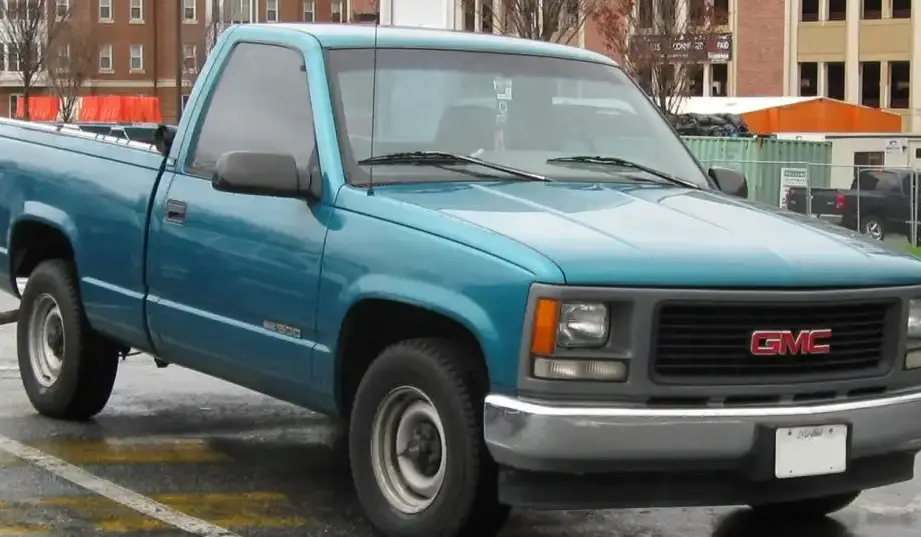
The GMC Sierra 1500, in its first generation (GMT400), represented GMC’s entry into the increasingly popular full-size pickup truck market. Produced from 1988 through 1992, the Sierra 1500 offered a range of configurations, including the Regular Cab Short Wheelbase (SWB) Wideside model powered by a 4.3-liter V6 engine producing 160 horsepower. This particular variant served as a work-oriented, value-focused option within the Sierra lineup, appealing to buyers prioritizing practicality and affordability over outright performance. It was positioned as the base engine choice, slotting below the more powerful V8 options.
Technical Specifications
| Brand | GMC |
| Model | Sierra 1500 |
| Generation | Sierra 1500 I (GMT400) Regular cab SWB Wideside |
| Type (Engine) | 4.3 V6 (160 Hp) |
| Start of production | 1988 |
| End of production | 1992 |
| Powertrain Architecture | Internal Combustion engine |
| Body type | Pick-up |
| Seats | 3 |
| Doors | 2 |
| Fuel Type | Petrol (Gasoline) |
| Power | 160 Hp @ 4000 rpm |
| Torque | 319 Nm @ 2400 rpm / 235.28 lb.-ft. @ 2400 rpm |
| Engine layout | Front, Longitudinal |
| Number of cylinders | 6 |
| Engine configuration | V-engine |
| Cylinder Bore | 101.6 mm / 4 in. |
| Piston Stroke | 88.39 mm / 3.48 in. |
| Compression ratio | 9.3:1 |
| Fuel injection system | Single-point injection |
| Engine aspiration | Naturally aspirated engine |
| Max. weight | 2540 kg / 5599.74 lbs. |
| Fuel tank capacity | 95 l / 25.1 US gal | 20.9 UK gal |
| Length | 5065 mm / 199.41 in. |
| Width | 1951 mm / 76.81 in. |
| Height | 1788 mm / 70.39 in. |
| Wheelbase | 2985 mm / 117.52 in. |
| Front overhang | 886 mm / 34.88 in. |
| Rear overhang | 1194 mm / 47.01 in. |
| Drivetrain Architecture | The Internal combustion engine (ICE) drives the rear wheels of the vehicle. |
| Drive wheel | Rear wheel drive |
| Number of gears and type of gearbox | 5 gears, manual transmission |
| Front suspension | Independent coil spring |
| Rear suspension | Rigid axle suspension, Leaf spring |
| Front brakes | Disc |
| Rear brakes | Drum |
| Tires size | 225/75 R15 |
Powertrain & Engine Architecture
The heart of this Sierra 1500 variant was the 4.3-liter (262 cubic inch) V6 engine, designated as the LB4. This engine was a member of GMC’s small-block V6 family, utilizing a 90-degree V-angle configuration. The LB4 featured a cast iron block and cylinder heads, and employed a single-point fuel injection system – a relatively simple system where fuel injectors were located in the throttle body, rather than directly into the intake manifold. This system, while cost-effective, wasn’t as efficient or precise as multi-port fuel injection. The engine’s valvetrain consisted of two valves per cylinder, operated by a single camshaft. The 5-speed manual transmission was the standard offering, providing a relatively deep gear ratio spread designed for both work and highway cruising.
Driving Characteristics
The 160 horsepower and 235 lb-ft of torque delivered by the 4.3L V6 in the Sierra 1500 SWB provided adequate, but not exhilarating, performance. Acceleration was modest, and the truck felt noticeably slower when fully loaded or climbing hills compared to models equipped with the larger V8 engines. The 5-speed manual transmission allowed drivers to keep the engine in its optimal power band, but required frequent shifting in everyday driving. The gear ratios were tuned for a balance between fuel economy and towing capability. The relatively light weight of the regular cab SWB configuration helped mitigate some of the engine’s power deficit, making it more manageable in urban environments.
Equipment & Trim Levels
The base-level Sierra 1500 SWB with the 4.3L V6 was typically sparsely equipped, reflecting its position as the entry-level offering. Standard features generally included a basic vinyl bench seat, a simple dashboard with analog gauges, and manual windows and locks. Air conditioning and an upgraded stereo system were often optional extras. The Wideside bed offered a generous cargo capacity for its size. Buyers could add options like a tilt steering wheel, cruise control, and upgraded interior trim packages to enhance comfort and convenience. The exterior typically featured minimal brightwork, emphasizing the truck’s utilitarian nature.
Chassis & Braking
The GMT400 platform utilized a body-on-frame construction, providing a robust and durable foundation. The front suspension consisted of independent coil springs, offering a reasonably comfortable ride. The rear suspension employed a traditional leaf spring setup, designed to handle heavier loads. Front disc brakes provided adequate stopping power, while rear drum brakes were standard. The steering was a recirculating ball system, offering a somewhat vague but durable feel. The relatively short wheelbase of the SWB model contributed to a tighter turning radius, making it easier to maneuver in confined spaces.
Market Reception & Comparison
The 4.3L V6-powered Sierra 1500 was generally viewed as a sensible, if uninspiring, choice for buyers who prioritized affordability and fuel economy. Critics acknowledged its practicality but often noted its lack of power compared to the V8-equipped models. Fuel economy was a strong point, offering a noticeable improvement over the larger engines. Reliability was generally good, although the single-point fuel injection system could be prone to issues over time. Compared to the 5.0L and 5.7L V8 options, the 4.3L offered a lower purchase price but significantly less towing capacity and overall performance. The Ford F-150 and Chevrolet C/K 1500 offered similar V6 options in this segment, with comparable performance and features.
Legacy
The 4.3L V6-powered GMC Sierra 1500 GMT400, while not a performance icon, holds a place in automotive history as a reliable and affordable work truck. Today, these trucks are relatively common in the used car market, often found with high mileage but still capable of performing basic tasks. The LB4 engine is known for its durability, although maintenance is crucial to prevent issues associated with age and wear. Parts availability is generally good, making it a relatively easy vehicle to maintain. While not highly sought after by collectors, these Sierras represent a significant era in American truck design and continue to serve as practical transportation for many owners.

