
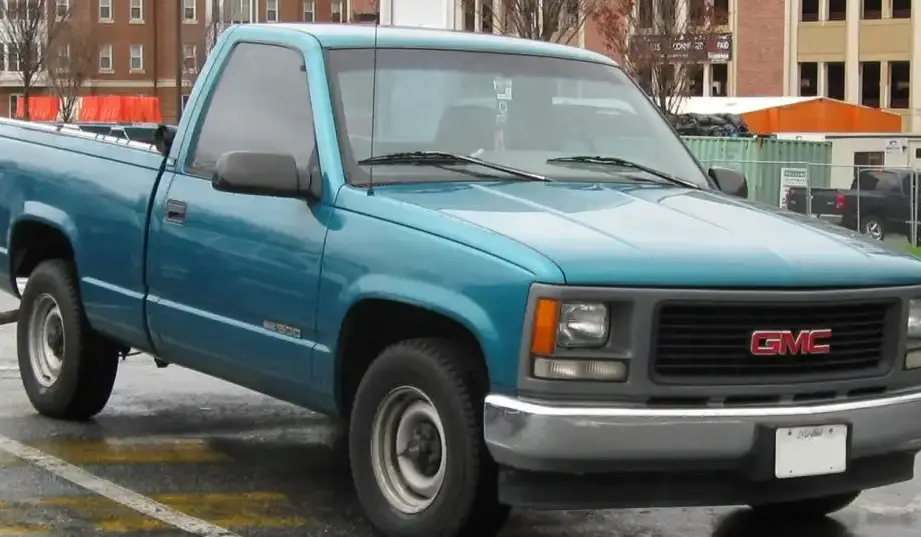
The GMC Sierra 1500, in its first generation (GMT400 platform) produced from 1988 to 1992, represented GMC’s entry into the increasingly popular full-size pickup truck market. This generation marked a significant departure from the previous square-bodied designs, adopting a more aerodynamic and modern aesthetic. The Regular Cab Short Wheelbase (SWB) Wideside configuration, equipped with the 5.7-liter V8 engine producing 210 horsepower, was a common sight on American roads and job sites during this period. It served as a workhorse for many, offering a balance of capability and affordability within the GMC lineup.
Technical Specifications
| Brand | GMC |
| Model | Sierra 1500 |
| Generation | Sierra 1500 I (GMT400) Regular cab SWB Wideside |
| Type (Engine) | 5.7 V8 (210 Hp) |
| Start of production | 1988 |
| End of production | 1992 |
| Powertrain Architecture | Internal Combustion engine |
| Body type | Pick-up |
| Seats | 3 |
| Doors | 2 |
| Fuel Type | Petrol (Gasoline) |
| Power | 210 Hp @ 4000 rpm |
| Torque | 407 Nm @ 2800 rpm / 300.19 lb.-ft. @ 2800 rpm |
| Engine layout | Front, Longitudinal |
| Number of cylinders | 8 |
| Engine configuration | V-engine |
| Cylinder Bore | 101.6 mm / 4 in. |
| Piston Stroke | 88.39 mm / 3.48 in. |
| Compression ratio | 9.3:1 |
| Fuel injection system | Multi-port manifold injection |
| Engine aspiration | Naturally aspirated engine |
| Max. weight | 2540 kg / 5599.74 lbs. |
| Fuel tank capacity | 95 l / 25.1 US gal | 20.9 UK gal |
| Length | 5065 mm / 199.41 in. |
| Width | 1951 mm / 76.81 in. |
| Height | 1788 mm / 70.39 in. |
| Wheelbase | 2985 mm / 117.52 in. |
| Front overhang | 886 mm / 34.88 in. |
| Rear overhang | 1194 mm / 47.01 in. |
| Drivetrain Architecture | The Internal combustion engine (ICE) drives the rear wheels of the vehicle. |
| Drive wheel | Rear wheel drive |
| Number of gears and type of gearbox | 5 gears, manual transmission |
| Front suspension | Independent coil spring |
| Rear suspension | Rigid axle suspension, Leaf spring |
| Front brakes | Disc |
| Rear brakes | Drum |
| Tires size | 225/75 R15 |
Powertrain & Engine Architecture
The heart of this Sierra 1500 variant was the 5.7-liter (350 cubic inch) small-block Chevrolet V8 engine. This engine, designated as the L05, was a staple of General Motors vehicles for decades, known for its reliability and relatively simple design. It featured a cast iron block and cylinder heads, a two-bolt main bearing cap design, and a hydraulic lifter camshaft. The multi-port fuel injection system, a relatively new technology at the time, improved fuel efficiency and throttle response compared to earlier carbureted designs. The engine’s 9.3:1 compression ratio and carefully tuned ignition timing contributed to its 210 horsepower output. The standard transmission for this configuration was a 5-speed manual, although a 4-speed automatic transmission was also available as an option. The engine was mounted longitudinally in the chassis, driving the rear wheels.
Driving Characteristics
The 5.7L V8 and 5-speed manual transmission combination provided adequate, though not exhilarating, performance. Acceleration was respectable for the era, but the truck’s weight and aerodynamic profile limited its top speed. The manual transmission offered drivers more control over gear selection, allowing them to optimize power delivery for towing or hauling. The gear ratios were fairly widely spaced, prioritizing low-end torque for work applications. Compared to the available 6.2L diesel engine, the 5.7L V8 offered quicker acceleration but significantly lower fuel economy. Against the later, more powerful 5.7L variants with tuned port injection, this earlier version felt less refined and offered less overall power.
Equipment & Trim Levels
The base-level Sierra 1500 Regular Cab SWB Wideside was a fairly spartan vehicle, focused on functionality rather than luxury. Standard features typically included a basic vinyl bench seat, a simple dashboard with analog gauges, and manual windows and locks. AM radio was standard, with an optional upgrade to AM/FM stereo. The “Wideside” designation referred to the wider bed, offering increased cargo capacity. Optional extras included air conditioning, power steering, cruise control, and upgraded interior trim. The interior color schemes were typically limited to neutral tones like gray or brown. The exterior paint options were also relatively basic, with a selection of solid colors and two-tone combinations.
Chassis & Braking
The GMT400 chassis featured a body-on-frame construction, providing a robust and durable platform for heavy-duty use. The front suspension utilized independent coil springs, offering a relatively comfortable ride. The rear suspension employed a traditional leaf spring setup, designed to handle heavy loads. The braking system consisted of front disc brakes and rear drum brakes. Power steering was often an optional extra, making maneuvering the truck easier, especially at low speeds. The tires, typically 225/75R15 size, were chosen for a balance of durability and traction. Stabilizer bars were not standard equipment on the base model, contributing to a slightly more pronounced body roll during cornering.
Market Reception & Comparison
The 1988-1992 GMC Sierra 1500 was generally well-received by the American public. Critics praised its modern styling, improved ride quality, and available V8 engines. However, the base-level models with the 5.7L V8 and manual transmission were sometimes criticized for their lack of refinement and relatively low horsepower compared to competitors. Fuel economy was also a concern, particularly with the V8 engine. Compared to the Ford F-150 and Chevrolet C/K series trucks, the Sierra 1500 offered a similar level of capability and features, but often at a slightly higher price point. The 5.7L V8 automatic combination was a popular choice, offering a more comfortable driving experience, but at the expense of fuel efficiency.
Legacy
The GMT400 generation Sierra 1500 laid the foundation for GMC’s continued success in the full-size pickup truck market. The 5.7L V8 engine, while eventually superseded by more powerful and efficient designs, proved to be remarkably durable and reliable. Today, these trucks are often sought after by enthusiasts and collectors, particularly those in well-maintained condition. The simplicity of the engine and drivetrain makes them relatively easy to repair and maintain. While not as technologically advanced as modern pickups, the GMT400 Sierra 1500 represents a significant era in American automotive history, embodying the ruggedness and practicality that defined the pickup truck segment.

