
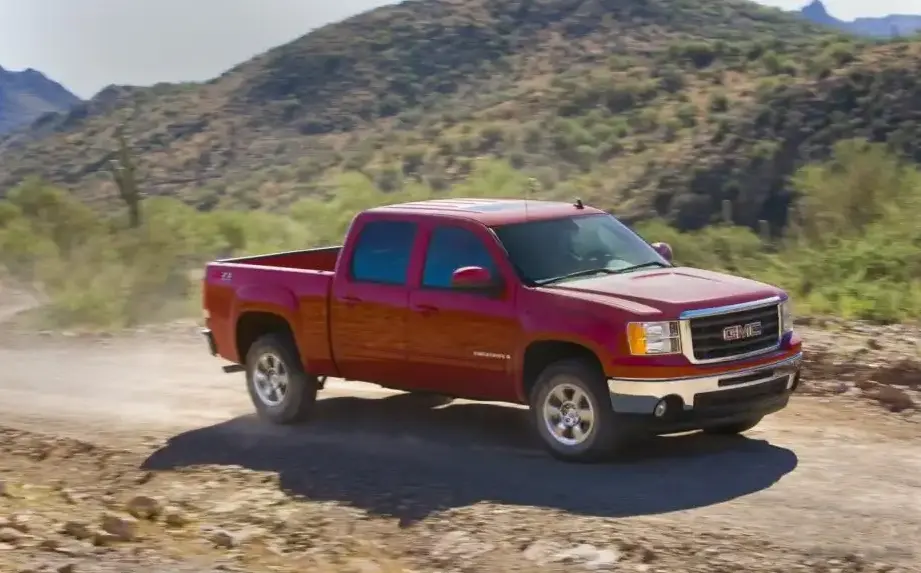
The GMC Sierra 1500 III, specifically the Crew Cab Short Box configuration with the 5.3-liter Vortec V8 engine and 4WD paired with a 6-speed automatic transmission, was produced from 2007 to 2010. This variant represented a popular choice within the GMT900 generation of the Sierra 1500, offering a balance of capability, comfort, and technology for the North American truck market. It slotted into the mid-range of the Sierra 1500 lineup, offering more power and features than the base models but remaining more accessible than the top-tier Denali trims.
Technical Specifications
| Brand | GMC |
| Model | Sierra 1500 |
| Generation | Sierra 1500 III (GMT900) Crew Cab Short Box |
| Type (Engine) | 5.3 Vortec V8 (315 Hp) 4WD 6 Automatic |
| Start of production | 2007 |
| End of production | 2010 |
| Powertrain Architecture | Internal Combustion engine |
| Body type | Pick-up |
| Seats | 6 |
| Doors | 4 |
| Fuel consumption (urban) | 16.8 l/100 km (14 US mpg) |
| Fuel consumption (extra urban) | 11.8 l/100 km (19.9 US mpg) |
| Fuel Type | Petrol (Gasoline) |
| Power | 315 Hp @ 5200 rpm |
| Torque | 458 Nm @ 4400 rpm (337.8 lb.-ft. @ 4400 rpm) |
| Maximum engine speed | 6000 rpm |
| Engine layout | Front, Longitudinal |
| Engine Model/Code | LH6 |
| Engine displacement | 5328 cm3 (325.13 cu. in.) |
| Number of cylinders | 8 |
| Engine configuration | V-engine |
| Cylinder Bore | 96.01 mm (3.78 in.) |
| Piston Stroke | 91.95 mm (3.62 in.) |
| Compression ratio | 9.9:1 |
| Number of valves per cylinder | 2 |
| Fuel injection system | Multi-port manifold injection |
| Engine aspiration | Naturally aspirated engine |
| Valvetrain | OHV |
| Engine oil capacity | 5.7 l (6.02 US qt | 5.02 UK qt) |
| Coolant capacity | 14.1 l (14.9 US qt | 12.41 UK qt) |
| Max. weight | 3175 kg (6999.68 lbs.) |
| Trunk (boot) space – maximum | 1506 l (53.18 cu. ft.) |
| Fuel tank capacity | 98 l (25.89 US gal | 21.56 UK gal) |
| Length | 5844 mm (230.08 in.) |
| Width including mirrors | 2031 mm (79.96 in.) |
| Height | 1872 mm (73.7 in.) |
| Wheelbase | 3645 mm (143.5 in.) |
| Front track | 1730 mm (68.11 in.) |
| Rear (Back) track | 1702 mm (67.01 in.) |
| Ride height (ground clearance) | 229 mm (9.02 in.) |
| Minimum turning circle | 14.4 m (47.24 ft.) |
| Approach angle | 15.3° |
| Departure angle | 22.4° |
| Ramp-over angle | 19.3° |
| Drivetrain Architecture | All wheel drive (4×4) |
| Number of gears and type of gearbox | 6 gears, automatic transmission Hydra-Matic |
| Front suspension | Independent coil spring |
| Rear suspension | Rigid axle suspension, Leaf spring |
| Front brakes | Disc, 330×30 mm |
| Rear brakes | Drum, 295×60 mm |
| Assisting systems | ABS (Anti-lock braking system) |
| Steering type | Steering rack and pinion |
| Power steering | Electric Steering |
| Tires size | 245/70 R17 |
| Wheel rims size | 7.5J x 17 |
INTRODUCTION
The 2007-2010 GMC Sierra 1500 Crew Cab with the 5.3L V8 and 4WD represented a significant step forward in full-size truck design. Built on the GMT900 platform, this generation offered improved interior space, a more refined ride, and enhanced safety features compared to its predecessors. The Crew Cab configuration, with its four full-size doors, provided significantly more rear passenger room, making it a popular choice for families and those needing to transport multiple passengers regularly. This particular variant, with its 315 horsepower engine and six-speed automatic transmission, aimed to deliver a balance of towing capacity, everyday drivability, and fuel efficiency.
Powertrain & Engine Architecture
At the heart of this Sierra 1500 is the 5.3-liter LH6 Vortec V8 engine. This engine is a member of the Vortec family, known for its robust construction and relatively simple design. It features a cast iron block and aluminum cylinder heads, utilizing a 9.9:1 compression ratio. The engine employs multi-port fuel injection, delivering fuel directly to each cylinder for optimized combustion. The overhead valve (OHV) valvetrain, while traditional, proved reliable and contributed to the engine’s longevity. The 6-speed Hydra-Matic automatic transmission, a significant upgrade from the previous 4-speed unit, provided smoother shifts and improved fuel economy. This transmission featured electronically controlled shifting and overdrive, allowing for comfortable highway cruising. The 4WD system was typically a part-time system, engaging the front axle when needed for increased traction in off-road or inclement weather conditions.
Driving Characteristics
The 5.3L V8, producing 315 horsepower and 337.8 lb-ft of torque, provided adequate power for most everyday driving situations and moderate towing needs. While not as quick as the available 6.0L V8, the 5.3L offered a more manageable power delivery and better fuel economy. The 6-speed automatic transmission helped to keep the engine in its optimal power band, providing responsive acceleration. However, compared to manual transmission equipped Sierras, the automatic felt slightly less engaging and resulted in a small power loss. The Crew Cab’s longer wheelbase and increased weight, compared to standard cab models, contributed to a more comfortable ride but also slightly reduced agility. The 4WD system provided confident traction in slippery conditions, but added to the vehicle’s overall weight and slightly decreased fuel efficiency when engaged.
Equipment & Trim Levels
The Sierra 1500 Crew Cab 5.3L 4WD typically came standard with features such as air conditioning, power windows and locks, a CD player, and cloth upholstery. Higher trim levels, such as SLE and SLT, added features like leather upholstery, heated seats, a premium sound system, and a navigation system. Optional extras included a sunroof, remote start, and various towing packages. The interior design was functional and durable, with a focus on providing a comfortable and spacious cabin. The dashboard layout was straightforward and easy to use, with large, clearly marked controls.
Chassis & Braking
The GMT900 Sierra 1500 featured an independent coil spring front suspension and a traditional leaf spring rear suspension. This setup provided a good balance of ride comfort and load-carrying capacity. The front brakes were disc brakes, while the rear brakes were drum brakes – a cost-saving measure common in this class of truck. Anti-lock brakes (ABS) were standard, enhancing safety during emergency braking situations. Steering was rack-and-pinion with power assist, providing responsive and precise handling. The frame was fully boxed, contributing to the truck’s overall rigidity and durability.
Market Reception & Comparison
The GMC Sierra 1500 GMT900 was generally well-received by critics and consumers alike. The 5.3L V8/6-speed automatic combination was praised for its balance of power, fuel economy, and refinement. Compared to the Ford F-150 and Ram 1500 of the same era, the Sierra 1500 offered a slightly more refined interior and a more comfortable ride. However, the Ford F-150 often had a slight edge in terms of overall towing capacity. Fuel economy was comparable to other trucks in its class, averaging around 14-20 mpg depending on driving conditions. Reliability was generally good, although some owners reported issues with the electronic throttle control system.
Legacy
The 5.3L Vortec V8 engine, in various iterations, has proven to be a remarkably durable and reliable powerplant. Many examples of the 2007-2010 Sierra 1500 are still on the road today, testament to the engine’s longevity. While not without its quirks, the GMT900 platform is generally considered to be a solid and dependable truck. In the used car market, these Sierras remain popular choices for those seeking a capable and affordable full-size pickup. Regular maintenance, including oil changes and fluid checks, is crucial for ensuring the continued reliability of this powertrain. The combination of a spacious cabin, capable engine, and available features makes this Sierra 1500 a practical and versatile vehicle for a wide range of needs.

