
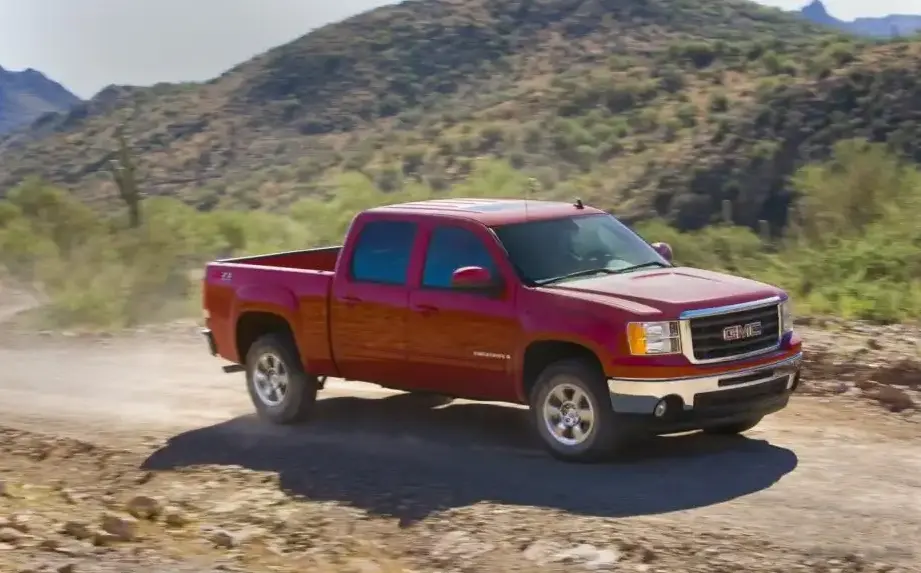
The GMC Sierra 1500 III, specifically the Crew Cab Short Box configuration with the 5.3-liter Vortec V8 engine and automatic transmission, represents a significant iteration in GMC’s full-size pickup truck lineage. Produced from 2007 through 2010 as part of the GMT900 platform generation, this variant aimed to balance capability, comfort, and value within the highly competitive North American truck market. It served as a popular choice for both personal and professional use, offering a spacious interior and robust powertrain in a package designed for everyday driving and moderate towing/hauling tasks.
Technical Specifications
| Brand | GMC |
| Model | Sierra 1500 |
| Generation | Sierra 1500 III (GMT900) Crew Cab Short Box |
| Type (Engine) | 5.3 Vortec V8 (315 Hp) Automatic |
| Start of production | 2007 |
| End of production | 2010 |
| Powertrain Architecture | Internal Combustion engine |
| Body type | Pick-up |
| Seats | 6 |
| Doors | 4 |
| Fuel consumption (urban) | 15.7-16.8 l/100 km (15-14 US mpg) |
| Fuel consumption (extra urban) | 11.8 l/100 km (19.9 US mpg) |
| Fuel Type | Petrol (Gasoline) |
| Weight-to-power ratio | 7.4 kg/Hp |
| Weight-to-torque ratio | 5.1 kg/Nm |
| Power | 315 Hp @ 5200 rpm |
| Power per litre | 59.1 Hp/l |
| Torque | 458 Nm @ 4400 rpm (337.8 lb.-ft. @ 4400 rpm) |
| Maximum engine speed | 6000 rpm |
| Engine layout | Front, Longitudinal |
| Engine Model/Code | LH6, LY5 |
| Engine displacement | 5328 cm3 (325.13 cu. in.) |
| Number of cylinders | 8 |
| Engine configuration | V-engine |
| Cylinder Bore | 96.01 mm (3.78 in.) |
| Piston Stroke | 91.95 mm (3.62 in.) |
| Compression ratio | 9.9:1 |
| Number of valves per cylinder | 2 |
| Fuel injection system | Multi-port manifold injection |
| Engine aspiration | Naturally aspirated engine |
| Valvetrain | OHV |
| Engine oil capacity | 5.7 l (6.02 US qt | 5.02 UK qt) |
| Coolant capacity | 14.1 l (14.9 US qt | 12.41 UK qt) |
| Kerb Weight | 2338 kg (5154.41 lbs.) |
| Max. weight | 3084 kg (6799.06 lbs.) |
| Max load | 746 kg (1644.65 lbs.) |
| Trunk (boot) space – maximum | 1506 l (53.18 cu. ft.) |
| Fuel tank capacity | 98 l (25.89 US gal | 21.56 UK gal) |
| Length | 5844 mm (230.08 in.) |
| Width including mirrors | 2031 mm (79.96 in.) |
| Height | 1875 mm (73.82 in.) |
| Wheelbase | 3645 mm (143.5 in.) |
| Front track | 1730 mm (68.11 in.) |
| Rear (Back) track | 1702 mm (67.01 in.) |
| Ride height (ground clearance) | 229 mm (9.02 in.) |
| Minimum turning circle | 14.4 m (47.24 ft.) |
| Drivetrain Architecture | Rear wheel drive |
| Number of gears and type of gearbox | 4 gears, automatic transmission Hydra-Matic |
| Front suspension | Independent coil spring |
| Rear suspension | Rigid axle suspension, Leaf spring |
| Front brakes | Disc, 330×30 mm |
| Rear brakes | Drum, 295×60 mm |
| Assisting systems | ABS (Anti-lock braking system) |
| Steering type | Steering rack and pinion |
| Power steering | Electric Steering |
| Tires size | 245/70 R17 |
| Wheel rims size | 7.5J x 17 |
INTRODUCTION
The 2007-2010 GMC Sierra 1500 Crew Cab Short Box, powered by the 5.3-liter Vortec V8 and paired with a four-speed automatic transmission, occupied a sweet spot in GMC’s lineup. Positioned as a mid-range offering, it provided a step up in features and comfort from the base models while remaining more accessible than the higher-trim levels equipped with the 6.0-liter V8. Built on the GMT900 platform, which represented a significant redesign for GM’s full-size trucks, this Sierra variant aimed to deliver improved ride quality, interior space, and overall refinement compared to its predecessors. The Crew Cab configuration, with its four full-size doors and spacious rear seating, catered to families and those needing to transport passengers regularly, while the short bed offered a balance between cargo capacity and maneuverability.
Powertrain & Engine Architecture
At the heart of this Sierra 1500 lay the 5.3-liter (325 cubic inch) Vortec 5300 V8 engine. Available in two primary iterations – the LH6 and LY5 – these engines shared a fundamental architecture but differed slightly in their intended applications and specific calibrations. Both featured a cast iron block and aluminum cylinder heads, utilizing a traditional overhead valve (OHV) valvetrain with two valves per cylinder. The engine employed multi-port fuel injection, delivering fuel directly to each cylinder for optimized combustion. The 5.3L Vortec was known for its robust construction and relatively simple design, contributing to its reputation for reliability. The four-speed Hydra-Matic 4L60-E automatic transmission was the standard pairing. This transmission, while proven, was sometimes criticized for its relatively conservative gear ratios, prioritizing fuel economy over outright performance. It featured electronic control for smoother shifting and adaptive shift patterns.
Driving Characteristics
The 315 horsepower and 337.8 lb-ft of torque produced by the 5.3L V8 provided adequate power for most everyday driving scenarios. Acceleration was respectable, though not particularly brisk, and the truck felt capable when towing lighter loads. The four-speed automatic transmission, while smooth, could sometimes feel sluggish during quick acceleration or when attempting to pass on the highway. Compared to the 6.0-liter V8 equipped models, the 5.3L offered a noticeable reduction in power, particularly at higher speeds. However, the 5.3L’s more conservative power delivery also translated to slightly better fuel economy. The short wheelbase of the Crew Cab Short Box configuration contributed to a more nimble feel compared to extended cab or long bed models, making it easier to maneuver in tight spaces.
Equipment & Trim Levels
The 2007-2010 GMC Sierra 1500 Crew Cab with the 5.3L V8 typically came standard with features such as air conditioning, power windows and locks, a tilt steering wheel, and a basic audio system. Higher trim levels, such as the SLE and SLT, added features like leather upholstery, heated seats, a premium audio system, alloy wheels, and additional chrome exterior trim. Optional extras included a navigation system, a sunroof, and various towing packages. Interior materials were generally durable and functional, though not as luxurious as some competitors. The Crew Cab configuration offered generous rear seat legroom, making it a comfortable option for passengers.
Chassis & Braking
The GMT900 platform featured a fully boxed frame for increased rigidity and improved handling. The front suspension utilized an independent coil spring design, while the rear suspension employed a traditional leaf spring setup. This combination provided a comfortable ride, though the leaf springs could sometimes result in a slightly bouncy ride when the truck was unloaded. Braking duties were handled by disc brakes up front and drum brakes in the rear. Anti-lock brakes (ABS) were standard equipment. The braking system was generally adequate for the truck’s weight and intended use, but it lacked the stopping power of some competitors equipped with four-wheel disc brakes.
Market Reception & Comparison
The GMC Sierra 1500 with the 5.3L V8 and automatic transmission was generally well-received by critics and consumers alike. It was praised for its spacious interior, comfortable ride, and robust powertrain. However, some reviewers noted the transmission’s conservative gearing and the lack of four-wheel disc brakes as potential drawbacks. Compared to the Ford F-150 and Ram 1500, the Sierra offered a similar level of capability and refinement. The 5.3L engine provided a good balance between power and fuel economy, making it a popular choice for those who didn’t require the extra power of the 6.0L V8. Fuel economy figures typically ranged from 15-16 mpg in the city and 19-20 mpg on the highway.
Legacy
The 5.3L Vortec V8, in conjunction with the 4L60-E automatic transmission, has proven to be a remarkably durable and reliable powertrain combination. Many examples of these trucks are still on the road today, often with well over 100,000 miles. While the 4L60-E transmission is known to have some potential weak points, particularly with heavy use or neglected maintenance, it is generally a relatively affordable and easy-to-repair unit. On the used car market, these Sierra 1500s represent a good value for those seeking a capable and reliable full-size pickup truck. Their spacious interiors and comfortable ride make them well-suited for both work and family use. However, potential buyers should be aware of the potential for rust, particularly in areas with harsh winters, and should carefully inspect the transmission for any signs of slipping or erratic shifting.

