
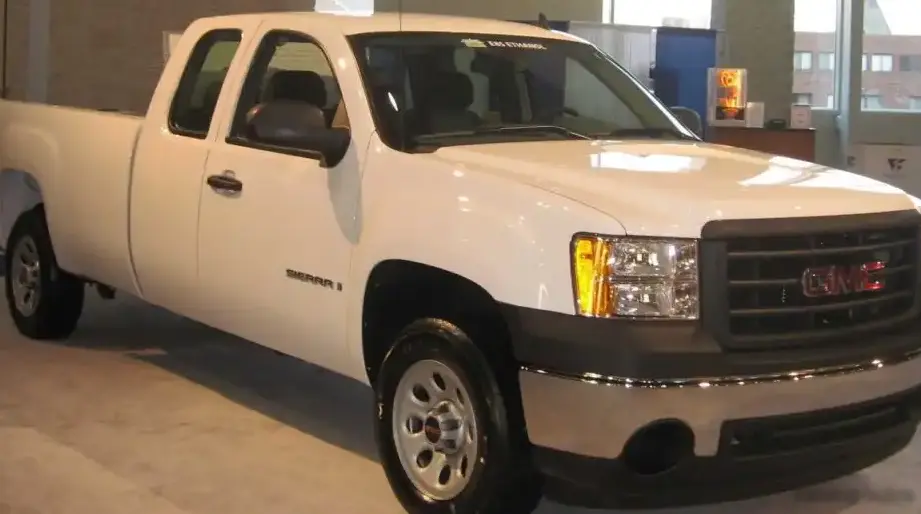
The GMC Sierra 1500 III, specifically the Extended Cab Long Box configuration with the 5.3-liter Vortec V8 engine, 4WD, and automatic transmission, was a mainstay of GMC’s full-size pickup truck lineup from 2010 to 2013. Representing the GMT900 generation, this truck aimed to balance capability, comfort, and fuel efficiency within the highly competitive American pickup truck market. This particular variant occupied a middle ground in the Sierra 1500 range, offering a significant step up in power and towing capacity compared to the base V6 models, while remaining more accessible than the top-tier trims equipped with the 6.2-liter V8.
Technical Specifications
| Brand | GMC |
| Model | Sierra 1500 |
| Generation | Sierra 1500 III (GMT900) Extended Cab Long Box |
| Type (Engine) | 5.3 Vortec V8 (315/326 Hp) 4WD Automatic FlexFuel |
| Start of production | 2010 |
| End of production | 2013 |
| Powertrain Architecture | Internal Combustion engine |
| Body type | Pick-up |
| Seats | 6 |
| Doors | 2 |
| Fuel consumption (urban) | 15.7 l/100 km (15 US mpg, 18 UK mpg, 6.4 km/l) |
| Fuel consumption (extra urban) | 11.2 l/100 km (21 US mpg, 25.2 UK mpg, 8.9 km/l) |
| Fuel Type | Petrol / Ethanol – E85 |
| Weight-to-power ratio | 7.9 kg/Hp, 126.1 Hp/tonne |
| Weight-to-torque ratio | 5.5 kg/Nm, 181.7 Nm/tonne |
| Power | 315 Hp @ 5200 rpm |
| Power per litre | 59.1 Hp/l |
| Power (Ethanol – E85) | 326 Hp @ 5300 rpm |
| Power per litre (Ethanol – E85) | 61.2 Hp/l |
| Torque | 454 Nm @ 4400 rpm (334.85 lb.-ft. @ 4400 rpm) |
| Torque (Ethanol – E85) | 472 Nm @ 4400 rpm |
| Maximum engine speed | 6000 rpm |
| Engine layout | Front, Longitudinal |
| Engine Model/Code | LMG |
| Engine displacement | 5328 cm3 (325.13 cu. in.) |
| Number of cylinders | 8 |
| Engine configuration | V-engine |
| Cylinder Bore | 96.01 mm (3.78 in.) |
| Piston Stroke | 91.95 mm (3.62 in.) |
| Compression ratio | 9.9:1 |
| Number of valves per cylinder | 2 |
| Fuel injection system | Multi-port manifold injection |
| Engine aspiration | Naturally aspirated engine |
| Valvetrain | OHV |
| Engine oil capacity | 5.7 l (6.02 US qt | 5.02 UK qt) |
| Coolant | 14.1 l (14.9 US qt | 12.41 UK qt) |
| Kerb Weight | 2499 kg (5509.35 lbs.) |
| Max. weight | 3175 kg (6999.68 lbs.) |
| Max load | 676 kg (1490.32 lbs.) |
| Trunk (boot) space – maximum | 2138 l (75.5 cu. ft.) |
| Fuel tank capacity | 128 l (33.81 US gal | 28.16 UK gal) |
| Permitted trailer load with brakes (12%) | 4173 kg (9199.89 lbs.) |
| Length | 6325 mm (249.02 in.) |
| Width including mirrors | 2031 mm (79.96 in.) |
| Height | 1868 mm (73.54 in.) |
| Wheelbase | 4001 mm (157.52 in.) |
| Front track | 1732 mm (68.19 in.) |
| Rear (Back) track | 1702 mm (67.01 in.) |
| Ride height (ground clearance) | 240 mm (9.45 in.) |
| Minimum turning circle (turning diameter) | 15.6 m (51.18 ft.) |
| Approach angle | 15.5° |
| Departure angle | 23.3° |
| Ramp-over (brakeover) angle | 19.3° |
| Drivetrain Architecture | The Internal combustion engine (ICE) drives the rear wheels permanently, and the front wheels are driven through an electrically or mechanically operated clutch if necessary. |
| Drive wheel | All wheel drive (4×4) |
| Number of gears and type of gearbox | 6 gears, automatic transmission Hydra-Matic |
| Front suspension | Independent coil spring |
| Rear suspension | Rigid axle suspension, Leaf spring |
| Front brakes | Disc, 330×30 mm |
| Rear brakes | Drum, 295×60 mm |
| Assisting systems | ABS (Anti-lock braking system) |
| Steering type | Steering rack and pinion |
| Power steering | Electric Steering |
| Tires size | 245/70 R17 |
| Wheel rims size | 7.5J x 17 |
INTRODUCTION
The 2010-2013 GMC Sierra 1500 Extended Cab Long Box, powered by the 5.3-liter Vortec V8 and paired with a four-speed automatic transmission, represented a sweet spot for many truck buyers. Built on the GMT900 platform, this generation Sierra aimed to improve upon its predecessor with a more refined interior, enhanced ride quality, and increased capability. The Extended Cab configuration offered a useful compromise between the regular cab’s affordability and the crew cab’s spaciousness, while the long bed provided ample cargo capacity. The 5.3L V8, a staple of GM trucks for years, delivered a balance of power and fuel economy, making it a popular choice for both work and personal use.
Powertrain & Engine Architecture
At the heart of this Sierra variant lies the LMG 5.3-liter (325 cubic inch) Vortec V8 engine. This engine is a member of GM’s small-block V8 family, known for its durability and relatively simple design. It features a cast iron block with aluminum cylinder heads, and utilizes a traditional overhead valve (OHV) valvetrain with two valves per cylinder. Fuel delivery is handled by a multi-port fuel injection system. The LMG engine benefits from GM’s Active Fuel Management (AFM) or Displacement on Demand (DOD) technology, which shuts down four of the cylinders during light-load cruising to improve fuel efficiency. The engine produces 315 horsepower at 5200 rpm and 454 lb-ft of torque at 4400 rpm. When running on E85 ethanol, output increases to 326 horsepower and 472 lb-ft of torque. The engine is mated to a four-speed Hydra-Matic 4L80-E automatic transmission, known for its robustness and ability to handle high torque loads. This transmission features electronic control for smoother shifting and improved efficiency.
Driving Characteristics
The 5.3L V8 and 4L80-E automatic combination provided a capable, if not particularly sporty, driving experience. Acceleration was adequate for everyday driving and towing, but it wasn’t as quick as the Sierra 1500 models equipped with the larger 6.2-liter V8. The four-speed automatic, while reliable, lacked the refinement and efficiency of newer transmissions with more gears. Gear ratios were optimized for towing and hauling, resulting in a lower first gear for strong off-the-line acceleration with a load, but also contributing to a higher engine speed at highway speeds. The AFM/DOD system was generally effective at improving fuel economy during highway cruising, but some owners reported occasional rough transitions when the system engaged or disengaged.
Equipment & Trim Levels
The Sierra 1500 Extended Cab Long Box with the 5.3L V8 typically came standard with features such as air conditioning, power windows and locks, a tilt steering wheel, and a basic audio system. Interior upholstery was typically cloth, although leather was available as an option. Higher trim levels, such as the SLE and SLT, added features like alloy wheels, upgraded audio systems, heated seats, and a navigation system. Optional extras included a trailer towing package, off-road suspension, and various convenience features like remote start and a sunroof.
Chassis & Braking
The GMT900 Sierra 1500 featured a fully boxed frame for increased rigidity and strength. Front suspension consisted of independent coil springs, while the rear suspension utilized a traditional leaf spring setup. This configuration provided a comfortable ride and good load-carrying capacity. Brakes were disc brakes up front and drum brakes in the rear. ABS (Anti-lock Braking System) was standard. The 4WD system was a part-time system, allowing the driver to switch between two-wheel drive and four-wheel drive as needed.
Market Reception & Comparison
The 2010-2013 GMC Sierra 1500 with the 5.3L V8 and 4WD was generally well-received by critics and consumers. It was praised for its comfortable ride, spacious interior, and strong towing capacity. However, some reviewers noted that the fuel economy was not class-leading, and the four-speed automatic transmission felt dated compared to the newer six- and eight-speed transmissions offered by competitors. Compared to the Sierra 1500 with the 4.8L V6, the 5.3L offered a significant boost in power and towing capacity. Compared to the 6.2L V8, the 5.3L was more affordable and offered slightly better fuel economy, but at the expense of some performance.
Legacy
The LMG 5.3L Vortec V8 and 4L80-E transmission combination proved to be a durable and reliable powertrain. These trucks are still commonly found on the used car market today, and are often sought after by buyers looking for a capable and affordable pickup truck. While not the most fuel-efficient or technologically advanced option, the 2010-2013 GMC Sierra 1500 Extended Cab Long Box with the 5.3L V8 remains a solid and dependable workhorse.

