
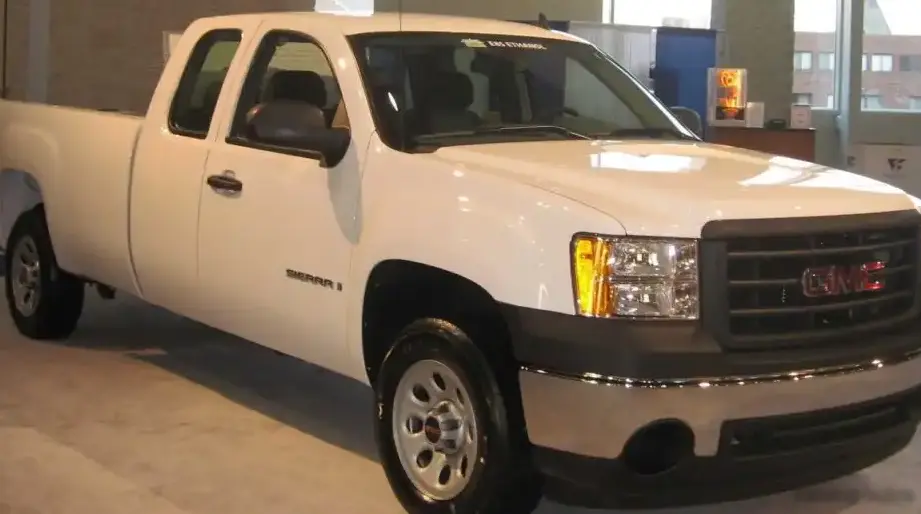
The GMC Sierra 1500 III, specifically the Extended Cab Long Box configuration with the 6.0-liter Vortec V8 engine and four-wheel drive, was a prominent full-size pickup truck produced from 2007 to 2010. This generation, known internally as GMT900, represented a significant update to GMC’s truck lineup, focusing on improved refinement, capability, and styling compared to its predecessor. The 6.0L V8/Automatic combination occupied a sweet spot in the Sierra 1500 range, offering a balance of power and usability for both work and personal use. It sat above the base 4.8L and 5.3L V8 options, and below the more specialized diesel offerings, appealing to buyers who needed substantial towing capacity without the added cost of the Duramax diesel.
Technical Specifications
| Brand | GMC |
| Model | Sierra 1500 |
| Generation | Sierra 1500 III (GMT900) Extended Cab Long Box |
| Type (Engine) | 6.0 Vortec V8 (367 Hp) 4WD Automatic |
| Start of production | 2007 |
| End of production | 2010 |
| Powertrain Architecture | Internal Combustion engine |
| Body type | Pick-up |
| Seats | 6 |
| Doors | 2 |
| Fuel consumption (urban) | 18.1 l/100 km (13 US mpg) |
| Fuel consumption (extra urban) | 13.8 l/100 km (17 US mpg) |
| Fuel Type | Petrol (Gasoline) |
| Power | 367 Hp @ 5600 rpm |
| Torque | 508 Nm @ 4300 rpm (374.68 lb.-ft. @ 4300 rpm) |
| Maximum engine speed | 6000 rpm |
| Engine layout | Front, Longitudinal |
| Engine Model/Code | L76 |
| Engine displacement | 5967 cm3 (364.13 cu. in.) |
| Number of cylinders | 8 |
| Engine configuration | V-engine |
| Cylinder Bore | 101.6 mm (4 in.) |
| Piston Stroke | 91.95 mm (3.62 in.) |
| Compression ratio | 9.6:1 |
| Number of valves per cylinder | 2 |
| Fuel injection system | Multi-port manifold injection |
| Engine aspiration | Naturally aspirated engine |
| Valvetrain | OHV |
| Engine oil capacity | 5.7 l (6.02 US qt | 5.02 UK qt) |
| Coolant capacity | 13.6 l (14.37 US qt | 11.97 UK qt) |
| Max. weight | 3175 kg (6999.68 lbs.) |
| Trunk (boot) space – maximum | 2138 l (75.5 cu. ft.) |
| Fuel tank capacity | 128 l (33.81 US gal | 28.16 UK gal) |
| Length | 6325 mm (249.02 in.) |
| Width including mirrors | 2029 mm (79.88 in.) |
| Height | 1868 mm (73.54 in.) |
| Wheelbase | 4001 mm (157.52 in.) |
| Front track | 1730 mm (68.11 in.) |
| Rear (Back) track | 1702 mm (67.01 in.) |
| Ride height (ground clearance) | 240 mm (9.45 in.) |
| Minimum turning circle | 15.6 m (51.18 ft.) |
| Approach angle | 16.4° |
| Departure angle | 22° |
| Ramp-over angle | 17.8° |
| Drivetrain Architecture | All wheel drive (4×4) |
| Number of gears and type of gearbox | 6 gears, automatic transmission Hydra-Matic |
| Front suspension | Independent coil spring |
| Rear suspension | Rigid axle suspension, Leaf spring |
| Front brakes | Ventilated discs |
| Rear brakes | Drum |
| Assisting systems | ABS (Anti-lock braking system) |
| Steering type | Steering rack and pinion |
| Power steering | Electric Steering |
| Tires size | 245/70 R17 |
| Wheel rims size | 7.5J x 17 |
Powertrain & Engine Architecture
The heart of this Sierra 1500 variant is the 6.0-liter Vortec L76 V8 engine. This engine is a member of the Vortec family, known for its robust construction and relatively simple design. It features a cast iron block and aluminum cylinder heads, contributing to its durability. The L76 utilizes a 9.6:1 compression ratio and multi-port fuel injection to deliver 367 horsepower and 374.68 lb-ft of torque. The engine’s overhead valve (OHV) valvetrain, while not as technologically advanced as overhead cam designs, proved reliable and easy to maintain. The engine is longitudinally mounted in the chassis. The transmission paired with the 6.0L V8 is the 6-speed Hydra-Matic automatic. This transmission offered smooth shifts and helped optimize the engine’s power delivery for both towing and everyday driving. The 6-speed configuration provided a wider range of gear ratios compared to older 4-speed automatics, improving fuel economy and performance.
Driving Characteristics
The 6.0L V8-equipped Sierra 1500 offered a noticeable step up in performance compared to the lower-displacement engines. Acceleration was brisk, and the truck felt confident when towing or hauling heavy loads. The Hydra-Matic 6-speed automatic transmission played a crucial role in maximizing the engine’s potential. The gear ratios were well-suited for both highway cruising and low-speed maneuvering. While not as fuel-efficient as the smaller engines, the 6.0L provided a satisfying balance of power and usability. Compared to a manual transmission equipped Sierra, the automatic offered greater convenience, especially in stop-and-go traffic. However, some drivers preferred the more direct control offered by a manual gearbox.
Equipment & Trim Levels
The Extended Cab Long Box 6.0L 4WD Sierra 1500 typically came standard with features like air conditioning, power windows and locks, a CD player, and cloth upholstery. The Extended Cab configuration provided additional rear seating, making it suitable for families or crews. Optional extras included leather upholstery, a premium sound system, a navigation system, and a power sunroof. Trim levels varied, with higher trims offering more luxurious appointments and features. The SLE and SLT trims were common choices, adding features like heated seats, automatic climate control, and upgraded interior finishes.
Chassis & Braking
The GMT900 Sierra 1500 featured a fully boxed frame, providing a solid foundation for the truck’s capabilities. The front suspension utilized an independent coil spring design, offering a comfortable ride. The rear suspension employed a traditional leaf spring setup, optimized for load-carrying capacity. Braking duties were handled by ventilated discs up front and drum brakes in the rear. Anti-lock brakes (ABS) were standard, enhancing safety. The 4WD system allowed for on-demand engagement of the front axle, providing improved traction in challenging conditions.
Market Reception & Comparison
The 6.0L V8-equipped Sierra 1500 was generally well-received by critics and consumers. It was praised for its strong performance, comfortable ride, and capable towing capacity. Fuel economy was a common criticism, as the 6.0L engine consumed more fuel than the smaller V8 options. However, buyers who prioritized power and capability were willing to accept the trade-off. Compared to the 5.3L V8, the 6.0L offered a significant boost in horsepower and torque, making it a better choice for those who frequently towed or hauled heavy loads. Compared to the diesel options, the 6.0L was less expensive to purchase and maintain, but it lacked the diesel’s superior fuel economy and low-end torque.
Legacy
The GMT900 Sierra 1500, particularly the 6.0L V8 variant, has proven to be a durable and reliable truck. The L76 engine is known for its longevity, and the Hydra-Matic transmission is generally considered robust. Today, these trucks can be found in the used car market at relatively affordable prices. They remain popular choices for those seeking a capable and dependable full-size pickup. While maintenance costs may increase with age, the readily available parts and relatively simple design make them relatively easy to repair. The 6.0L Vortec engine continues to be a favorite among truck enthusiasts, known for its potential for modification and its satisfying V8 rumble.

