
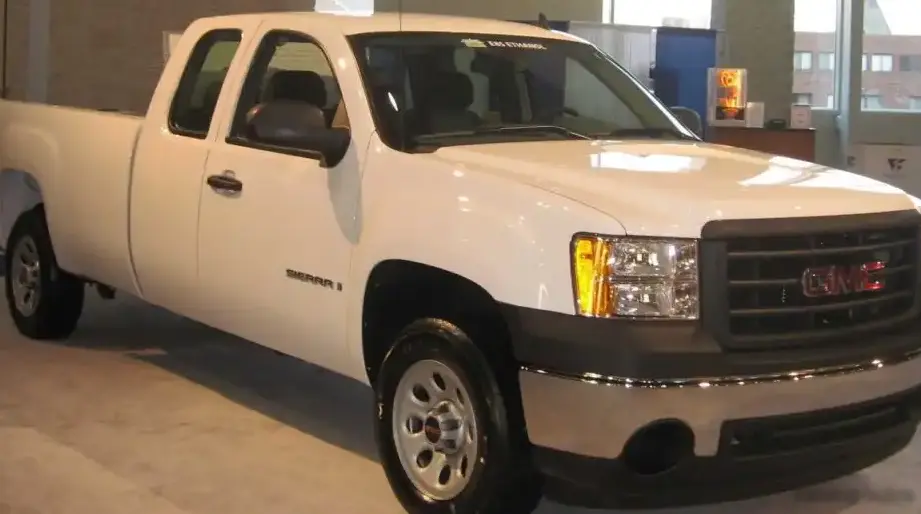
The GMC Sierra 1500 III, specifically the Extended Cab Long Box configuration with the 6.2-liter Vortec V8 engine, 4WD, and automatic transmission, was produced from 2010 to 2013. This variant represented a significant offering within the GMT900 platform, GMC’s full-size pickup truck line. Positioned as a robust and capable workhorse, it catered to buyers needing substantial towing and hauling capacity without sacrificing everyday usability. The 6.2L engine option placed this trim level above the base V6 and 5.3L V8 models, appealing to those prioritizing power and performance. It was offered alongside FlexFuel capability, allowing operation on gasoline or ethanol blends up to E85.
Technical Specifications
| Brand | GMC |
| Model | Sierra 1500 |
| Generation | Sierra 1500 III (GMT900) Extended Cab Long Box |
| Type (Engine) | 6.2 Vortec V8 (403 Hp) 4WD Automatic FlexFuel |
| Start of production | 2010 |
| End of production | 2013 |
| Powertrain Architecture | Internal Combustion engine |
| Body type | Pick-up |
| Seats | 5 |
| Doors | 2 |
| Fuel consumption (urban) | 19.6 l/100 km (12 US mpg, 14.4 UK mpg, 5.1 km/l) |
| Fuel consumption (extra urban) | 12.4 l/100 km (19 US mpg, 22.8 UK mpg, 8.1 km/l) |
| Fuel Type | Petrol / Ethanol – E85 |
| Power | 403 Hp @ 5700 rpm |
| Power per litre | 65.4 Hp/l |
| Torque | 565 Nm @ 4300 rpm (416.72 lb.-ft. @ 4300 rpm) |
| Maximum engine speed | 6000 rpm |
| Engine layout | Front, Longitudinal |
| Engine Model/Code | L9H |
| Engine displacement | 6162 cm3 (376.03 cu. in.) |
| Number of cylinders | 8 |
| Engine configuration | V-engine |
| Cylinder Bore | 103.25 mm (4.06 in.) |
| Piston Stroke | 92 mm (3.62 in.) |
| Compression ratio | 10.5:1 |
| Number of valves per cylinder | 2 |
| Fuel injection system | Multi-port manifold injection |
| Engine aspiration | Naturally aspirated engine |
| Valvetrain | OHV |
| Engine oil capacity | 5.7 l (6.02 US qt | 5.02 UK qt) |
| Coolant capacity | 11.9 l (12.57 US qt | 10.47 UK qt) |
| Max. weight | 3175 kg (6999.68 lbs.) |
| Trunk (boot) space – maximum | 2138 l (75.5 cu. ft.) |
| Fuel tank capacity | 128 l (33.81 US gal | 28.16 UK gal) |
| Length | 6325 mm (249.02 in.) |
| Width including mirrors | 2031 mm (79.96 in.) |
| Height | 1868 mm (73.54 in.) |
| Wheelbase | 4001 mm (157.52 in.) |
| Front track | 1732 mm (68.19 in.) |
| Rear (Back) track | 1702 mm (67.01 in.) |
| Ride height (ground clearance) | 240 mm (9.45 in.) |
| Minimum turning circle | 15.6 m (51.18 ft.) |
| Approach angle | 15.5° |
| Departure angle | 23.3° |
| Ramp-over angle | 19.3° |
| Drivetrain Architecture | All wheel drive (4×4). ICE drives rear wheels, front wheels engaged via clutch. |
| Number of gears | 6 |
| Gearbox type | Automatic (Hydra-Matic) |
| Front suspension | Independent coil spring |
| Rear suspension | Rigid axle, Leaf spring |
| Front brakes | Ventilated discs, 330.2×30 mm |
| Rear brakes | Disc, 342.9×20 mm |
| Assisting systems | ABS |
| Steering type | Steering rack and pinion |
| Power steering | Electric |
| Tires size | 265/70 R17 |
| Wheel rims size | 7.5J x 17 |
Powertrain & Engine Architecture
The heart of this Sierra 1500 variant is the 6.2-liter (6162 cc) Vortec L9H V8 engine. This engine is a member of the Vortec family, known for its robust construction and relatively simple design. It features a cast iron block with aluminum cylinder heads, utilizing a 10.5:1 compression ratio. The engine employs a traditional overhead valve (OHV) valvetrain with two valves per cylinder. Fuel delivery is managed by a multi-port fuel injection system, providing precise fuel metering for optimal combustion. The L9H engine is capable of running on gasoline or E85 ethanol fuel, offering flexibility at the pump. The engine is longitudinally mounted in the chassis, driving all four wheels through a six-speed Hydra-Matic automatic transmission. This transmission was chosen for its durability and ability to handle the engine’s substantial torque output.
Driving Characteristics
The 6.2L V8 paired with the six-speed automatic delivers a noticeable performance advantage over the lower-displacement engines offered in the Sierra 1500. Acceleration is brisk, and the truck feels confident when towing or hauling heavy loads. The automatic transmission is well-tuned, providing smooth shifts and responsive downshifts when needed. While not as fuel-efficient as the smaller engines, the 6.2L offers a compelling balance of power and usability. The gear ratios in the Hydra-Matic transmission are optimized for both highway cruising and low-end torque, making it a versatile performer in various driving conditions. Compared to a manual transmission equipped Sierra, the automatic offers convenience, especially in stop-and-go traffic, but sacrifices some driver control and potentially a slight amount of fuel economy.
Equipment & Trim Levels
The Extended Cab Long Box 6.2L 4WD Sierra typically came standard with features like air conditioning, power windows and locks, a basic audio system, and cloth upholstery. The extended cab configuration provided additional rear seating, though legroom was limited. Optional extras included leather upholstery, a premium audio system, navigation, a sunroof, and various towing packages. Trim levels varied, but generally offered increasing levels of luxury and convenience features. The specific trim level influenced the exterior styling, with options for chrome accents, upgraded wheels, and body-colored components.
Chassis & Braking
The GMT900 platform utilizes a body-on-frame construction, providing a robust and durable foundation. The front suspension consists of independent coil springs, offering a comfortable ride and good handling characteristics. The rear suspension employs a traditional leaf spring setup, designed to handle heavy loads. Braking duties are handled by ventilated discs at the front and discs at the rear. Anti-lock brakes (ABS) were standard, enhancing safety and control during emergency braking situations. The truck’s relatively high ground clearance (240 mm) allows for moderate off-road capability.
Market Reception & Comparison
The 6.2L Sierra 1500 was generally well-received by automotive critics, who praised its powerful engine and capable towing capacity. However, its fuel economy was often criticized, especially compared to newer trucks with smaller, more efficient engines. Compared to the 5.3L V8, the 6.2L offered a significant performance boost, but at a higher price point. The 6.2L also tended to be more expensive to maintain due to its larger displacement and increased complexity. Against competitors like the Ford F-150 and Ram 1500, the Sierra 1500 6.2L held its own, offering a compelling combination of power, capability, and reliability.
Legacy
The L9H 6.2L Vortec V8 has proven to be a relatively reliable engine, with many examples still on the road today. While not immune to common truck issues like rust and suspension wear, the engine itself is known for its durability. The Hydra-Matic transmission is also generally considered to be a robust unit. In the used car market, the 6.2L Sierra 1500 commands a premium over models equipped with smaller engines, reflecting its desirable performance characteristics. These trucks remain popular among those seeking a capable and dependable full-size pickup with ample power for work and play.

