
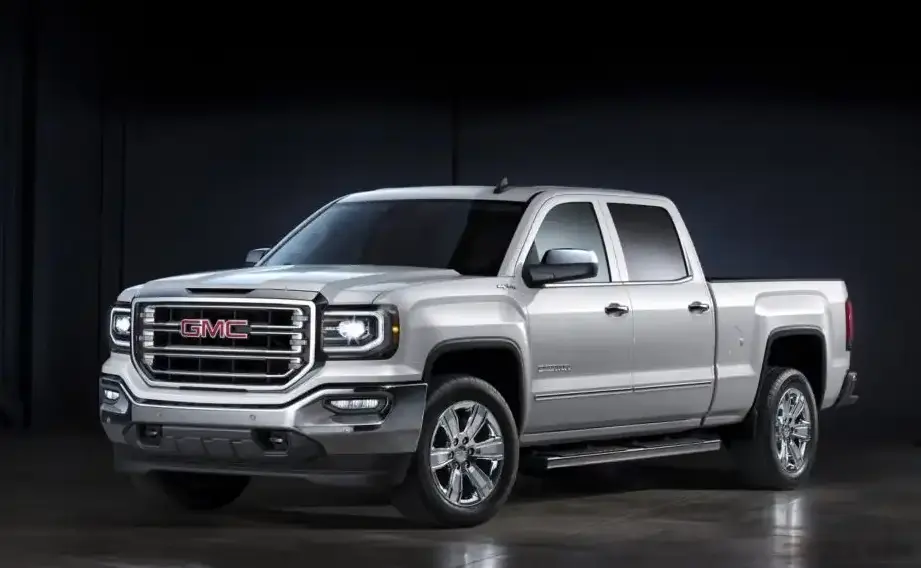
The GMC Sierra 1500 IV, specifically the Crew Cab Standard Box configuration with the 5.3 EcoTec3 V8 engine and automatic transmission, represents a significant iteration in GMC’s full-size pickup truck lineage. Produced from 2016 to 2018 as part of the GMTK2XX platform’s facelift, this variant aimed to balance capability, comfort, and efficiency within the highly competitive American truck market. This model year saw updates to styling, technology, and powertrain refinement compared to earlier GMTK2XX Sierras. It occupied a middle-ground position in the Sierra 1500 lineup, offering a step up in power and features from the base V6 models, while remaining more accessible than the top-tier trims equipped with the 6.2L V8.
Technical Specifications
| Brand | GMC |
| Model | Sierra 1500 |
| Generation | Sierra 1500 IV (GMTK2XX, facelift 2016) Crew Cab Standard Box |
| Type (Engine) | 5.3 EcoTec3 V8 (355/380 Hp) Automatic FlexFuel |
| Start of production | 2016 |
| End of production | 2018 |
| Powertrain Architecture | Internal Combustion engine |
| Body type | Pick-up |
| Seats | 5 |
| Doors | 4 |
| Fuel consumption (urban) | 14.7 l/100 km (16 US mpg, 19.2 UK mpg) |
| Fuel consumption (extra urban) | 10.2 l/100 km (23.1 US mpg, 27.7 UK mpg) |
| Fuel Type | Petrol / Ethanol – E85 |
| Weight-to-power ratio | 6.7 kg/Hp, 148.7 Hp/tonne |
| Weight-to-torque ratio | 4.6 kg/Nm, 217.3 Nm/tonne |
| Power | 355 Hp @ 5600 rpm |
| Power per litre | 66.6 Hp/l |
| Power (Ethanol – E85) | 380 Hp @ 5600 rpm |
| Power per litre (Ethanol – E85) | 71.3 Hp/l |
| Torque | 519 Nm @ 4100 rpm (382.79 lb.-ft. @ 4100 rpm) |
| Torque (Ethanol – E85) | 564 Nm @ 4100 rpm |
| Maximum engine speed | 5800 rpm |
| Engine layout | Front, Longitudinal |
| Engine Model/Code | L83 |
| Engine displacement | 5328 cm3 (325.13 cu. in.) |
| Number of cylinders | 8 |
| Engine configuration | V-engine |
| Cylinder Bore | 96 mm (3.78 in.) |
| Piston Stroke | 92 mm (3.62 in.) |
| Compression ratio | 11:1 |
| Number of valves per cylinder | 2 |
| Fuel injection system | Direct injection |
| Engine aspiration | Naturally aspirated engine |
| Valvetrain | OHV |
| Engine oil capacity | 8 l (8.45 US qt | 7.04 UK qt) |
| Coolant | 14.8 l (15.64 US qt | 13.02 UK qt) |
| Kerb Weight | 2388 kg (5264.64 lbs.) |
| Max. weight | 3175 kg (6999.68 lbs.) |
| Max load | 787 kg (1735.04 lbs.) |
| Trunk (boot) space – minimum | 1728 l (61.02 cu. ft.) |
| Fuel tank capacity | 98 l (25.89 US gal | 21.56 UK gal) |
| Permitted trailer load with brakes (12%) | 2857 kg (6298.61 lbs.) |
| Length | 6067 mm (238.86 in.) |
| Width including mirrors | 2032 mm (80 in.) |
| Height | 1873 mm (73.74 in.) |
| Wheelbase | 3886 mm (152.99 in.) |
| Front track | 1747 mm (68.78 in.) |
| Rear (Back) track | 1716 mm (67.56 in.) |
| Ride height (ground clearance) | 216 mm (8.5 in.) |
| Minimum turning circle (turning diameter) | 14.8 m (48.56 ft.) |
| Approach angle | 16.7° |
| Departure angle | 23.3° |
| Ramp-over (brakeover) angle | 17.5° |
| Drivetrain Architecture | Rear wheel drive |
| Drive wheel | Rear wheel drive |
| Number of gears and type of gearbox | 6 gears, automatic transmission Hydra-Matic |
| Front suspension | Independent coil spring |
| Rear suspension | Rigid axle suspension, Leaf spring |
| Front brakes | Ventilated discs, 330×30 mm |
| Rear brakes | Ventilated discs, 345×20 mm |
| Assisting systems | ABS (Anti-lock braking system) |
| Steering type | Steering rack and pinion |
| Power steering | Electric Steering |
| Tires size | 265/70 R17 |
| Wheel rims size | 8J x 17 |
Powertrain & Engine Architecture
At the heart of this Sierra 1500 variant lies the 5.3-liter L83 EcoTec3 V8 engine. This engine is a member of GM’s small-block V8 family, known for its durability and relatively compact size. The “EcoTec3” designation signifies a suite of technologies aimed at improving fuel efficiency, including direct injection, variable valve timing, and cylinder deactivation. The L83 utilizes direct injection to precisely meter fuel into the combustion chambers, enhancing combustion efficiency and power output. The cylinder deactivation system, also known as Active Fuel Management, allows the engine to operate on four cylinders during light-load conditions, further reducing fuel consumption. The engine’s OHV valvetrain, while traditional, is robust and contributes to its longevity. The Hydra-Matic 6L80 six-speed automatic transmission was the standard pairing for this engine. This transmission is known for its smooth shifting and reliability, offering a balance between performance and fuel economy. The transmission’s gear ratios are tuned for towing and hauling, providing ample torque multiplication for demanding tasks.
Driving Characteristics
The 5.3L V8 with the 6-speed automatic delivers a comfortable and capable driving experience. While not as quick as the 6.2L V8-equipped Sierras, the 355 horsepower and 382 lb-ft of torque provide sufficient power for everyday driving and towing. The automatic transmission shifts smoothly and predictably, although it may occasionally hunt for the right gear during highway cruising. The FlexFuel capability allows the engine to run on gasoline or a blend of gasoline and ethanol (up to E85), offering some flexibility at the pump. Utilizing E85 increases horsepower to 380, but typically results in lower fuel economy. The Crew Cab configuration provides ample interior space for passengers, while the standard box offers a practical cargo bed for hauling. The ride quality is generally comfortable, thanks to the independent front suspension and leaf-spring rear suspension, but can become somewhat firm when the bed is loaded.
Equipment & Trim Levels
The 2016-2018 Sierra 1500 Crew Cab with the 5.3L V8 typically came standard with features such as air conditioning, power windows and locks, a rearview camera, and a basic infotainment system. Higher trim levels, such as the SLT and Denali, added features like leather upholstery, heated and ventilated seats, a premium sound system, and advanced safety technologies. Optional extras included a navigation system, a sunroof, and a trailering package. Interior upholstery was typically cloth on lower trims, with leather available on higher trims. The dashboard configuration was relatively straightforward, with easy-to-read gauges and intuitive controls.
Chassis & Braking
The Sierra 1500 IV utilizes a body-on-frame construction, providing a robust and durable platform. The front suspension features independent coil springs, while the rear suspension employs a traditional leaf-spring setup. This configuration provides a good balance between ride comfort and load-carrying capacity. The braking system consists of ventilated discs at all four corners, providing adequate stopping power. Anti-lock brakes (ABS) are standard, enhancing safety during emergency braking situations. The steering system is a rack-and-pinion setup with electric power steering, offering precise and responsive handling.
Market Reception & Comparison
The 5.3L V8/automatic combination was a popular choice among Sierra 1500 buyers, offering a sweet spot between price, performance, and fuel economy. Critics generally praised the engine’s power and refinement, as well as the transmission’s smooth operation. Compared to the base V6 models, the 5.3L V8 provided a noticeable increase in performance, making it a better choice for towing and hauling. However, it wasn’t as fuel-efficient as the V6. Compared to the 6.2L V8, the 5.3L offered a more affordable price point, but with less overall power. Reliability was generally good, with the L83 engine proving to be a durable and long-lasting powerplant.
Legacy
The 5.3L EcoTec3 V8 paired with the 6-speed automatic transmission has proven to be a reliable and durable powertrain combination. These engines are still commonly found on the used car market today, and with proper maintenance, can provide many years of service. The GMTK2XX Sierra 1500, in general, is considered a well-rounded and capable truck, and the 5.3L variant remains a popular choice among buyers looking for a balance of power, efficiency, and affordability. While newer trucks offer more advanced technology and features, the 2016-2018 Sierra 1500 with the 5.3L V8 continues to represent a solid value in the full-size pickup truck segment.

