
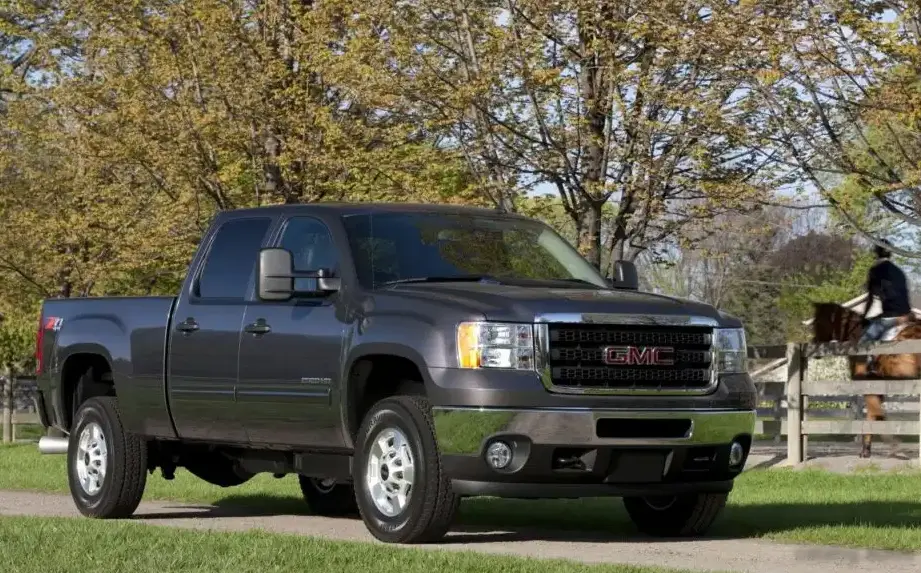
The GMC Sierra 2500HD III, specifically the Crew Cab Standard Box configuration with the 6.0-liter V8 engine paired to an automatic transmission and capable of running on Compressed Natural Gas (CNG), was produced for a limited run between 2013 and 2014. This variant represented a niche offering within the GMT900 platform – a facelift of the third-generation Sierra HD series – aimed at customers requiring heavy-duty capability with an alternative fuel option. It occupied a middle ground in the 2500HD lineup, offering a balance between power, towing capacity, and the potential cost savings associated with CNG fuel.
Technical Specifications
| Brand | GMC |
| Model | Sierra 2500HD |
| Generation | Sierra 2500HD III (GMT900, facelift 2011) Crew Cab Standard Box |
| Type (Engine) | 6.0 V8 (301 Hp) Automatic CNG |
| Start of production | 2013 |
| End of production | 2014 |
| Powertrain Architecture | Internal Combustion engine |
| Body type | Pick-up |
| Seats | 5 |
| Doors | 2 |
| Fuel Type | Petrol / CNG |
| Power | 301 Hp @ 5000 rpm |
| Power per litre | 50.4 Hp/l |
| Torque | 452 Nm @ 4200 rpm / 333.38 lb.-ft. @ 4200 rpm |
| Maximum engine speed | 6000 rpm |
| Engine layout | Front, Longitudinal |
| Engine Model/Code | Vortec LC8 |
| Engine displacement | 5967 cm3 / 364.13 cu. in. |
| Number of cylinders | 8 |
| Engine configuration | V-engine |
| Cylinder Bore | 101.6 mm / 4 in. |
| Piston Stroke | 92 mm / 3.62 in. |
| Compression ratio | 9.6:1 |
| Number of valves per cylinder | 2 |
| Fuel injection system | Multi-port manifold injection |
| Engine aspiration | Naturally aspirated engine |
| Valvetrain | OHV, VVT |
| Engine oil capacity | 5.7 l / 6.02 US qt | 5.02 UK qt |
| Coolant | 15.5 l / 16.38 US qt | 13.64 UK qt |
| Fuel tank capacity | 136 l / 35.93 US gal | 29.92 UK gal |
| CNG cylinder capacity | 67 kg |
| Length | 6101 mm / 240.2 in. |
| Width including mirrors | 2032 mm / 80 in. |
| Height | 1958 mm / 77.09 in. |
| Wheelbase | 3904 mm / 153.7 in. |
| Front track | 1748 mm / 68.82 in. |
| Rear (Back) track | 1709 mm / 67.28 in. |
| Ride height (ground clearance) | 213 mm / 8.39 in. |
| Minimum turning circle (turning diameter) | 15.4 m / 50.52 ft. |
| Drivetrain Architecture | The Internal combustion engine (ICE) drives the rear wheels of the vehicle. |
| Drive wheel | Rear wheel drive |
| Number of gears and type of gearbox | 6 gears, automatic transmission Hydra-Matic |
| Front suspension | Coil spring, Double wishbone, Transverse stabilizer |
| Rear suspension | Rigid axle suspension, Leaf spring |
| Front brakes | Ventilated discs, 350×40 mm |
| Rear brakes | Ventilated discs, 360×34 mm |
| Assisting systems | ABS (Anti-lock braking system) |
| Steering type | Cone worm with recirculation balls |
| Tires size | 245/75 R17; 265/70 R17; 265/70 R18; 265/60 R20 |
| Wheel rims size | 7.5J x 17; 8J x 18; 8.5J x 20 |
Powertrain & Engine Architecture
At the heart of this Sierra 2500HD variant lies the Vortec LC8 engine, a 6.0-liter (364 cubic inch) V8. This engine is a member of the Vortec family, known for its robust construction and relatively simple design. It features a cast iron block and aluminum cylinder heads, utilizing a 9.6:1 compression ratio and a two-valve-per-cylinder OHV valvetrain with variable valve timing (VVT). Fuel delivery is managed by a multi-port fuel injection system. The LC8 produces 301 horsepower at 5000 rpm and 452 Nm (333.38 lb-ft) of torque at 4200 rpm. The engine was designed to run on gasoline, but this specific configuration was factory-equipped to also operate on Compressed Natural Gas (CNG), requiring a dedicated CNG fuel system and storage cylinder. The transmission is a six-speed Hydra-Matic automatic, chosen for its durability and ability to handle the engine’s torque output. This transmission featured electronically controlled shifting and overdrive for improved fuel economy at highway speeds.
Driving Characteristics
The combination of the 6.0L V8 and the six-speed automatic transmission provided a capable, though not particularly sporty, driving experience. The automatic transmission, while smooth, prioritized functionality over performance. Gear ratios were optimized for towing and hauling, resulting in relatively quick acceleration from a standstill but less responsiveness during passing maneuvers compared to the available diesel options or even the 6.2L gasoline V8. The CNG system, while offering potential fuel cost savings, could slightly reduce overall power output depending on the CNG fuel quality and system calibration. The truck’s substantial weight and heavy-duty suspension contributed to a firm ride, even when unladen.
Equipment & Trim Levels
The 2500HD Crew Cab Standard Box with the 6.0L CNG engine typically came with a fairly comprehensive set of standard features. These included air conditioning, power windows and locks, a basic audio system, and cloth upholstery. The Crew Cab configuration offered spacious seating for five passengers. Optional extras included leather upholstery, a premium audio system, navigation, and various towing packages. The trim level generally fell between the base work truck models and the more luxurious Denali trims, offering a balance of functionality and comfort.
Chassis & Braking
The Sierra 2500HD’s chassis was built for heavy-duty use. The front suspension utilized a coil spring, double wishbone setup with a transverse stabilizer bar, while the rear suspension employed a traditional leaf spring design. This configuration provided a robust and durable platform for hauling and towing. Braking duties were handled by ventilated disc brakes on all four wheels, with ABS (Anti-lock Braking System) as standard equipment. The rear brakes were slightly larger (360x34mm) than the front brakes (350x40mm) to accommodate the increased weight typically carried in the bed. Steering was accomplished via a cone worm with recirculation balls system.
Market Reception & Comparison
The 2500HD 6.0L CNG variant received mixed reviews. Critics acknowledged the potential benefits of CNG as an alternative fuel, particularly in areas with readily available and affordable CNG infrastructure. However, the limited availability of CNG fueling stations and the slightly reduced power output compared to gasoline-only models were drawbacks. Compared to the popular 6.6L Duramax diesel engine, the 6.0L CNG offered significantly less torque and lower fuel economy when operating on gasoline. However, it was often more affordable to purchase upfront and could offer lower running costs in areas where CNG was significantly cheaper than gasoline or diesel.
Legacy
The GMC Sierra 2500HD 6.0L CNG variant represents a relatively rare and interesting chapter in the history of heavy-duty trucks. While not a mainstream success, it demonstrated GMC’s willingness to explore alternative fuel options. Today, these trucks are relatively uncommon on the used car market. The Vortec LC8 engine is generally considered reliable, but the CNG system requires specialized maintenance and inspection. Finding qualified technicians to service the CNG components can be a challenge. Overall, a well-maintained example of this truck can still provide years of reliable service for those seeking a capable and potentially fuel-efficient heavy-duty pickup.

