
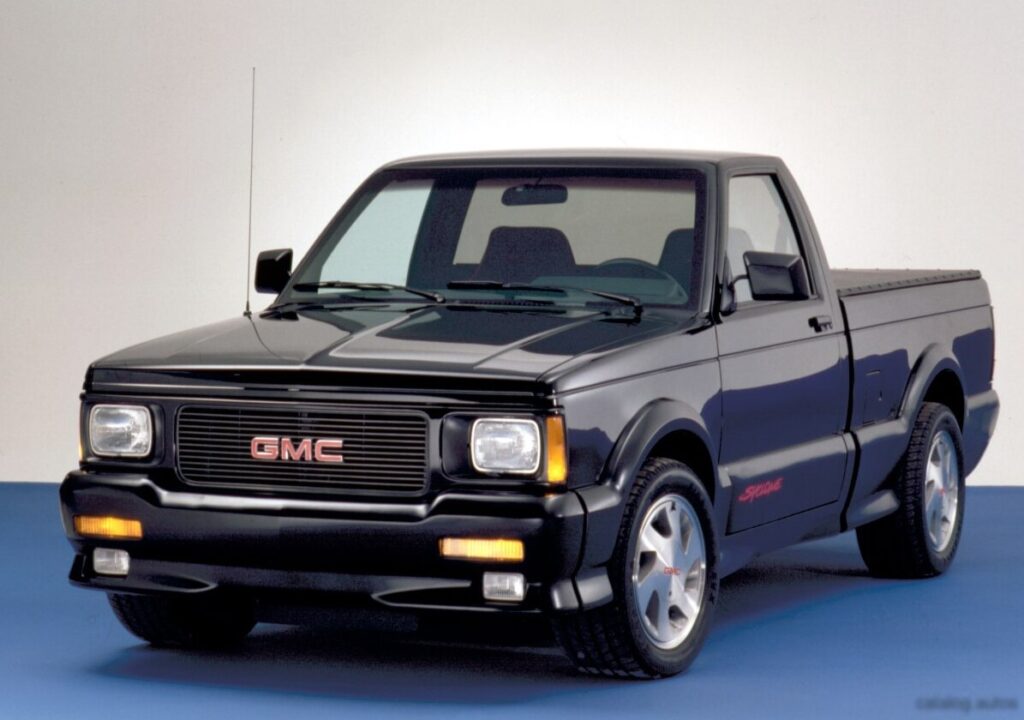
The GMC Syclone was a high-performance pickup truck produced by General Motors from 1991 to 1993. Based on the compact GMC Sonoma pickup, the Syclone distinguished itself with a powerful turbocharged engine, all-wheel drive, and a surprisingly quick acceleration time. It represented a unique offering in the early 1990s, bridging the gap between practical utility and sports car performance. The Syclone was a limited-production vehicle, adding to its collectibility today. This article focuses specifically on the 4.3L V6 4WD variant, the only configuration offered during its production run.
Technical Specifications
| Brand | GMC |
| Model | Syclone |
| Generation | Syclone |
| Type (Engine) | 4.3L i V6 4WD (280 Hp) |
| Start of production | 1991 |
| End of production | 1993 |
| Powertrain Architecture | Internal Combustion engine |
| Body type | Pick-up |
| Seats | 3 |
| Doors | 2 |
| Fuel Type | Petrol (Gasoline) |
| Acceleration 0 – 60 mph | 4.6 sec |
| Maximum speed | 203 km/h (126.14 mph) |
| Weight-to-power ratio | 5.8 kg/Hp, 171.6 Hp/tonne |
| Weight-to-torque ratio | 3.4 kg/Nm, 291.1 Nm/tonne |
| Power | 280 Hp @ 4400 rpm |
| Power per litre | 65.2 Hp/l |
| Torque | 475 Nm @ 3600 rpm (350.34 lb.-ft. @ 3600 rpm) |
| Engine layout | Front, Longitudinal |
| Engine Model/Code | LB4 |
| Engine displacement | 4293 cm3 (261.97 cu. in.) |
| Number of cylinders | 6 |
| Engine configuration | V-engine |
| Cylinder Bore | 101.6 mm (4 in.) |
| Piston Stroke | 88.4 mm (3.48 in.) |
| Compression ratio | 8.35:1 |
| Number of valves per cylinder | 2 |
| Fuel injection system | Multi-port manifold injection |
| Engine aspiration | Turbocharger, Intercooler |
| Valvetrain | OHV |
| Kerb Weight | 1632 kg (3597.94 lbs.) |
| Max. weight | 1859 kg (4098.39 lbs.) |
| Max load | 227 kg (500.45 lbs.) |
| Fuel tank capacity | 75.7 l (20 US gal | 16.65 UK gal) |
| Length | 4584 mm (180.47 in.) |
| Width | 1646 mm (64.8 in.) |
| Height | 1524 mm (60 in.) |
| Wheelbase | 2750 mm (108.27 in.) |
| Drivetrain Architecture | All wheel drive (4×4). Internal Combustion engine. |
| Drive wheel | All wheel drive (4×4) |
| Number of gears and type of gearbox | 4 gears, automatic transmission |
| Front suspension | Transverse stabilizer, Torsion |
| Rear suspension | Rigid axle suspension, Leaf spring |
| Front brakes | Ventilated discs |
| Rear brakes | Disc |
| Assisting systems | ABS (Anti-lock braking system) |
| Steering type | Steering rack and pinion |
| Power steering | Hydraulic Steering |
| Tires size | Front wheel tires: 245/50 R16 Rear wheel tires: 245/50 R16 |
| Wheel rims size | Front wheel rims: 8J x 16 Rear wheel rims: 8J x 16 |
Introduction
The GMC Syclone debuted in 1991 as a limited-edition performance truck. Built on the S-15 pickup platform (also sold as the Chevrolet S-10), the Syclone aimed to deliver sports car-like performance in a more utilitarian package. All Syclones were identically equipped with the 4.3-liter V6 engine, 4L60 four-speed automatic transmission, and a four-wheel drive system. Production was limited to approximately 2,995 units in 1991, with slightly higher numbers in 1992 and 1993, making it a relatively rare vehicle even in its time. The Syclone was positioned as a unique offering, appealing to buyers who wanted both the practicality of a pickup and the thrill of a high-performance vehicle.
Powertrain & Engine Architecture
The heart of the Syclone was the 4.3-liter (262 cubic inch) LB4 V6 engine. This engine was based on the Chevrolet 350 small-block V8, but with two cylinders lopped off. Crucially, it was equipped with a Mitsubishi TD04 turbocharger and an intercooler, boosting output to 280 horsepower and 350 lb-ft of torque. The engine utilized multi-port fuel injection and an overhead valve (OHV) valvetrain. The 4L60 four-speed automatic transmission was specifically calibrated for the Syclone to handle the increased power and provide relatively quick shifts. While not a particularly sophisticated transmission by modern standards, it proved durable and reliable in the Syclone application. The engine’s longitudinal mounting and the robust 4WD system contributed to its impressive traction and acceleration.
Driving Characteristics
The Syclone’s performance was genuinely surprising for a pickup truck. Its 0-60 mph time of around 4.6 seconds was comparable to many contemporary sports cars. The turbocharger provided a noticeable boost in power, delivering strong acceleration once spooled up. The automatic transmission, while not offering manual control, provided smooth and predictable shifts. The all-wheel drive system provided excellent traction, particularly from a standstill. Compared to a manual transmission S-10, the Syclone’s automatic offered ease of use, but some performance enthusiasts felt it slightly dulled the driving experience. The Syclone wasn’t designed for off-roading; its focus was firmly on on-road performance. The ride quality was typical of a short-wheelbase pickup, being somewhat firm but acceptable for daily driving.
Equipment & Trim Levels
The Syclone came standard with a relatively well-equipped interior for a compact pickup of the era. Standard features included air conditioning, power windows and locks, a tilt steering wheel, and a premium sound system. The interior was typically finished in black cloth upholstery. Optional extras were limited, reflecting the Syclone’s focus on performance rather than luxury. A few available options included a sliding rear window and upgraded speakers. The dashboard layout was fairly basic, consistent with other S-15 pickups, but the Syclone featured unique badging and instrumentation to distinguish it from its more pedestrian siblings.
Chassis & Braking
The Syclone’s chassis was based on the S-15 pickup, but with several key upgrades to handle the increased power. The suspension featured stiffer springs and shocks, along with a thicker front stabilizer bar. The rear suspension utilized leaf springs, a common setup for pickups of the time. Braking duties were handled by ventilated discs at the front and solid discs at the rear. An anti-lock braking system (ABS) was standard, providing improved stopping power and control. The Syclone’s relatively short wheelbase and firm suspension contributed to its responsive handling, but also meant that the ride could be somewhat bumpy on uneven surfaces.
Market Reception & Comparison
The GMC Syclone was generally well-received by automotive critics, who praised its impressive performance and unique combination of practicality and speed. It was often compared to sports cars in terms of acceleration and handling. However, some critics noted the Syclone’s relatively basic interior and firm ride. Compared to other S-15 trims, the Syclone was significantly more expensive, reflecting its higher level of performance. The standard S-15 with a naturally aspirated V6 offered much lower performance and fuel economy, while the diesel-powered S-15 focused on fuel efficiency and towing capacity. The Syclone occupied a niche market, appealing to buyers who wanted a fast and capable pickup truck.
Legacy
The GMC Syclone has become a highly sought-after vehicle among collectors and enthusiasts. Its limited production numbers and unique performance characteristics have contributed to its rising value in the used car market. The 4.3L V6 and 4L60 transmission combination, while not without their potential maintenance needs, have proven to be relatively durable over time. Common issues include turbocharger wear and potential transmission slippage with heavy use. However, well-maintained Syclones can provide years of reliable performance. The Syclone paved the way for future high-performance trucks, such as the Chevrolet Silverado SS and the GMC Typhoon, demonstrating that pickups could be more than just work vehicles.
