
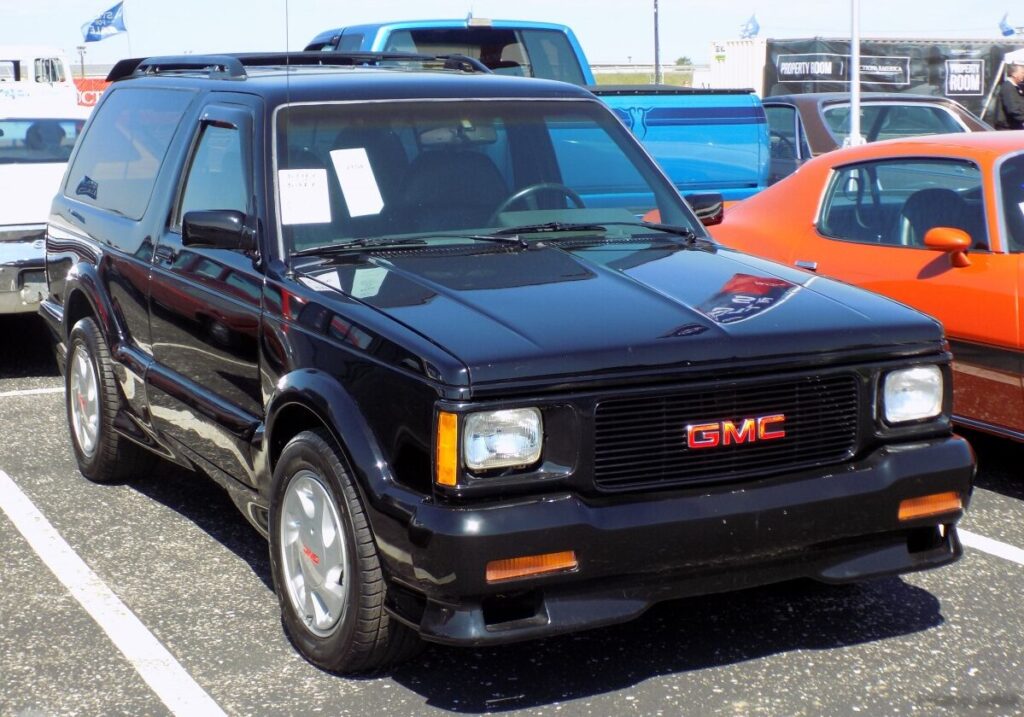
The GMC Typhoon, produced for the 1992 and 1993 model years, represents a unique and potent offering in the early 1990s performance SUV segment. Built on a shortened S-15 pickup truck chassis, the Typhoon was a collaborative effort between GMC and McLaren Performance Technologies, aiming to deliver sports car-like acceleration in a compact, all-wheel-drive package. It quickly gained notoriety as one of the fastest production vehicles of its time, and remains a highly sought-after vehicle among collectors and enthusiasts. The Typhoon was a limited-production model, with just over 4,600 units built across its two-year run.
Technical Specifications
| Brand | GMC |
| Model | Typhoon |
| Generation | Typhoon |
| Type (Engine) | 4.3 i V6 4WD (279 Hp) |
| Start of production | 1992 |
| End of production | 1993 |
| Powertrain Architecture | Internal Combustion engine |
| Body type | SUV |
| Seats | 5 |
| Doors | 3 |
| Fuel Type | Petrol (Gasoline) |
| Acceleration 0 – 100 km/h | 5.4 sec |
| Acceleration 0 – 62 mph | 5.4 sec |
| Acceleration 0 – 60 mph | 5.1 sec |
| Weight-to-power ratio | 6.2 kg/Hp, 160.9 Hp/tonne |
| Weight-to-torque ratio | 4.6 kg/Nm, 215.1 Nm/tonne |
| Power | 279 Hp @ 6000 rpm |
| Power per litre | 67.1 Hp/l |
| Torque | 373 Nm @ 3600 rpm, 275.11 lb.-ft. @ 3600 rpm |
| Engine layout | Front, Longitudinal |
| Engine displacement | 4157 cm3, 253.68 cu. in. |
| Number of cylinders | 6 |
| Engine configuration | Inline |
| Cylinder Bore | 93 mm, 3.66 in. |
| Piston Stroke | 102 mm, 4.02 in. |
| Compression ratio | 10:1 |
| Number of valves per cylinder | 4 |
| Fuel injection system | Multi-port manifold injection |
| Engine aspiration | Supercharger |
| Kerb Weight | 1734 kg, 3822.82 lbs |
| Fuel tank capacity | 75.7 l, 20 US gal | 16.65 UK gal |
| Length | 4326 mm, 170.31 in. |
| Width | 1732 mm, 68.19 in. |
| Height | 1524 mm, 60 in. |
| Wheelbase | 2553 mm, 100.51 in. |
| Drive wheel | All wheel drive (4×4) |
| Number of gears and type of gearbox | 4 gears, automatic transmission |
| Front suspension | Torsion |
| Rear suspension | Leaf spring |
| Front brakes | Ventilated discs |
| Rear brakes | Disc |
| Assisting systems | ABS (Anti-lock braking system) |
| Power steering | Hydraulic Steering |
| Tires size | 205/75 R15 |
| Wheel rims size | 15 |
Powertrain & Engine Architecture
The heart of the GMC Typhoon is its 4.3-liter (262 cubic inch) V6 engine, designated the LB4. This engine is notable for being a relatively simple, pushrod design, but significantly enhanced with a Mitsubishi TD04 turbocharger and intercooler. The engine utilizes multi-port fuel injection and a 10:1 compression ratio. The turbocharger delivers approximately 14.5 psi of boost, contributing to the impressive 279 horsepower and 373 lb-ft of torque. The engine is longitudinally mounted in the chassis. The Typhoon exclusively came equipped with a 4L60 four-speed automatic transmission, chosen for its durability and ability to handle the engine’s output. While some enthusiasts have expressed a desire for a manual transmission option, none was ever offered from the factory.
Driving Characteristics
The combination of the turbocharged V6 and all-wheel drive provides the Typhoon with exhilarating acceleration. The 0-60 mph sprint was consistently achieved in around 5.1 to 5.4 seconds, making it significantly faster than most SUVs and many sports cars of the era. The automatic transmission, while not offering the driver the ultimate control of a manual, provides smooth and relatively quick shifts. The all-wheel-drive system, a Borg-Warner transfer case, distributes power to all four wheels, enhancing traction and stability, particularly in adverse weather conditions. However, the Typhoon’s relatively short wheelbase and leaf-spring rear suspension can contribute to a somewhat choppy ride quality, especially on rough roads. The steering is hydraulic, providing adequate feedback, but isn’t particularly precise.
Equipment & Trim Levels
The GMC Typhoon was relatively well-equipped for its time, though it wasn’t positioned as a luxury vehicle. Standard features included air conditioning, power windows and locks, a tilt steering wheel, and a premium sound system. The interior featured cloth bucket seats, and a relatively simple dashboard layout. Optional extras included a sunroof, upgraded sound system, and various cosmetic enhancements. The Typhoon was offered in a limited range of exterior colors, typically including black, red, and white. The interior color schemes were generally coordinated with the exterior paint.
Chassis & Braking
The Typhoon’s chassis is based on the S-15 pickup truck platform, but significantly modified for improved handling and performance. The suspension features torsion bars at the front and leaf springs at the rear. The rear leaf springs were upgraded from the standard S-15 setup to handle the increased weight and power of the Typhoon. Braking duties are handled by ventilated discs at the front and solid discs at the rear. An anti-lock braking system (ABS) was standard equipment, enhancing safety and control during hard braking. The tires are 205/75R15, mounted on 15-inch wheels.
Market Reception & Comparison
The GMC Typhoon was generally well-received by automotive critics, who praised its impressive acceleration and unique combination of performance and practicality. It was often compared to the Chevrolet Syclone, a similar performance pickup truck also developed by McLaren. The Syclone was generally considered to be slightly quicker in a straight line, due to its lighter weight, but the Typhoon offered a more refined driving experience and a more SUV-like body style. Fuel economy was relatively poor, averaging around 14-16 mpg in city driving and 17-19 mpg on the highway. Reliability was generally good, although the turbocharger and fuel injection system could require occasional maintenance.
Legacy
The GMC Typhoon remains a highly collectible vehicle today, with well-maintained examples commanding premium prices. The 4.3L V6 and 4L60 transmission, while not known for being particularly complex, are generally durable and reliable when properly maintained. Common issues include turbocharger failure, fuel injector problems, and wear and tear on the suspension components. The Typhoon’s legacy lies in its pioneering role as one of the first high-performance SUVs, paving the way for the modern breed of performance crossovers. It continues to be celebrated by enthusiasts as a unique and exciting vehicle that offered a thrilling driving experience in the early 1990s.
